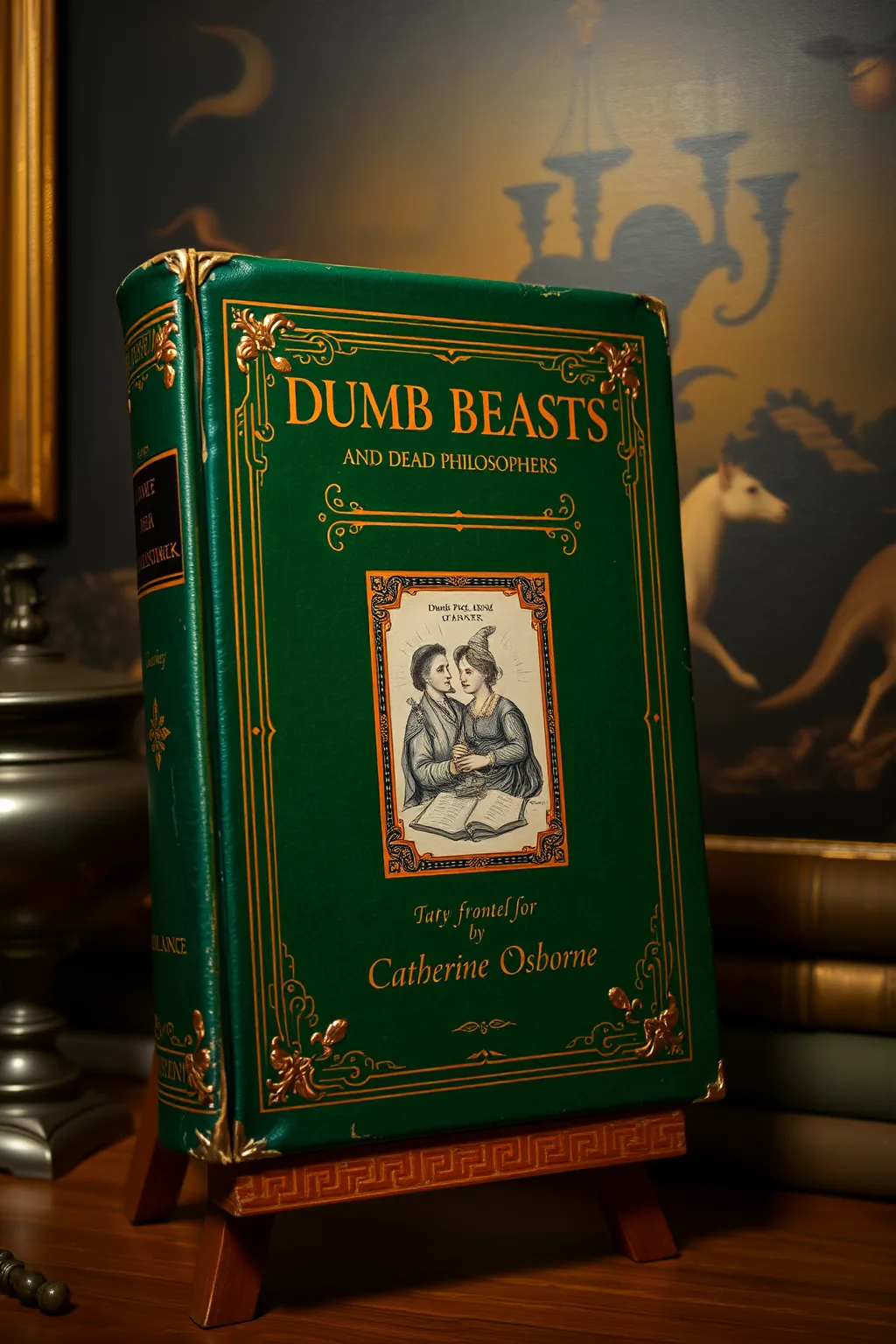
Dumb Beasts and Dead Philosophers
 62
62

Dumb Beasts and Dead Philosophers



Silas Hawthorne (Hermetic Studies Editor) — Catherine Osborne’s 'Dumb Beasts and Dead Philosophers' is a revelation for those who perceive the world through a lens of symbolic depth. Osborne meticulously excavates the often-overlooked animalistic metaphors and allegories woven into the fabric of ancient philosophy and literature. Her scholarship illuminates how creatures, from the humble to the majestic, served as conduits for understanding cosmic principles and ethical truths. This work is essential for scholars of classical thought, but more importantly, for practitioners seeking to reintegrate the wisdom of the natural world into their esoteric studies. It’s a compelling argument for the animistic pulse within seemingly rational discourse.
📝 Description
62
Catherine Osborne's 2007 book examines the symbolic roles of animals in ancient philosophy.
Catherine Osborne's 'Dumb Beasts and Dead Philosophers' investigates the symbolic significance of animals in ancient Greek and Roman philosophical traditions. The book details how philosophers like Plato, Aristotle, and Stoics used observations of animal behavior and characteristics to illustrate ethical principles and cosmological ideas. Osborne shows that creatures from the ox to the bird were not just background elements but active participants in philosophical arguments, serving as metaphors for human virtues, vices, and the natural order.
The research uncovers how these animal allegories provided insights into human existence, ethics, and the perceived structure of the universe. It highlights a connection between the natural world and the pursuit of wisdom that was often central to ancient thought. The book aims to illuminate this often overlooked philosophical dimension of our relationship with animals, tracing its roots in Western intellectual history.
This work situates itself within the study of ancient Western esotericism by analyzing how philosophical systems incorporated non-human life into their understanding of the cosmos and human place within it. It moves beyond purely rationalist interpretations to consider how symbolic and analogical reasoning, common in esoteric traditions, shaped philosophical discourse. The book demonstrates that even within mainstream philosophical texts, there is an engagement with deeper, often hidden, meanings attributed to the natural world, suggesting a less secularized ancient worldview than often assumed.
💡 Why Read This Book?
Uncover the hidden wisdom embodied by animals in ancient philosophy and literature. 'Dumb Beasts and Dead Philosophers' offers a unique perspective on the interconnectedness of nature and human thought, revealing symbolic truths often veiled by modern interpretation. Ideal for seekers of esoteric knowledge, scholars of ancient civilizations, and practitioners looking to enrich their understanding of the world through a lens of profound symbolism.
⭐ Reader Reviews
Honest opinions from readers who have explored this book.
❓ Frequently Asked Questions
What is the primary focus of 'Dumb Beasts and Dead Philosophers'?
The book primarily explores the symbolic and philosophical significance of animals within ancient Greek and Roman thought, literature, and the nascent stages of Western philosophy, revealing their role in conveying complex ideas and ethical principles.
Does the book discuss specific philosophical schools?
Yes, it touches upon various philosophical schools and thinkers, examining how different traditions interpreted animal behavior and symbolism to understand concepts like virtue, reason, and the natural order.
Is this book suitable for beginners in philosophy?
While it engages with scholarly topics, the accessible prose and fascinating subject matter make it engaging for beginners interested in the intersection of philosophy, literature, and the natural world.
What kind of 'dead philosophers' are discussed?
The book primarily refers to ancient Greek and Roman philosophers whose ideas are foundational to Western thought, drawing connections between their philosophies and their engagement with the animal kingdom.
How does the book relate to animal welfare?
While not a direct treatise on modern animal welfare, the book implicitly highlights the historical respect and symbolic value attributed to animals, offering a perspective on our long-standing relationship with them.
🔮 Key Themes & Symbolism
Animality as Philosophical Metaphor
This theme looks at how ancient thinkers utilized the observed characteristics and behaviors of animals as potent metaphors to articulate abstract philosophical concepts. From the perceived wisdom of owls to the steadfastness of tortoises, creatures served as living embodiments of virtues, vices, and existential truths, offering tangible anchors for complex ethical and metaphysical discussions. Osborne reveals how these symbolic connections were not mere literary devices but integral to the very structure of ancient philosophical inquiry, providing a rich vocabulary for understanding the human condition.
The Sacred & The Bestial
Explore the often-blurry lines between the divine, the human, and the animal in ancient worldviews. This theme examines how certain animals were imbued with sacred significance, acting as intermediaries between realms or embodying divine attributes. Conversely, it also investigates how the 'bestial' aspects of nature were used to define humanity's own perceived superiority or its struggles with primal instincts. Osborne uncovers how this duality shaped ethical frameworks and spiritual practices, revealing a profound respect for the wild alongside a keen awareness of humanity's place within the cosmic hierarchy.
Elements of Nature in Ancient Literature
This theme focuses on the pervasive presence of animals within ancient literary works, extending beyond mere naturalistic depiction to serve crucial narrative and symbolic functions. From epic poems to fables, animals act as characters, omens, and allegorical figures, reflecting societal values, moral lessons, and cosmic order. Osborne demonstrates how these literary representations were deeply intertwined with philosophical thought, offering insights into how ancient cultures perceived their relationship with the natural world and the hidden currents of meaning within it.
💬 Memorable Quotes
Direct passages from the work, attributed to the author.
“To see a World in a Grain of Sand...”
— This iconic fragment suggests that the microcosm reflects the macrocosm, hinting at the profound interconnectedness of all things, from the smallest particle to the grandest cosmic design.
“Hold Infinity in the palm of your hand...”
— This evocative phrase speaks to the boundless potential and universal truths that can be grasped through focused contemplation and direct experience, even within the finite confines of human perception.
“And Eternity in an hour.”
— This final line suggests that time itself is fluid and illusory, and moments of useful insights or spiritual connection can offer an experience of timelessness, revealing the eternal within the transient.
“The bird, the beast, the human child.”
— This simple enumeration underscores the fundamental unity of all living beings, positing that the essence of existence can be understood by observing and appreciating the shared nature of the wild, the domesticated, and the human.
💡 Key Ideas
Editorial paraphrase of the work's core concepts — not direct quotes.
And a Heaven in a Wild Flower...
This line points to the divine presence and spiritual revelation that can be found within the untamed beauty of the natural world, often overlooked by those who seek enlightenment solely in abstract pursuits.
🌙 Esoteric Significance
Tradition
This work resonates deeply with hermetic and neoplatonic traditions that emphasize the interconnectedness of all creation and the search for hidden knowledge within the natural world. It aligns with the hermetic principle of 'As Above, So Below,' suggesting that lessons from the animal kingdom mirror universal truths. The book also touches upon elements of animism, recognizing the inherent spirit or consciousness within all beings, a core tenet in many indigenous and ancient esoteric systems.
Symbolism
The book explores the detailed symbolism of animals as archetypes and avatars for philosophical ideas. Creatures like the lion (courage, royalty), the serpent (wisdom, transformation), the eagle (vision, transcendence), and the ox (steadfastness, labor) are examined not just for their literal attributes but for their deeper esoteric meanings within ancient mythologies and philosophical allegories. These symbols served as keys to understanding cosmic order, human psychology, and the path to spiritual enlightenment.
Modern Relevance
In an age often characterized by technological detachment from nature, 'Dumb Beasts and Dead Philosophers' offers a vital reminder of our ancient and profound connection to the animal kingdom. It encourages a re-evaluation of our relationship with other species, fostering empathy and a deeper appreciation for the inherent wisdom present in the natural world. The book's insights into symbolic thinking and the interpretation of nature's language are directly applicable to contemporary spiritual practices and the search for meaning beyond material existence.
👥 Who Should Read This Book
This book is an essential read for scholars of ancient philosophy and classical literature seeking a fresh perspective on their subjects. It will deeply appeal to seekers of esoteric wisdom and those interested in the philosophical underpinnings of animal symbolism. Practitioners of divination, mythology, and nature-based spiritual paths will find invaluable insights into the archetypal language of the animal kingdom. For anyone who feels a profound connection to nature and a curiosity about the hidden dialogues between humanity and the wild, this work offers a rich and rewarding journey.
📜 Historical Context
Catherine Osborne's 'Dumb Beasts and Dead Philosophers' emerges from a rich scholarly tradition that re-examines classical antiquity through a more holistic and symbolic lens. The work is situated within a period of renewed interest in the philosophical underpinnings of human-animal relationships, moving beyond purely scientific or ethical considerations to explore deeper metaphysical and cultural connections. The era of its writing likely reflects a growing awareness of the limitations of purely anthropocentric viewpoints, prompting a deeper engagement with how past civilizations perceived and integrated the natural world into their understanding of existence. Osborne's scholarship draws upon the enduring legacy of thinkers who saw the animal kingdom not merely as a biological phenomenon but as a profound source of wisdom, allegory, and spiritual insight, echoing the animistic and pantheistic currents present in various ancient traditions.
📔 Journal Prompts
Reflect on an animal that has profoundly impacted your life. What qualities did it embody, and how might these relate to ancient philosophical concepts?
Consider the 'dumb beasts' in your immediate environment. What unspoken wisdom or lessons do they seem to offer about existence?
Explore a specific animal mentioned in ancient literature or philosophy. How was it used symbolically, and what does this reveal about the values of that era?
How does the modern perception of animals differ from their portrayal in ancient philosophical texts? What has been lost or gained in this transition?
Imagine you could converse with one of the 'dead philosophers' discussed in the book. What question would you ask them about the role of animals in their understanding of the cosmos?
🗂️ Glossary
Archetype
A universal, inherited symbol or image that forms part of the collective unconscious, often represented by figures or concepts found in mythology and literature, such as animal totems or divine beings.
Allegory
A literary device where characters, events, or settings represent abstract ideas or moral qualities, used to convey a hidden meaning, often spiritual or political.
Cosmos
The universe regarded as a complex and orderly system, often implying a divine or inherent structure and purpose that ancient philosophers sought to understand.
Esoteric
Intended for or likely to be understood by only a small number of people with a specialized knowledge or interest, often referring to hidden spiritual or mystical teachings.
Metaphysical
Relating to the branch of philosophy that deals with the first principles of things, including abstract concepts such as being, knowing, substance, cause, identity, time, and space.
This book appears in 5 collections
🔮 Readers Also Liked
Browse all →









From the “Augury” Collection
View all →









More Free Divination & Tarot Books
View all →