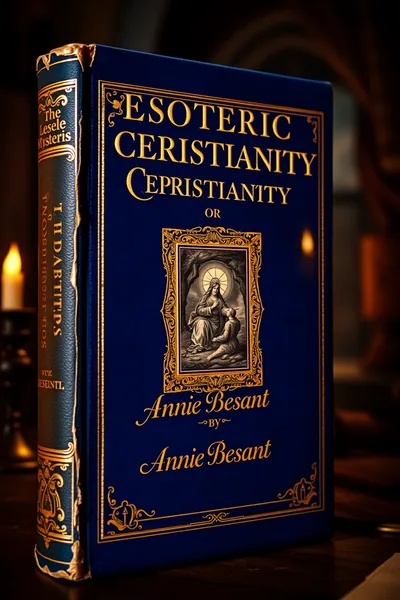
Esoteric Christianity and the Mission of Christian Rosenkreutz
 71
71

Esoteric Christianity and the Mission of Christian Rosenkreutz
Steiner's examination of Christian Rosenkreutz is less a biography and more a spiritual cosmology. He posits the Christ event of 33 AD not merely as a historical occurrence, but as a pivotal cosmic intervention intended to infuse Earth with a new spiritual force. The work's strength lies in its ambitious scope, attempting to link the highest spiritual realms to tangible historical and social developments. However, readers unfamiliar with Steiner's Anthroposophical framework might find the terminology dense and the leaps between spiritual hierarchies and earthly events challenging. The detailed discussions of Luciferic and Ahrimanic influences, while central to his system, can be particularly abstract. Nevertheless, the book offers a compelling, albeit complex, alternative narrative to the spiritual history of Western civilization.
📝 Description
71
Rudolf Steiner delivered lectures on esoteric Christianity and Christian Rosenkreutz between 1908 and 1914.
Rudolf Steiner's "Esoteric Christianity and the Mission of Christian Rosenkreutz" presents a series of lectures from 1908-1914. He posits that Christ's incarnation marked a new phase in human spiritual development. Steiner connects this to the work of spiritual beings and movements like the Rosicrucians, who he believed guided this evolution. The book examines the historical and spiritual significance of Jesus Christ and the Rosicrucian movement.
This work is for individuals interested in a spiritual interpretation of Christianity and Western esotericism. Readers familiar with Anthroposophy, Theosophy, or Rosicrucianism will find value in its exploration of hidden meanings behind historical events and figures. Those questioning conventional religious dogma and seeking a mystical understanding of Christ's role in history and the cosmos will encounter relevant material.
These lectures emerged during a period of significant European spiritual inquiry, influenced by the popularization of Eastern and Western esoteric traditions. The era saw renewed interest in figures like Christian Rosenkreutz, founder of the Rosicrucian order, often viewed as central to the Renaissance and modern occultism. Steiner's work offers his Anthroposophical perspective on these currents, situating Christ's advent within a cosmic, evolutionary framework.
💡 Why Read This Book?
• Gain insight into Rudolf Steiner's specific interpretation of the Christ impulse, understanding it as a cosmic event that initiated a new phase of human spiritual evolution after 33 AD. • Explore the Rosicrucian movement's role as presented by Steiner, viewing it as a vital force for disseminating spiritual knowledge and guiding humanity's path. • Understand Steiner's perspective on the spiritual significance of Christian Rosenkreutz, seeing him not just as a historical figure but as a key initiator of spiritual renewal in the West.
⭐ Reader Reviews
Honest opinions from readers who have explored this book.
❓ Frequently Asked Questions
When was "Esoteric Christianity and the Mission of Christian Rosenkreutz" first published?
The work was first published on December 1, 1984. It comprises lectures delivered by Rudolf Steiner between 1908 and 1914.
What is the central thesis of Rudolf Steiner's book?
Steiner's central thesis is that the incarnation of Christ on Earth initiated a new spiritual impulse for humanity's evolution, and that figures like Christian Rosenkreutz were instrumental in bringing this spiritual renewal to the West.
Who was Christian Rosenkreutz according to Steiner?
According to Steiner, Christian Rosenkreutz was a significant spiritual initiator who founded the Rosicrucian movement, a force working to bring profound spiritual knowledge and renewal to humanity, particularly during the Renaissance and beyond.
What is Anthroposophy and how does it relate to this book?
Anthroposophy is Rudolf Steiner's spiritual philosophy. This book is a key text within Anthroposophy, presenting his unique spiritual-scientific interpretation of Christianity and esoteric history.
Does the book discuss the historical Jesus?
Yes, the book discusses the historical Jesus but also distinguishes between the earthly Jesus and the spiritual being of Christ, emphasizing the latter's cosmic significance and impact on human evolution.
What is the 'Christ impulse' as described by Steiner?
The 'Christ impulse' refers to the spiritual force that entered the Earth's evolution through Christ's incarnation. Steiner describes it as essential for human development, fostering freedom and spiritual consciousness.
🔮 Key Themes & Symbolism
The Christ Impulse
Steiner presents the incarnation of Christ not merely as a historical event but as a cosmic impulse that fundamentally altered the spiritual trajectory of Earth and humanity. This impulse, occurring around 33 AD, is depicted as the source of freedom, individuality, and the potential for higher spiritual development. The work argues that understanding this impulse is crucial for grasping the subsequent evolution of human consciousness and the spiritual forces at play in the world. It represents a shift from older, fate-driven spiritual orders to a path of conscious spiritual realization.
The Rosicrucian Mission
The book details the mission of Christian Rosenkreutz and the Rosicrucian Brotherhood as a vital force in Western esotericism. Steiner portrays them as custodians and disseminators of spiritual knowledge, working behind the scenes to prepare humanity for the Christ impulse. Their work is associated with bringing forth a spiritual science that can be understood by modern consciousness, particularly during the Renaissance and in the lead-up to the modern era. Their influence is seen as essential for balancing materialistic tendencies with spiritual understanding.
Spiritual Evolution of Humanity
A core theme is the ongoing spiritual evolution of humankind. Steiner traces this evolution from ancient mysteries through the impact of Christ and the subsequent role of spiritual movements like Rosicrucianism. He discusses how human consciousness has transformed and how different spiritual forces, including those of Lucifer and Ahriman, interact with this process. The book emphasizes that humanity is at a critical juncture, needing to consciously engage with spiritual realities to work through the challenges of modern life and achieve its evolutionary potential.
The Nature of the Spiritual World
Steiner elaborates on the nature of the spiritual realms, the beings that inhabit them, and their interaction with the physical world. He describes the subtle bodies of human beings and the processes of reincarnation and karma as integral to spiritual development. The work seeks to bridge the gap between the material and the spiritual, providing a framework for understanding unseen realities and the spiritual underpinnings of earthly existence. This includes exploring the spiritual significance of earthly events and historical figures.
💬 Memorable Quotes
Direct passages from the work, attributed to the author.
“The Incarnation of Christ is the central event in the spiritual evolution of the Earth.”
— This statement expresses Steiner's view that Christ's coming was not just a historical moment but a cosmic turning point, fundamentally altering the spiritual destiny and potential of humanity and the planet itself.
“Christian Rosenkreutz brought a new impulse of spiritual knowledge to the West.”
— This highlights Steiner's characterization of Rosenkreutz as a key spiritual figure who initiated the Rosicrucian movement, tasked with imparting profound spiritual wisdom necessary for human development.
“The spiritual world is as real as the physical world, but requires different faculties to perceive.”
— This conveys Steiner's assertion that the spiritual realms are not imaginary but accessible through developed inner senses, offering a parallel reality to the physical one.
💡 Key Ideas
Editorial paraphrase of the work's core concepts — not direct quotes.
Man must become his own master through spiritual knowledge.
This paraphrase reflects Steiner's emphasis on the individual's journey towards self-mastery and spiritual freedom, achieved through conscious engagement with esoteric truths and self-awareness.
The Rosicrucian path aims to spiritualize the earthly.
This paraphrase points to the Rosicrucian endeavor, as described by Steiner, to infuse earthly life and consciousness with spiritual understanding and divine principles.
🌙 Esoteric Significance
Tradition
Steiner's work is deeply rooted in the Western esoteric tradition, particularly drawing from Gnosticism, Hermeticism, and Rosicrucianism, while reinterpreting them through the lens of his unique spiritual science, Anthroposophy. He sought to synthesize these streams with a modern understanding of Christ, moving beyond purely historical or dogmatic interpretations. This approach positions his work as a continuation and transformation of earlier esoteric currents, aiming to provide a spiritual-scientific basis for understanding Christ's cosmic significance and the evolution of human consciousness.
Symbolism
Key symbols include the figure of Christian Rosenkreutz, representing the initiator of a spiritual renewal movement in the West, and the Rosicrucian cross, symbolizing the union of the spiritual and the material. The number 33, referring to the year of Christ's earthly mission, is also significant, marking a key point in Earth's spiritual evolution. Steiner also discusses the spiritual significance of the Grail legend and the nature of spiritual hierarchies, all imbued with esoteric meaning concerning humanity's path.
Modern Relevance
Modern practitioners of Anthroposophy continue to study and apply Steiner's teachings. His ideas on the Christ impulse and the spiritual evolution of humanity influence contemporary Waldorf education, biodynamic agriculture, and artistic movements like eurythmy. Thinkers and groups exploring the deeper spiritual dimensions of Christianity, the role of esoteric traditions in modern society, and alternative pathways to spiritual development often reference Steiner's comprehensive cosmology and his unique interpretations of historical and spiritual figures.
👥 Who Should Read This Book
• Students of Rudolf Steiner's Anthroposophy seeking a foundational text on his view of Christ and Rosicrucianism. • Scholars of Western Esotericism interested in how figures like Christian Rosenkreutz were reinterpreted in the early 20th century. • Individuals exploring alternative spiritual interpretations of Christianity who are open to complex cosmological and historical frameworks.
📜 Historical Context
Rudolf Steiner delivered the lectures that form "Esoteric Christianity and the Mission of Christian Rosenkreutz" between 1908 and 1914, a period of intense spiritual ferment in Europe. Theosophy, heavily influenced by Helena Blavatsky, had popularized esoteric concepts and awakened widespread interest in spiritualism, reincarnation, and ancient mysteries. Steiner himself had been a prominent figure in the Theosophical Society before breaking away to found Anthroposophy. This era also saw a renewed fascination with Rosicrucianism, particularly following the publication of Christian Rosenkreutz's supposed manifestos in the 17th century. Scholars and occultists alike were re-examining figures like Christian Rosenkreutz, seeing him as a key figure in Western esotericism and the Renaissance. Steiner's work offered his distinct Anthroposophical interpretation of these currents, positioning the Christ event and the Rosicrucian mission as central to humanity's spiritual evolution, thereby engaging with and diverging from contemporary Theosophical and occult perspectives.
📔 Journal Prompts
The Christ impulse as a cosmic event transforming Earth's spiritual trajectory.
Christian Rosenkreutz's role in bringing spiritual knowledge to the West.
The evolution of human consciousness from ancient mysteries to modern spirituality.
The interplay of Luciferic and Ahrimanic forces in human development.
Perceiving the spiritual world through developed inner faculties.
🗂️ Glossary
Christ Impulse
Rudolf Steiner's concept for the spiritual force introduced to Earth through Christ's incarnation, essential for fostering human freedom and spiritual evolution.
Christian Rosenkreutz
The legendary founder of the Rosicrucian Order. Steiner presents him as a significant spiritual initiator who brought esoteric wisdom to the West.
Rosicrucianism
An esoteric movement traditionally associated with Christian Rosenkreutz, focused on spiritual knowledge, alchemy, and the renewal of society.
Anthroposophy
Rudolf Steiner's spiritual philosophy and method, seeking to understand the spiritual dimensions of existence through spiritual-scientific investigation.
Luciferic Influence
In Steiner's cosmology, the influence that promotes spiritual pride, illusion, and separation from the physical world, aiming to prematurely elevate the spirit.
Ahrimanic Influence
In Steiner's cosmology, the influence that promotes materialism, rigid intellectuality, and a purely mechanical view of the world, binding consciousness to the physical.
Spiritual Science
Steiner's term for the investigation of spiritual realities using developed inner perception and rigorous thinking, analogous to natural science.