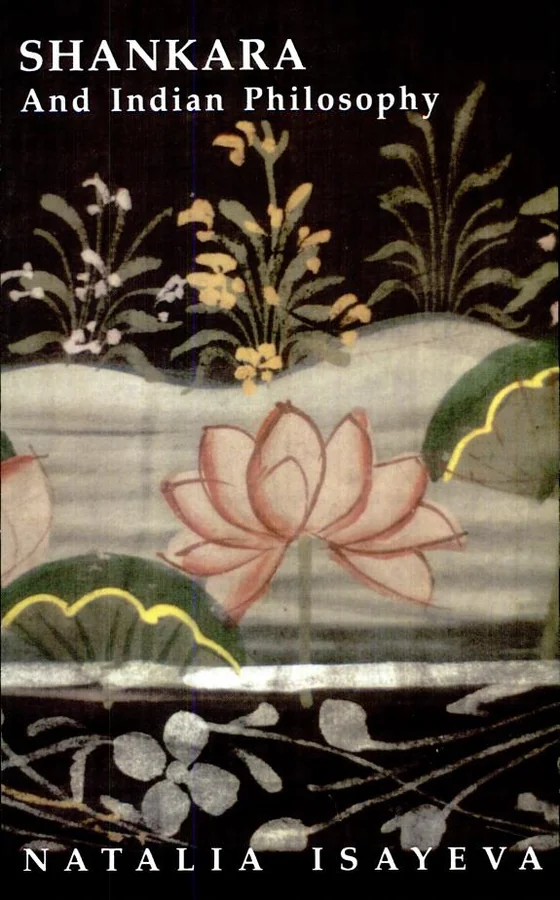
Shankara and Indian Philosophy
 79
79

Shankara and Indian Philosophy
Isaeva's treatment of Shankara is commendably direct, cutting through layers of commentary to present the core arguments of Advaita Vedanta. The strength lies in its clear articulation of Shankara's logical framework, particularly how the concept of Maya functions to reconcile the appearance of multiplicity with ultimate non-duality. A limitation, however, is the book's dense academic prose, which may pose a barrier for those without a background in Indian philosophy. The discussion around Shankara's refutation of opposing philosophical schools, while intellectually rigorous, could benefit from more accessible examples. The work ultimately provides a solid foundation for understanding a pivotal figure in Indian thought.
📝 Description
79
N. V. Isaeva's 1992 study examines Adi Shankara's Advaita Vedanta.
Published in 1992, N. V. Isaeva's "Shankara and Indian Philosophy" offers a focused study of the Advaita Vedanta tradition as articulated by Adi Shankara. The book details Shankara's core doctrines, including his assertion of the identity between Brahman, the absolute reality, and Atman, the individual self. Isaeva also discusses Shankara's concept of the phenomenal world as Maya, or illusion.
The work presents these complex metaphysical ideas with an emphasis on their logical structure and their implications for spiritual realization. It is intended for students and scholars of Indian philosophy, comparative religion, and comparative mysticism. Readers seeking a rigorous exposition of Advaita Vedanta, distinct from devotional or simplified interpretations, will find substantial material. The book also suits those interested in the philosophical underpinnings of meditation practices, non-dualistic thought, and the nature of consciousness.
This book situates Adi Shankara's philosophy within the rich history of Hindu thought, specifically the Advaita Vedanta school. Advaita, meaning 'non-duality,' is a central tenet in Indian mystical traditions, positing the ultimate oneness of existence. Isaeva's work analyzes how Shankara systemized these ideas, challenging conventional dualistic perceptions and emphasizing direct realization of the self's identity with ultimate reality. The book addresses concepts that have informed centuries of contemplation and spiritual practice in India and beyond.
💡 Why Read This Book?
• Gain a precise understanding of Advaita Vedanta's non-dualistic core, as Isaeva systematically explains the identity of Atman and Brahman, a concept central to Shankara's philosophy. • Grasp the function of Maya, the concept of cosmic illusion, and how it explains the perceived diversity of the world according to Shankara's 8th-century teachings. • Learn about Shankara's epistemology, specifically the distinction between higher and lower knowledge (para vidya and apara vidya), which is crucial for understanding the path to liberation.
⭐ Reader Reviews
Honest opinions from readers who have explored this book.
❓ Frequently Asked Questions
What is the central philosophical tenet of Advaita Vedanta as presented by Shankara?
The central tenet is Advaita, meaning 'non-duality.' It posits that Brahman, the ultimate reality, is identical with Atman, the individual self. All perceived multiplicity is considered Maya, or illusion.
Who was Adi Shankara and why is he significant?
Adi Shankara was an 8th-century Indian philosopher and theologian who consolidated the Advaita Vedanta school of thought. He is crucial for his systematic expositions and commentaries on Upanishads, Bhagavad Gita, and Brahma Sutras.
What is Maya in the context of Shankara's philosophy?
Maya refers to the illusory nature of the phenomenal world. It is the power that conceals the true reality of Brahman and projects the appearance of a diverse, material universe.
Does the book discuss Shankara's approach to liberation (moksha)?
Yes, the book explains Shankara's view that liberation (moksha) is achieved through Jnana Yoga, the path of knowledge, by realizing the non-dual nature of existence and transcending Maya.
What distinguishes higher knowledge from lower knowledge in Shankara's philosophy?
Higher knowledge (para vidya) is direct realization of Brahman, leading to liberation. Lower knowledge (apara vidya) pertains to the empirical world and its phenomena, which are ultimately illusory.
When was Shankara and Indian Philosophy first published?
Shankara and Indian Philosophy, by N. V. Isaeva, was first published on December 24, 1992.
🔮 Key Themes & Symbolism
Non-Duality (Advaita)
The core of Shankara's philosophy, Advaita, posits that ultimate reality is a single, undifferentiated consciousness (Brahman). The work meticulously details how Shankara argues against the perceived duality of subject and object, self and non-self. Isaeva explains the logical necessity of this non-dual perspective for achieving spiritual liberation, presenting Brahman not merely as a creator god but as the very substratum of existence, identical with the inner essence (Atman) of all beings.
The Nature of Maya
Isaeva's exposition clarifies Maya not as outright non-existence, but as a potent illusion that veils the singular reality of Brahman. The book explores how Maya accounts for the empirical world of multiplicity, change, and causality. Understanding Maya is presented as a critical step in the Advaita path, as it allows the practitioner to deconstruct the perceived reality and recognize its illusory character, thereby detaching from worldly phenomena.
Epistemology and Liberation
The work focuses on Shankara's understanding of knowledge as the means to liberation (moksha). Isaeva distinguishes between two levels of knowledge: lower knowledge (apara vidya), concerned with the empirical, and higher knowledge (para vidya), which is the direct intuitive realization of Brahman. The book traces Shankara's argument that only through the latter can one achieve freedom from the cycle of birth and death (samsara).
The Self (Atman)
Central to Advaita Vedanta is the concept of Atman, the true self, which Shankara identifies with Brahman. Isaeva's analysis highlights Shankara's method of negating all empirical attributes and identifications to arrive at the pure, unconditioned Atman. This exploration is crucial for readers interested in the nature of consciousness and the perennial quest for self-knowledge, as presented within a rigorous philosophical framework.
💬 Memorable Quotes
Direct passages from the work, attributed to the author.
“God or Brahman is identical with the inner self (the Atman) of each person.”
— This fundamental assertion of Advaita Vedanta, as presented by Shankara, lies at the heart of non-dual philosophy. It suggests that the deepest reality of our being is not separate from the ultimate, universal consciousness.
“the rest of the world is nothing but objective illusion (maya).”
— This statement expresses Shankara's view on the phenomenal universe. It is not that the world doesn't appear, but that its appearance is misleading, obscuring the singular reality of Brahman.
“there are two primary levels of existence and knowledge: the higher knowledge that is Brahman itself, and the relative, limited knowledge, regarded as the very texture of the universe.”
— This highlights Shankara's epistemological dualism within a metaphysical monism. It distinguishes between ultimate truth (Brahman) and empirical perception, which operates within the confines of the illusory world.
“the task of a human being is to reach the absolute unity and the reality of Brahman”
— This points to the soteriological aim of Shankara's philosophy. The ultimate purpose of human life is seen as the realization of one's true identity with the absolute, transcending all limitations and distinctions.
“Shankara maintains that there are two primary levels of existence and knowledge”
— This emphasizes Shankara's structured approach to understanding reality and knowing it. Isaeva's work unpacks these levels, crucial for understanding the Advaita path from illusion to truth.
🌙 Esoteric Significance
Tradition
While Advaita Vedanta is a major philosophical school within Hinduism, its non-dualistic conclusions and emphasis on direct realization of the Absolute align with perennial esoteric principles found across traditions. Its focus on transcending the empirical self and realizing unity with the divine echoes Gnostic and Hermetic ideals of gnosis and divine immanence. The work fits within the broader esoteric library by exploring metaphysical systems that posit a hidden, unified reality beneath the surface of manifest existence.
Symbolism
The primary symbolic concept is Brahman, representing the unmanifest, absolute reality from which all existence emanates and to which it returns. Atman symbolizes the innermost essence of the individual, often depicted as a spark of the divine, identical with Brahman. Maya functions symbolically as a veil or cosmic illusion, representing the perceived world of multiplicity that obscures the underlying unity, much like the Platonic cave allegory.
Modern Relevance
Shankara's Advaita Vedanta continues to influence contemporary non-dual spiritual movements and mindfulness practices. Thinkers and teachers in Western and Eastern spiritual circles often draw upon Shankara's concepts to explain states of consciousness and the nature of reality. Modern interpretations of meditation, self-inquiry, and the understanding of consciousness frequently reference the core tenets of Advaita Vedanta explored in this book.
👥 Who Should Read This Book
• Students of Indian Philosophy: Those seeking a clear, academic exposition of Advaita Vedanta and the philosophical contributions of Adi Shankara, moving beyond introductory texts. • Comparative Religion Scholars: Researchers interested in the metaphysical foundations of Hinduism and comparing non-dualistic concepts across global spiritual traditions. • Practitioners of Meditation and Self-Inquiry: Individuals looking to deepen their understanding of consciousness, the nature of the self, and the philosophical underpinnings of spiritual realization.
📜 Historical Context
N. V. Isaeva's Shankara and Indian Philosophy, first published in 1992, entered a scholarly landscape where the study of Indian philosophical systems was well-established, yet often approached with diverse methodologies. The late 20th century saw a continued Western academic engagement with Vedanta, building on the foundational work of scholars like Swami Vivekananda and Sarvepalli Radhakrishnan. Isaeva's work contributes to this ongoing discourse by providing a focused analysis of Adi Shankara (c. 8th century CE), the key systematizer of Advaita Vedanta. This period also witnessed a rise in popular interest in Eastern spirituality, sometimes leading to simplified interpretations that academic works like Isaeva's sought to counter with rigorous philosophical exposition. The book's approach is situated within the tradition of analytical philosophy applied to Indian thought, differentiating it from more devotional or purely historical accounts.
📔 Journal Prompts
Reflect on the implications of Atman being identical with Brahman for your personal sense of self.
Consider how the concept of Maya might explain your own perceptions of reality.
Analyze the distinction between higher and lower knowledge as presented by Shankara in this work.
Explore the logical arguments Isaeva presents for the non-dual nature of existence.
How does the idea of transcending Maya alter one's perspective on worldly concerns?
🗂️ Glossary
Advaita Vedanta
A school of Hindu philosophy that emphasizes the non-duality of Brahman (ultimate reality) and Atman (the individual self). It asserts that the perceived world is illusory (Maya).
Brahman
The ultimate, unchanging, infinite, and all-pervading reality in Hindu philosophy. It is the supreme cosmic spirit, the source and substratum of all existence.
Atman
The individual self or soul. In Advaita Vedanta, Atman is considered identical with Brahman, representing the true, innermost essence of a being.
Maya
A Sanskrit term meaning illusion, deception, or magic. In Advaita Vedanta, it refers to the cosmic power that conceals the true nature of reality (Brahman) and projects the illusion of the phenomenal world.
Moksha
Liberation or release from the cycle of birth, death, and rebirth (samsara). It is the ultimate goal in many Indian religions, achieved through spiritual knowledge and realization.
Jnana Yoga
The yoga of knowledge or wisdom. It is a path to spiritual liberation in Hinduism, emphasizing intellectual understanding, discrimination, and direct realization of the truth.
Samsara
The cycle of death and rebirth, a continuous process of reincarnation driven by karma. It is generally considered a state of suffering from which liberation (moksha) is sought.
This book appears in 1 collection
🔮 Readers Also Liked
Browse all →







From the “Vedanta” Collection
View all →





More Free Sacred Texts & Gnosticism Books
View all →