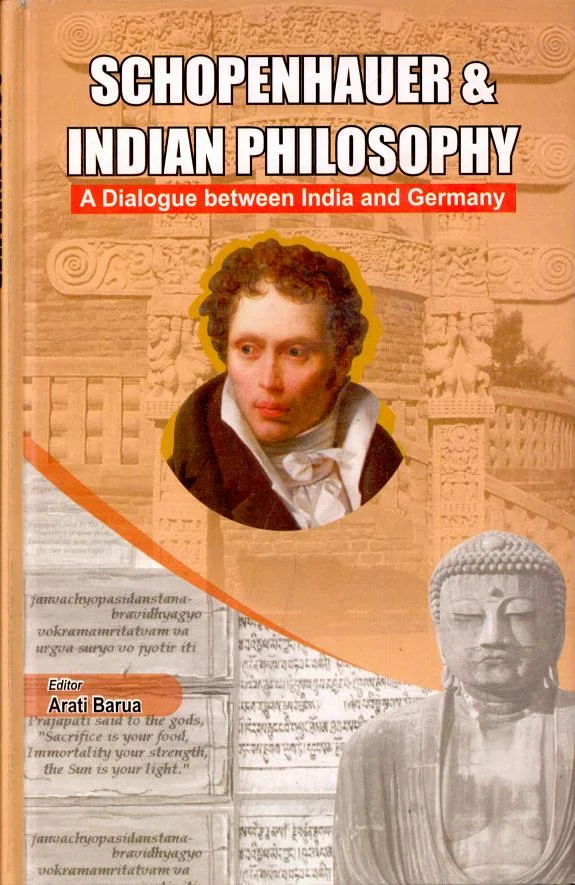
Schopenhauer and Indian Philosophy
 79
79

Schopenhauer and Indian Philosophy
Arati Barua's "Schopenhauer and Indian Philosophy" offers a meticulously researched exploration of a philosophical nexus often acknowledged but rarely dissected with such scholarly rigor. Barua skillfully positions Schopenhauer not merely as an admirer of Indian thought, but as a Western philosopher whose core metaphysical tenets, particularly the concept of the "will," find uncanny parallels in Indic traditions. A particular strength lies in the detailed comparison of Schopenhauer's "will-to-live" with the Buddhist concept of "tanha" (craving) and the Hindu "samsara." The book's limitation, however, is its dense academic prose, which may deter the casual reader. While the original blurb mentions Prof. Kossler's endorsement, the text itself could benefit from more direct engagement with contemporary Indian scholars discussing this bridge. Nevertheless, Barua's work provides a valuable academic resource for understanding this East-West philosophical dialogue.
📝 Description
79
Arati Barua's 2008 study connects Schopenhauer's philosophy to Indian metaphysical traditions.
Arati Barua's 2008 book, "Schopenhauer and Indian Philosophy," examines the links between the German philosopher Arthur Schopenhauer and various Indian philosophical systems. The work seeks to revitalize interest in Schopenhauer's ideas, both in India and internationally, positioning him as a bridge between Western and Eastern metaphysical thought. Barua argues for a reevaluation of core Schopenhauerian concepts within current academic discussions.
The book is designed for academics and students of comparative philosophy, especially those interested in the interplay between Western and Indian thought. Readers familiar with Schopenhauer's "The World as Will and Representation," as well as Buddhist and Hindu concepts like karma and suffering, will find this work particularly relevant. It also serves scholars investigating the historical reception and interpretation of Western philosophy in India.
Schopenhauer's philosophy, particularly his concept of the 'will' as a blind, striving force, resonates with certain Indian philosophical traditions. His work drew parallels to Vedic texts and Buddhist doctrines, finding echoes in concepts like Maya (illusion), Avidya (ignorance), and Samsara (the cycle of existence). This book situates Schopenhauer's often pessimistic outlook within this broader metaphysical landscape, highlighting how his ideas on suffering and the renunciation of will align with the Buddhist understanding of the Four Noble Truths and aspects of Hindu thought.
💡 Why Read This Book?
• Gain a nuanced understanding of how Arthur Schopenhauer's concept of the "will" (as detailed in his major works) mirrors Indian notions of karma and samsara, offering a unique lens on suffering. • Discover the historical context of Western philosophy's reception in India, specifically examining the 2008 revival of interest in Schopenhauerism and its academic significance. • Explore the parallels between Schopenhauer's pessimism and the Buddhist Four Noble Truths, providing concrete philosophical frameworks for understanding existential dissatisfaction.
⭐ Reader Reviews
Honest opinions from readers who have explored this book.
❓ Frequently Asked Questions
What is the primary philosophical connection explored between Schopenhauer and Indian thought?
The book primarily connects Schopenhauer's concept of the "will" as a blind, striving force to Indian ideas like Maya (illusion), Avidya (ignorance), and the cycle of Samsara, highlighting shared perspectives on suffering and existence.
When was Arati Barua's "Schopenhauer and Indian Philosophy" first published?
Arati Barua's "Schopenhauer and Indian Philosophy" was first published in 2008, marking a period of renewed academic interest in Schopenhauer's work.
How does this book propose Schopenhauer acts as a 'bridge' between philosophies?
It positions Schopenhauer as a bridge by demonstrating how his metaphysical framework, particularly the "will," resonates deeply with core tenets of Hindu and Buddhist philosophy, facilitating cross-cultural understanding.
What specific Indian philosophical concepts are discussed in relation to Schopenhauer?
The book discusses concepts such as Maya, Avidya, Samsara, karma, and the Four Noble Truths, drawing explicit parallels with Schopenhauer's philosophy of the will and its inherent suffering.
Is this book suitable for beginners in philosophy?
While comprehensive, the book is written for an academic audience. Beginners might find it more accessible after establishing foundational knowledge of both Schopenhauer and Indian philosophical traditions.
What is the significance of Schopenhauer's 'will' in this comparative study?
Schopenhauer's 'will' is central, representing a fundamental, unthinking drive that causes suffering. Its comparison to Indian concepts of craving and illusion forms the core argument for the book's East-West philosophical linkage.
🔮 Key Themes & Symbolism
The Will and Samsara
This theme examines Schopenhauer's central concept of the "will" – a blind, ceaseless striving force – and its striking parallels with the Indian doctrine of Samsara, the endless cycle of birth, death, and suffering driven by karma. Barua explores how Schopenhauer's view of the world as a manifestation of this insatiable will reflects the Buddhist understanding of craving (tanha) as the root of suffering and the Hindu concept of Avidya (ignorance) perpetuating the cycle of rebirth.
Pessimism and Liberation
The book studies the shared pessimistic outlook present in both Schopenhauer's philosophy and certain schools of Indian thought, particularly Buddhism. Schopenhauer's argument that life is inherently filled with suffering due to the will's constant dissatisfaction is juxtaposed with the Four Noble Truths. The exploration then extends to the paths of liberation—Moksha in Hinduism and Nirvana in Buddhism—as analogous to the ascetic negation of the will proposed by Schopenhauer.
Maya and Phenomenal Illusion
A crucial theme is the comparison between Schopenhauer's "world as representation" and the Indian concept of Maya. Barua investigates how Schopenhauer's idea that the phenomenal world is merely an illusion or a veil, obscuring the underlying reality of the will, aligns with the Advaita Vedanta notion of Maya, which posits that the perceived world is not ultimately real. This comparison highlights a shared critique of empirical reality and a search for a deeper, often hidden, truth.
Schopenhauer as a Philosophical Bridge
This theme addresses the book's core assertion: Schopenhauer's unique position as a conduit between Western and Indian philosophical traditions. Barua argues that Schopenhauer's engagement with Eastern texts was not superficial but fundamental to his own system. The work aims to foster a renewed appreciation for this cross-cultural dialogue, demonstrating how Schopenhauer's insights into suffering, will, and illusion can enrich contemporary philosophical discourse on both sides of the globe.
💬 Memorable Quotes
Direct passages from the work, attributed to the author.
“Schopenhauer has been rightly described as a ‘bridge’ between Western and Indian philosophy.”
— This statement from the original blurb expresses the book's central thesis. It highlights Schopenhauer's unique role in facilitating a dialogue between two seemingly disparate philosophical systems, suggesting his work offers common ground for understanding fundamental human experiences.
“The insatiable nature of the will leads to perpetual suffering.”
— This is an interpretation of Schopenhauer's core idea. It suggests that the fundamental drive of existence, as he saw it, is a source of endless dissatisfaction, a concept Barua links to similar ideas in Indian philosophy.
“The phenomenal world can be seen as a veil obscuring ultimate reality.”
— This interpretation connects Schopenhauer's epistemology to Indian concepts like Maya. It implies that our everyday perception of reality is illusory and that a deeper truth lies beyond this veil.
“A new perspective on Schopenhauer's philosophy is hoped for in India and abroad.”
— This interpretation reflects the book's aim to offer a fresh lens on Schopenhauer's thought, particularly by emphasizing his connections to Indian traditions and encouraging global scholarly engagement.
💡 Key Ideas
Editorial paraphrase of the work's core concepts — not direct quotes.
The work explores the revival of Schopenhauerism in the contemporary academic world.
This paraphrased concept points to the book's focus on the modern relevance of Schopenhauer's ideas. It suggests a contemporary academic interest in rediscovering and re-evaluating his philosophy, particularly its intersections with Eastern thought.
🌙 Esoteric Significance
Tradition
This work engages with the perennial philosophy, a concept suggesting a single, universal spiritual truth underlying diverse religious and philosophical traditions. It fits within the lineage of comparative mysticism and esoteric studies that seek common ground between seemingly disparate worldviews. While not strictly adhering to a single esoteric lineage like Hermeticism or Kabbalah, it aligns with the Theosophical project of demonstrating the universality of spiritual and metaphysical principles found across cultures and eras.
Symbolism
The primary symbolic resonance lies in the concept of the "will" itself, functioning as a blind, impersonal force driving existence, akin to primal cosmic energies in various mythologies. The "veil of Maya" is another potent symbol, representing the illusory nature of the phenomenal world, a common motif in Gnostic and Eastern traditions signifying ignorance that obscures a higher reality. The "negation of the will" or asceticism can be seen as a symbolic path towards liberation, echoing motifs of renunciation and spiritual discipline found in yogic and monastic traditions.
Modern Relevance
Contemporary thinkers exploring consciousness studies, transpersonal psychology, and radical phenomenology often revisit Schopenhauer's ideas on the subjective nature of reality and the driving force of will. His concepts continue to inform discussions on existentialism, the nature of suffering, and the search for meaning in a seemingly indifferent universe. Practices rooted in mindfulness and Buddhist meditation, while distinct, share philosophical ground with Schopenhauer's analysis of desire and dissatisfaction, making his work relevant to modern seekers of inner peace.
👥 Who Should Read This Book
• Students of comparative philosophy: Those seeking to understand the intellectual bridges between Western metaphysics and Eastern spiritual traditions, particularly Buddhism and Hinduism. • Scholars of Arthur Schopenhauer: Academics interested in exploring the Indian influences on Schopenhauer's thought and his reception in India. • Individuals exploring existentialism and the nature of suffering: Readers grappling with philosophical perspectives on life's difficulties and the search for meaning or liberation.
📜 Historical Context
Arati Barua's "Schopenhauer and Indian Philosophy," published in 2008, emerged during a period of sustained scholarly interest in Arthur Schopenhauer's metaphysics, particularly his engagement with Eastern thought. Schopenhauer, writing in the mid-19th century, was one of the first major Western philosophers to extensively incorporate concepts from Vedic texts and Buddhist philosophy into his system. His key work, "The World as Will and Representation," published in 1818 (with a second edition in 1844), directly referenced Upanishadic teachings. This period also saw growing Orientalist scholarship, but Schopenhauer's integration was unique. While competing schools like Hegelian idealism dominated German philosophy, Schopenhauer's ideas on the will, suffering, and asceticism found resonance later with figures like Nietzsche and Freud. The book's publication in 2008 reflects a continuing academic effort to bridge the perceived divide between Western and Eastern philosophical traditions, building on earlier comparative studies and the legacy of figures like Swami Vivekananda, who engaged with Western thinkers.
📔 Journal Prompts
The concept of the 'will' as a driving force behind existence, its parallels with karma.
Schopenhauer's 'veil of Maya' and its relation to perceived reality.
The Four Noble Truths and the nature of suffering in Schopenhauer's philosophy.
The historical reception of Western philosophy in India post-1800.
Asceticism as a path to liberation, compared across traditions.
🗂️ Glossary
Will
In Schopenhauer's philosophy, the fundamental, blind, irrational, and ceaseless striving force that underlies all phenomena and is the source of all suffering in the world.
Representation
The phenomenal world as it appears to us through our senses and intellect; according to Schopenhauer, this is a subjective construct, a 'veil' of Maya, that conceals the underlying reality of the Will.
Maya
A key concept in Indian philosophy (especially Vedanta), referring to illusion or the power that conceals the true nature of reality, making the phenomenal world appear as real and distinct.
Samsara
The cycle of birth, death, and rebirth, driven by karma and ignorance, a fundamental concept in Hinduism, Buddhism, Jainism, and Sikhism, representing the state of existence from which liberation is sought.
Avidya
Ignorance; in Indian philosophy, particularly Buddhism and Advaita Vedanta, it is the fundamental ignorance of the true nature of reality, which perpetuates suffering and the cycle of Samsara.
Asceticism
A practice of rigorous self-discipline and self-denial, often for spiritual reasons. In Schopenhauer's philosophy, it represents the denial of the Will-to-live as a path to overcoming suffering.
Four Noble Truths
The foundational teachings of Buddhism, explaining the nature of suffering (Dukkha), its cause (craving/tanha), its cessation, and the path to its cessation (the Eightfold Path).
This book appears in 1 collection
🔮 Readers Also Liked
Browse all →









From the “Vedanta” Collection
View all →






More Free Occult Philosophy Books
View all →