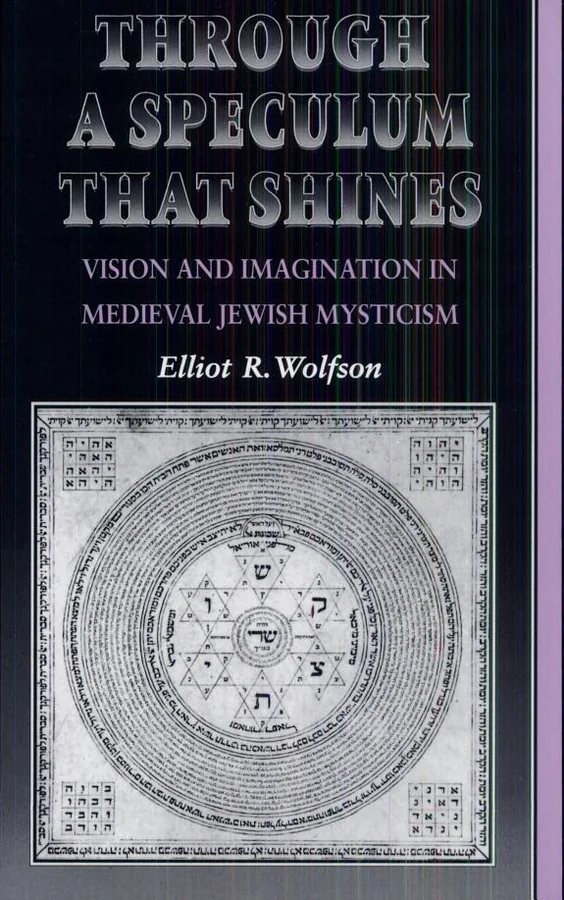
Through a Speculum that Shines
 82
82

Through a Speculum that Shines
Elliot R. Wolfson's "Through a Speculum that Shines" is a dense, rewarding exploration of Jewish mysticism, particularly its visual and experiential aspects. Published in 1994, the book remains a significant contribution to the field, moving beyond purely theological exegesis to consider the phenomenology of religious perception. Wolfson's meticulous analysis of texts from late antiquity and the medieval period, including pre-kabbalistic and early kabbalistic sources, reveals a consistent emphasis on the visual as a conduit for divine apprehension. A particular strength lies in his deconstruction of how early mystical texts frame religious experience as an intensely visual, almost cinematic, event. However, the book's academic rigor, while commendable, can make it less accessible to the casual reader; the prose demands significant concentration and prior knowledge of the subject matter. The chapter discussing the "speculum" concept itself, and its implications for understanding divine revelation through visionary states, is a standout. Ultimately, "Through a Speculum that Shines" is an essential, albeit challenging, text for serious scholars of Jewish mysticism.
📝 Description
82
Elliot R. Wolfson's 1993 book examines Jewish mystical traditions from antiquity through the medieval period.
Through a Speculum that Shines, published in 1993, provides a scholarly examination of Jewish mystical traditions, tracing their development from late antiquity through the medieval period. Elliot R. Wolfson analyzes a range of texts, including pre-kabbalistic sources and foundational kabbalistic literature from the 10th to the 13th centuries. The work highlights the intensely visual and experiential dimensions inherent in Jewish spirituality across these eras.
The study situates Jewish mysticism within its broader historical and intellectual context, spanning from the formative periods of late antiquity to the flourishing of Kabbalah in the 12th and 13th centuries. It engages with the theological and philosophical currents of the medieval era, a time when Jewish thinkers were developing sophisticated esoteric systems. The work implicitly contrasts with more purely philosophical or legalistic interpretations of Judaism prevalent at the time.
Central to the book is the concept of the 'speculum' – a mirror or lens through which divine realities are perceived. Wolfson analyzes how vision, imagination, and ecstatic experience function as pathways to mystical knowledge within Jewish thought. The analysis extends to the symbolic language and conceptual frameworks used to articulate these encounters with the divine, emphasizing the visual nature of religious experience.
This book belongs to the study of Kabbalah, the esoteric system of Jewish mysticism. It traces the lineage of Kabbalistic thought from its earlier expressions in late antiquity and the Gaonic period, through to the classic medieval Kabbalistic texts of the 10th to 13th centuries. Wolfson's work situates these mystical developments within the broader intellectual currents of medieval Judaism, considering their philosophical and theological underpinnings. The focus on the 'speculum' as a metaphor for divine perception connects to broader themes in mystical traditions concerning the nature of revelation and the methods for achieving Gnosis.
💡 Why Read This Book?
• Gain a nuanced understanding of the visual emphasis in Jewish mystical traditions, as explored through the "speculum" concept, offering an alternative to purely textual or intellectual approaches to spirituality. • Grasp the historical trajectory of Jewish mysticism from late antiquity to the 13th century, contextualizing early Kabbalah within a lineage of experiential and visionary religious practice. • Appreciate the scholarly methodology applied to esoteric texts, learning how Wolfson analyzes the phenomenology of religious experience in pre-kabbalistic and kabbalistic literature.
⭐ Reader Reviews
Honest opinions from readers who have explored this book.
❓ Frequently Asked Questions
What period does "Through a Speculum that Shines" cover?
The book examines Jewish mystical texts from late antiquity, pre-kabbalistic sources from the 10th to 12th centuries, and early kabbalistic literature from the 12th and 13th centuries.
What is the central theme of the book?
The central theme is the overwhelmingly visual nature of religious experience in Jewish spirituality, with the "speculum" serving as a key metaphor for divine perception.
Who is the author, Elliot R. Wolfson?
Elliot R. Wolfson is a renowned Judaic scholar specializing in Jewish mysticism and philosophy. "Through a Speculum that Shines" is one of his highly acclaimed works.
What types of texts are analyzed in the book?
The book analyzes a range of Jewish mystical texts, including those from late antiquity, pre-kabbalistic writings, and foundational 12th- and 13th-century Kabbalistic literature.
Is this book suitable for beginners in mysticism?
While comprehensive, the book's academic depth makes it more suitable for advanced students and scholars of religious studies and Jewish mysticism rather than absolute beginners.
What is the significance of the 'speculum' in the book?
The 'speculum' is explored as a metaphor for the lens or mirror through which mystics perceive divine realities, emphasizing the visual and imaginative aspects of their spiritual encounters.
🔮 Key Themes & Symbolism
The Visual Nature of Revelation
This theme centers on how Jewish mystics, from antiquity through the medieval period, understood divine communication and spiritual attainment through visual perception. Wolfson examines texts that describe ecstatic visions, imaginative journeys, and the use of symbolic imagery as direct pathways to apprehending the divine. The concept of the 'speculum' itself functions as a critical lens, highlighting how mystical experience is often framed through the act of seeing, whether it be inner visions or the contemplation of cosmic structures.
Evolution of Jewish Mysticism
The book meticulously traces the development of Jewish mystical thought across significant historical epochs. It moves from the foundational mystical currents of late antiquity, through the formative pre-kabbalistic sources of the 10th to 12th centuries, culminating in the emergence of classic Kabbalistic literature in the 12th and 13th centuries. This chronological approach reveals shifts in conceptualization and practice while identifying persistent themes of experiential spirituality.
The Speculum as Metaphor
Central to Wolfson's analysis is the metaphor of the 'speculum' (mirror or lens). This motif is explored as a means by which the divine is perceived, reflected, and understood by the mystic. It signifies not just passive observation but an active engagement with visionary experience, where the mystic's internal state and the external divine realm are perceived to interact through a reflective medium. This concept underscores the phenomenological aspect of mystical encounter.
Phenomenology of Religious Experience
Wolfson's work is deeply concerned with the subjective experience of the mystic. By analyzing the language and imagery used in various Jewish mystical texts, he reconstructs the qualitative nature of these encounters. The emphasis is on how the divine is *experienced*—particularly through the senses, with vision playing a paramount role—rather than solely on abstract theological doctrines. This approach brings the lived reality of mystical practice to the forefront.
💬 Memorable Quotes
Direct passages from the work, attributed to the author.
“The 'speculum' as a means of perceiving the divine.”
— This highlights the central metaphor of the book, suggesting that mystical texts often describe the divine as being apprehended through a reflective or mediating 'mirror,' enabling the mystic to 'see' or experience sacred realities.
“Analysis of pre-kabbalistic sources from the 10th to 12th centuries.”
— This points to the book's detailed examination of the formative period before the full flowering of Kabbalah, revealing earlier expressions of mystical thought and practice that laid the groundwork for later developments.
“Jewish mystical texts from late antiquity.”
— This indicates the book's deep historical roots, showing how the foundations for later medieval mysticism were already present in earlier Jewish literature and thought, often with a strong emphasis on visionary elements.
“The phenomenological dimension of Jewish spirituality.”
— This emphasizes Wolfson's focus on the subjective, lived experience of the mystic – what it felt like to have a divine encounter – particularly through the lens of sensory, especially visual, perception.
💡 Key Ideas
Editorial paraphrase of the work's core concepts — not direct quotes.
The overwhelming visual nature of religious experience in Jewish spirituality.
This paraphrase expresses the book's core argument: that across different periods of Jewish mysticism, the primary mode of divine encounter and spiritual insight was through visionary experiences and visual apprehension, rather than solely through intellectual understanding or textual interpretation.
🌙 Esoteric Significance
Tradition
This work is situated firmly within the study of Jewish Esotericism, specifically focusing on the development and nature of Kabbalah and its antecedents. It bridges the gap between earlier Merkabah mysticism and the Zoharic tradition, examining the continuity and transformation of mystical concepts. Wolfson's analysis highlights how Jewish mysticism, while distinct, shares common phenomenological ground with other esoteric traditions focused on visionary experience and symbolic interpretation.
Symbolism
Key symbols explored include the 'speculum' (mirror/lens), representing the interface between the human and the divine through which vision occurs. The book also examines the symbolism of light, cosmic structures, and imaginative ascent, all of which are crucial motifs in Jewish mystical literature for articulating ineffable spiritual realities and the pathways to divine knowledge.
Modern Relevance
Contemporary scholars of religion and mysticism continue to engage with Wolfson's work for its sophisticated analysis of textual interpretation and the phenomenology of religious experience. Thinkers exploring embodied spirituality, the role of imagination in religious practice, and comparative mysticism often draw upon his insights into the visual dimensions of Jewish tradition, influencing fields beyond Jewish studies.
👥 Who Should Read This Book
• Scholars of Jewish Studies and Religious History: To gain a deep, textually grounded understanding of the evolution of Jewish mysticism and its emphasis on visual experience. • Students of Comparative Mysticism: To analyze the specific manifestations of visionary and ecstatic states within a major Western esoteric tradition. • Advanced Practitioners of Esoteric Disciplines: To explore the theoretical underpinnings and historical context of techniques involving visualization and symbolic contemplation.
📜 Historical Context
Published in 1994, Elliot R. Wolfson's "Through a Speculum that Shines" emerged during a period of intense scholarly interest in Jewish mysticism, particularly Kabbalah. The late 20th century saw a move away from purely historical or philological approaches towards more phenomenological and comparative studies of esoteric traditions. Wolfson's work contributed significantly to this shift by analyzing texts from late antiquity through the 13th century, a period that witnessed the evolution from earlier mystical currents to the structured system of Kabbalah. His rigorous textual analysis engaged with contemporary scholarship on medieval Jewish thought, philosophy, and theology, implicitly challenging purely rationalist interpretations of Jewish religious life. The book's detailed examination of visual and imaginative experience offered a counterpoint to dominant intellectualist readings of religious texts and practices.
📔 Journal Prompts
The concept of the 'speculum' as a tool for divine perception.
Visual elements in Jewish mystical texts from late antiquity.
The relationship between imagination and religious experience in pre-kabbalistic sources.
How the 12th- and 13th-century kabbalistic literature expands upon earlier mystical visions.
The role of symbolism in articulating mystical encounters.
🗂️ Glossary
Speculum
Latin for 'mirror' or 'lens.' In the context of the book, it refers to a metaphorical or conceptual tool through which mystics perceive, reflect, or apprehend divine realities, emphasizing the visual aspect of spiritual experience.
Late Antiquity
The historical period roughly from the 3rd to the 6th century CE, during which foundational Jewish texts and mystical traditions that influenced later Kabbalah began to take shape.
Pre-Kabbalistic Sources
Texts and traditions from the period preceding the major codifications of Kabbalah (roughly before the 12th century), which exhibit early forms of Jewish mystical speculation and practice.
Kabbalah
The esoteric system of Jewish mysticism, which emerged prominently in the medieval period, focusing on divine emanations, symbolic interpretation of scripture, and mystical practices aimed at union with God.
Phenomenology of Religion
An approach to studying religion that focuses on the subjective, lived experience of religious individuals and communities, seeking to understand the qualitative nature of their beliefs and practices.
Merkabah Mysticism
An early form of Jewish mysticism (flourishing from the Talmudic period onwards) focused on visionary ascent through heavenly palaces to the divine throne (Merkabah, 'chariot').
Visionary Experience
A type of religious experience characterized by seeing visions, often interpreted as direct encounters with the divine, angels, or celestial realms.
This book appears in 1 collection
🔮 Readers Also Liked
Browse all →






From the “Visions” Collection
View all →




More Free Esoteric History & Biography Books
View all →