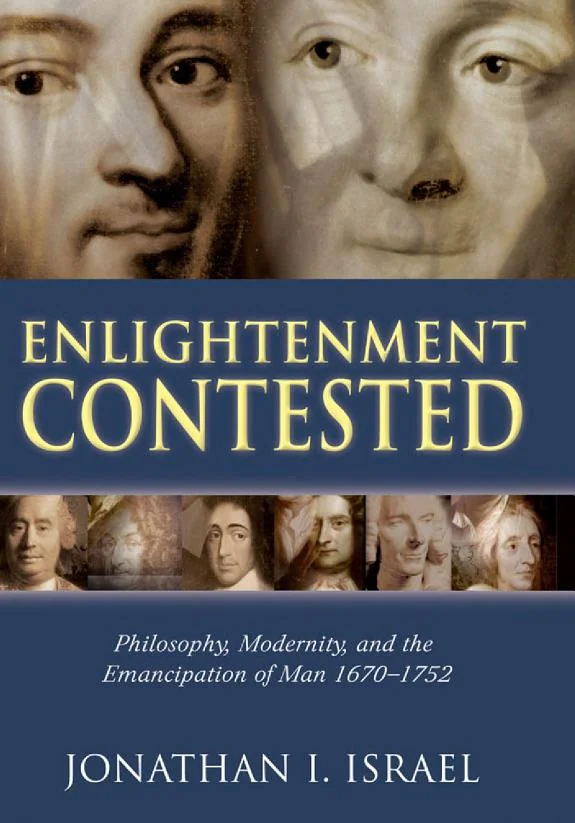
Enlightenment Contested
 82
82

Enlightenment Contested
Jonathan I. Israel’s Enlightenment Contested is a formidable intellectual undertaking, presenting a thesis that, while forcefully argued, invites considerable debate. The book’s primary strength lies in its ambitious scope and the author’s clear command of a vast array of philosophical texts from the period. Israel compellingly articulates the radical versus conservative Enlightenment divide, particularly highlighting figures like Spinoza as foundational to the radical strain. However, the sheer weight of the argument sometimes leads to a tendency to subsume nuances of national intellectual traditions under his overarching dichotomy. For instance, while the analysis of the Dutch Enlightenment is robust, the book's central thesis may oversimplify the distinct historical and cultural factors shaping the Enlightenment across different European societies. The work is most potent when dissecting specific philosophical arguments, such as the debates surrounding materialism and atheism in the later 18th century. Despite its sometimes monolithic approach, Enlightenment Contested remains a significant contribution for its challenge to conventional periodization and its insistence on the centrality of radical thought.
This is a vital, if occasionally overreaching, reinterpretation of a pivotal historical era.
📝 Description
82
Jonathan I. Israel's 2006 book argues the Enlightenment's core division was radical versus conservative thought, not national differences.
Enlightenment Contested reevaluates the Enlightenment period by challenging interpretations that prioritize national variations. Jonathan I. Israel posits that the fundamental ideological split between radical and conservative thinkers is more significant than distinct "national enlightenments."
The book meticulously examines key philosophical currents, assessing their development and impact. Israel's work engages with historians who have emphasized figures like Voltaire or Rousseau as representatives of national intellectual traditions. Instead, he asserts the primacy of the radical versus conservative philosophical division as the era's defining characteristic. This approach aims to provide a rigorous, argument-driven analysis for those interested in the foundational debates that shaped modern Western thought.
The central concept is the radical Enlightenment, a tradition marked by democratic ideals, secularism, and a commitment to reason and individual liberty, often in opposition to established religious and political authorities. Israel contrasts this with the conservative Enlightenment, which sought reform within existing structures rather than fundamental overturn. The work traces the intellectual lineage of these ideas.
While not strictly an esoteric text in the occult sense, this book engages with traditions of radical thought that have often been marginalized or viewed with suspicion by established powers. The "radical Enlightenment" Israel describes encompasses a lineage of philosophical dissent, secularism, and intellectual liberation that, throughout history, has been perceived as challenging societal norms and orthodoxies. This focus on intellectual currents that question authority and advocate for reason and individual autonomy aligns with broader historical trends of esoteric or non-conformist thought that seek deeper, often unacknowledged, truths beyond conventional understanding.
💡 Why Read This Book?
• Understand the core philosophical divide between radical and conservative Enlightenment thinkers, moving beyond simplistic national categories. • Gain insight into the intellectual lineage of modern secularism and democratic ideals, tracing their emergence from 17th-century philosophical currents. • Re-evaluate the Enlightenment not as a monolithic movement, but as a battlefield of competing ideas, particularly concerning reason, religion, and political reform.
⭐ Reader Reviews
Honest opinions from readers who have explored this book.
❓ Frequently Asked Questions
What is the main argument of Jonathan I. Israel's Enlightenment Contested?
The book argues that the primary division within the Enlightenment was not between national enlightenments (e.g., French, British) but between a conservative and a radical philosophical current, with the latter championing secularism and democracy.
Which historical period does Enlightenment Contested primarily focus on?
The book centers on the long 18th century, from the late 17th century through the French Revolution and into the early 19th century, examining the development of Enlightenment thought.
Who are some key philosophers discussed in relation to the radical Enlightenment?
Key figures associated with the radical Enlightenment discussed include Baruch Spinoza, John Locke (whose ideas were interpreted radically), Denis Diderot, and Jean-Jacques Rousseau, among others.
What does Israel mean by 'conservative Enlightenment'?
The conservative Enlightenment refers to thinkers who sought to reform existing religious and political institutions rather than overturn them, often emphasizing moderation and a degree of traditionalism in contrast to radical thinkers.
How does Enlightenment Contested challenge previous scholarship?
It challenges scholarship that emphasizes distinct national variations of the Enlightenment by positing a more universal philosophical conflict between radical and conservative factions across Europe.
When was Enlightenment Contested first published?
Enlightenment Contested was first published on October 12, 2006.
🔮 Key Themes & Symbolism
Radical Enlightenment
The core of Israel's argument centers on the 'Radical Enlightenment,' a philosophical movement advocating for comprehensive secularism, rationalism, and democratic principles, often in direct opposition to established religious and political authority. This current draws significantly from figures like Spinoza, whose monism and pantheism provided a basis for challenging traditional metaphysics and divine right. The book traces the propagation of these ideas through pamphlets, salons, and philosophical treatises, highlighting their role in fostering revolutionary sentiments and shaping modern conceptions of liberty and human rights.
Conservative Enlightenment
Contrasting the radical strain, the 'Conservative Enlightenment' represents a more moderate approach to reform. Thinkers within this tradition aimed to modernize existing structures without dismantling them, often seeking a balance between reason and tradition, or between state authority and individual rights. This perspective frequently engaged with established religious frameworks, seeking to reconcile faith with Enlightenment ideals rather than replace it entirely with secular philosophy. Israel examines how this conservative current attempted to steer the Enlightenment away from what it perceived as dangerous, destabilizing radicalism.
The Philosophical Divide
The central thesis posits that the most significant fissure within the Enlightenment was this ideological chasm between radical and conservative thought, rather than distinctions between French, British, or other 'national' Enlightenments. This divide manifested in profound disagreements over materialism, atheism, political sovereignty, and the very nature of human reason. The work meticulously details these intellectual battles, showing how they laid the groundwork for subsequent political and social movements, and how the radical current, in particular, seeded concepts that remain central to contemporary political discourse.
Secularism and Reason
A crucial element explored is the burgeoning emphasis on secularism and the supreme authority of reason. The radical Enlightenment, in particular, sought to liberate thought from the constraints of religious dogma and superstition, promoting a worldview grounded in empirical observation and philosophical inquiry. This focus on reason as the primary tool for understanding the world and organizing society represents a fundamental departure from previous eras and underpins many of the era's most transformative ideas, from scientific advancement to political reform.
💬 Memorable Quotes
Direct passages from the work, attributed to the author.
“The core of the Enlightenment consisted in the challenge posed by the radical and critical philosophy of the Spanish-Portuguese Jew Baruch Spinoza (1632–1677) and his followers.”
— This statement positions Spinoza as a key figure, suggesting his philosophy, particularly his monism and critique of traditional religious and political authority, was the foundational element from which the more radical aspects of the Enlightenment emerged and spread.
“The Enlightenment was not a single, unified movement but a complex and often deeply divided intellectual current.”
— This highlights Israel's central argument that the Enlightenment was characterized by internal conflict, specifically the tension between radical and conservative factions, rather than presenting a monolithic or universally accepted set of ideas.
“The supposed 'national enlightenments' were of less significance than the rift between conservative and radical thought.”
— This directly challenges the historiographical trend of analyzing the Enlightenment through national lenses, asserting that the universal philosophical debates, particularly the radical-conservative split, were the more defining feature of the era.
“The conservative Enlightenment sought to reform but not to revolutionize.”
— This provides a succinct definition of the conservative Enlightenment's aims, distinguishing it from its radical counterpart by its focus on gradual change and the preservation of fundamental societal structures, rather than radical upheaval.
💡 Key Ideas
Editorial paraphrase of the work's core concepts — not direct quotes.
The Enlightenment’s radical wing championed democracy, sexual equality, and the abolition of all state churches and state religions.
This concisely summarizes the ambitious social and political agenda of the radical Enlightenment, emphasizing its commitment to universal rights and a complete separation of church and state, a stark contrast to more moderate reformist ideas.
🌙 Esoteric Significance
Tradition
While not explicitly a work of esoteric doctrine, Enlightenment Contested engages with philosophical currents that have significant resonance within esoteric traditions, particularly those influenced by Hermeticism and Kabbalah. The emphasis on radical secularism and rationalism, particularly as derived from Spinoza, can be seen as a modern manifestation of the Gnostic or Hermetic impulse to uncover hidden, rational truths independent of orthodox dogma. The book's focus on the intellectual lineage of radical thought positions it as a crucial text for understanding the historical development of ideas that later informed or were reinterpreted by esoteric movements seeking to synthesize reason with mystical or philosophical insights.
Symbolism
The most potent symbolic motif is the figure of Baruch Spinoza himself, whose philosophy is presented as the wellspring of the radical Enlightenment. Spinoza’s concept of God as identical with Nature (Deus sive Natura) and his pantheistic worldview can be interpreted esoterically as a form of immanent divinity or cosmic unity, challenging anthropomorphic deities and external divine intervention. The book implicitly uses Spinoza’s rationalist critique of revelation and superstition as a symbolic battleground against established religious authority, mirroring perennial esoteric quests for direct, rational apprehension of the divine or ultimate reality.
Modern Relevance
Contemporary thinkers and movements focused on secular spirituality, rational mysticism, or the philosophical underpinnings of progressive politics often draw implicitly or explicitly on the intellectual heritage discussed in Enlightenment Contested. Those exploring the roots of modern humanism, atheism, or secular ethics find a rigorous historical account of their philosophical origins. Furthermore, scholars and practitioners interested in how rationalist philosophies intersect with or diverge from mystical traditions can use Israel's work to understand the historical context of such dialogues, particularly concerning Spinoza's enduring influence across diverse intellectual landscapes.
👥 Who Should Read This Book
• Students of modern European intellectual history seeking a comprehensive reinterpretation of the Enlightenment, particularly those interested in the philosophical underpinnings of secularism and democratic thought. • Scholars of philosophy who want to understand the radical versus conservative schism in Enlightenment thought and its impact on subsequent philosophical traditions. • Readers interested in the historical development of radical political ideas, including secularism, rationalism, and critiques of religious authority, from the 17th century onwards.
📜 Historical Context
Published in 2006, Jonathan I. Israel's Enlightenment Contested emerged in an era of ongoing scholarly reassessment of the 18th century. The work directly confronts historiographical trends that had increasingly emphasized the distinct characteristics of national Enlightenments, such as the French Enlightenment exemplified by figures like Voltaire and Rousseau, or the Scottish Enlightenment associated with Hume and Smith. Israel's intervention, however, posits that the overarching philosophical conflict between a radical, secularizing, democratic current and a more conservative, reformist approach was the era's defining feature. This radical strain, he argues, was significantly indebted to the philosophy of Baruch Spinoza, a viewpoint that offered a counter-narrative to interpretations focusing primarily on Enlightenment figures who sought accommodation with existing power structures. The book’s rigorous argumentation and expansive scope positioned it as a major contribution to the ongoing debate about the Enlightenment's legacy and internal dynamics, sparking considerable academic discussion.
📔 Journal Prompts
The radical Enlightenment's challenge to religious dogma.
The conservative Enlightenment's balance between reform and tradition.
Spinoza's influence on radical thought.
The significance of the philosophical divide over materialism.
Interpreting Enlightenment ideas in contemporary contexts.
🗂️ Glossary
Radical Enlightenment
A philosophical current within the broader Enlightenment that advocated for comprehensive secularism, rationalism, democracy, and individual liberty, often challenging established religious and political authorities.
Conservative Enlightenment
A segment of Enlightenment thought that favored reform over revolution, seeking to modernize institutions while often maintaining a balance with tradition and established religious frameworks.
Baruch Spinoza
A 17th-century Dutch philosopher whose rationalist metaphysics, pantheism (Deus sive Natura), and critique of religious superstition profoundly influenced the radical Enlightenment.
Materialism
The philosophical view that matter is the fundamental substance in nature, and that all things, including mental states and consciousness, are results of material interactions. A key point of contention during the Enlightenment.
Secularism
The principle of separation of the state from religious institutions, advocating for a public sphere governed by reason and civil law rather than religious doctrine.
Philosophical Divide
The fundamental ideological split within the Enlightenment, characterized by Israel as the conflict between radical and conservative thinkers, rather than national variations.
National Enlightenments
The concept, challenged by Israel, that the Enlightenment manifested distinctly within different European nations (e.g., French, British, German), each with unique characteristics.
This book appears in 1 collection
🔮 Readers Also Liked
Browse all →








From the “Enlightenment” Collection
View all →






More Free Esoteric History & Biography Books
View all →