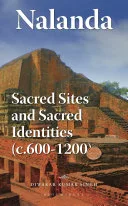
Sacred Sites and Sacred Identities
 73
73

Sacred Sites and Sacred Identities
Diwakar Kumar Singh’s "Sacred Sites and Sacred Identities" offers a compelling scholarly counter-narrative to the often-assumed monolithic decline of Buddhist institutions in India. The book's strength lies in its granular approach to Nalanda, meticulously reconstructing its significance through a synthesis of textual and archaeological evidence. Singh avoids broad generalizations, instead focusing on the specific historical contexts that elevated Nalanda to its mahavihara status. A particularly illuminating section details the architectural evolution of the monastery, correlating structural changes with shifts in philosophical emphasis. However, the dense academic prose, while precise, may present a barrier for readers less familiar with South Asian Buddhist historiography. The work's consistent focus on the "intellectual paraphernalia" is its defining characteristic, showcasing Nalanda as a vibrant, dynamic center of learning rather than a static relic. This book is an essential resource for specialists seeking a nuanced understanding of a pivotal Buddhist site.
📝 Description
73
Diwakar Kumar Singh's 2026 book examines Nalanda's historical trajectory and its role in shaping sacred identities.
Published in 2026, Diwakar Kumar Singh's "Sacred Sites and Sacred Identities" offers a detailed look at Nalanda's history. The book moves past simple stories to show the many reasons Nalanda became a famous center of learning, a mahavihara with great intellectual influence. Singh uses ancient texts and archaeological finds to put together the site's importance through different times.
The work questions the idea that Indian Buddhism uniformly declined. Instead, it points out the strong continuation of intellectual traditions at Nalanda. By looking at the "intellectual paraphernalia" the monastery was known for, Singh shows how its unique academic and spiritual nature continued. This close study contrasts with general historical views by focusing on the specific strength and changes within this important Buddhist center.
"Sacred Sites and Sacred Identities" argues that Nalanda was more than just a monastery; it was a place where sacred identities were formed and kept alive. The physical and intellectual environment of Nalanda guided the spiritual and scholarly lives of those there. The book discusses how the idea of sacredness itself was shaped within its walls and how this influence spread to wider religious and philosophical discussions.
This book fits within a tradition of scholarship that examines the historical development and lived experience of major spiritual centers. It looks at how physical locations and intellectual pursuits merge to create enduring traditions, a common theme in the study of esoteric lineages and their institutional forms. Singh's analysis of Nalanda's "intellectual paraphernalia" and its role in perpetuating sacred identities connects to broader discussions on the material and conceptual underpinnings of spiritual movements.
💡 Why Read This Book?
• Gain a detailed understanding of Nalanda's rise to mahavihara status, moving beyond simplistic historical narratives by examining specific textual and archaeological evidence presented in the book. • Discover how Nalanda fostered enduring intellectual traditions, challenging the notion of a uniform Buddhist decline through an analysis of its unique "intellectual paraphernalia." • Explore the tangible connection between the physical site of Nalanda and the formation of sacred identities, as illuminated by the book's focus on historical contexts and continuity.
⭐ Reader Reviews
Honest opinions from readers who have explored this book.
❓ Frequently Asked Questions
What historical period does "Sacred Sites and Sacred Identities" primarily cover regarding Nalanda?
The book examines Nalanda's historical trajectory across various periods, focusing on its rise to mahavihara status and the continuity of its intellectual traditions, challenging narratives of uniform decline.
What types of evidence does Diwakar Kumar Singh use to support his analysis of Nalanda?
Singh utilizes a comprehensive approach, drawing from both textual sources, such as ancient scriptures and historical accounts, and archaeological findings from the Nalanda site itself.
Does the book discuss the decline of Nalanda?
While acknowledging historical events, the book primarily focuses on Nalanda's significance and the continuity of its intellectual traditions, offering a nuanced perspective that counters generalized views of Buddhist decline.
What does the term 'mahavihara' mean in the context of the book?
Mahavihara refers to a large, significant monastery, often a center of learning and spiritual practice. The book explores Nalanda's attainment of this status and its implications.
Who is the intended audience for this book?
The book is suited for scholars, students of religious history, archaeology, and anyone interested in a detailed, evidence-based exploration of a major Buddhist monastic complex.
When was "Sacred Sites and Sacred Identities" first published?
The book was first published on October 30, 2026, making it a contemporary scholarly work on the subject.
🔮 Key Themes & Symbolism
Nalanda as a Mahavihara
This theme explores Nalanda's transformation into a "mega-monastery" (mahavihara), a process driven by its historical context and the development of its extensive intellectual and spiritual infrastructure. The work examines how this status was achieved and maintained, emphasizing the site's role as a preeminent center for Buddhist scholarship and practice. It moves beyond a simple description of size to analyze the functional and symbolic significance of Nalanda's mahavihara identity, detailing the "intellectual paraphernalia" that defined its academic prestige.
Continuity of Buddhist Thought
Contrary to narratives suggesting a widespread collapse of Buddhist learning, this theme highlights Nalanda's role in fostering remarkable continuity. Singh investigates how the "intellectual paraphernalia"—the specific methods, texts, and traditions—persisted and evolved within Nalanda's unique environment. This continuity is presented as a evidence of the resilience of Buddhist thought and practice, demonstrating how key philosophical and pedagogical lineages were sustained and transmitted through generations at the site.
Sacred Identity Formation
The book examines how the physical location and intellectual atmosphere of Nalanda contributed to the formation of distinct "sacred identities." This theme examines the interplay between the site itself and the individuals who studied and resided there, shaping their spiritual and scholarly paths. It explores how Nalanda served as a crucible for forging identities deeply intertwined with Buddhist principles, monastic discipline, and advanced philosophical inquiry, extending its influence beyond its immediate physical boundaries.
Textual and Archaeological Synthesis
This theme focuses on the methodology employed by Singh, which critically synthesizes diverse sources to reconstruct Nalanda's history. By integrating findings from archaeological excavations with interpretations of historical texts, the work provides a multi-layered understanding of the site's development and significance. This approach allows for a robust examination of Nalanda's historical contexts, revealing patterns of continuity and change that might be missed by relying on a single source type.
💬 Memorable Quotes
Direct passages from the work, attributed to the author.
“Nalanda attained its mahavihara status through a complex interplay of historical contexts and sustained intellectual development.”
— This statement captures the book's central argument: Nalanda's eminence was not accidental but a product of specific historical conditions and a continuous cultivation of its unique academic and spiritual traditions.
“The intellectual paraphernalia of Nalanda reveals a remarkable continuity, challenging notions of pan-Indian Buddhist decline.”
— This highlights Singh's counter-argument to prevailing historical interpretations. It emphasizes that Nalanda's specific scholarly output and methodologies demonstrate a vibrant, ongoing tradition, rather than a period of widespread decay.
“Archaeological evidence corroborates textual accounts in mapping Nalanda's historical significance.”
— This points to the book's methodology, underscoring the importance of integrating physical findings with written records to create a more complete and reliable historical picture of Nalanda.
“The continuity perceptible at Nalanda offers a distinct perspective on Buddhist history.”
— This suggests that by focusing on the sustained traditions within Nalanda, the book provides a specific, alternative viewpoint to broader historical trends concerning Buddhism in India.
💡 Key Ideas
Editorial paraphrase of the work's core concepts — not direct quotes.
Sacred sites actively shape the identities of those who engage with them.
This paraphrased concept emphasizes the reciprocal relationship between place and person central to the book's thesis, suggesting that Nalanda was not just a location but an active force in forming spiritual and intellectual identities.
🌙 Esoteric Significance
Tradition
While primarily a work of historical and religious scholarship, "Sacred Sites and Sacred Identities" touches upon themes relevant to esoteric traditions by examining the development of sacred spaces and their influence on identity. It aligns with esoteric interests in the power of place, the transmission of knowledge, and the cultivation of specific states of consciousness through structured environments. The book's focus on Nalanda, a center of advanced Buddhist philosophy and practice, speaks to esoteric lineages that emphasize rigorous intellectual discipline and profound meditative states as paths to spiritual realization.
Symbolism
The concept of the "mahavihara" itself functions as a potent symbol, representing not just a physical monastic complex but an organized matrix for spiritual and intellectual attainment. The "intellectual paraphernalia"—the specific texts, commentaries, and pedagogical methods—can be seen as symbolic tools for unlocking higher consciousness. Furthermore, the very idea of Nalanda as a "sacred site" imbues the location with symbolic power, representing a nexus where the earthly and the spiritual converge, facilitating transformation for those who engage with its legacy.
Modern Relevance
Contemporary practitioners and scholars interested in Buddhist philosophy, comparative religion, and the study of sacred geography find value in Singh's meticulous research. Modern Buddhist movements, particularly those emphasizing monastic education and philosophical depth, can draw parallels from Nalanda's historical model. Thinkers exploring the intersection of place, identity, and spiritual practice, as well as those researching the transmission of esoteric knowledge systems, may find Singh's detailed historical reconstruction particularly relevant for understanding the enduring impact of foundational sites.
👥 Who Should Read This Book
• Academic researchers in Buddhist studies, South Asian history, and religious archaeology will benefit from the book's detailed synthesis of textual and archaeological evidence regarding Nalanda. • Students of comparative religion seeking to understand the historical development and continuity of major religious institutions will find a nuanced case study in Nalanda's mahavihara status. • Individuals interested in the philosophy of place and its role in shaping spiritual and intellectual identities will appreciate the book's exploration of how Nalanda influenced its inhabitants.
📜 Historical Context
Published in 2026, Diwakar Kumar Singh's "Sacred Sites and Sacred Identities" emerges at a time when scholarship on ancient Indian Buddhism continues to evolve, often debating the extent and nature of decline in various regions. The work directly engages with interpretations that posit a uniform cessation of Buddhist intellectual activity, particularly following the Gupta period. Singh's focus on Nalanda as a site of remarkable continuity stands in contrast to scholarship emphasizing the resurgence of Hindu traditions or the impact of invasions on monastic centers. Key contemporaries whose work might implicitly or explicitly be addressed include historians examining the Pala Empire, under whose patronage Nalanda flourished, and archaeologists involved in the extensive excavations at the site, which began in earnest in the mid-20th century. The book's detailed analysis of Nalanda's "intellectual paraphernalia" offers a specific counterpoint to generalized narratives of decline, highlighting the persistent vibrancy of specific Buddhist lineages and scholarly practices.
📔 Journal Prompts
Nalanda's "intellectual paraphernalia" – what specific elements might have fostered its distinct identity?
Reflect on the concept of "sacred sites and sacred identities" as presented in the book's analysis of Nalanda.
The historical continuity of Buddhist thought at Nalanda: how does this challenge common assumptions?
Consider the integration of textual and archaeological sources for understanding Nalanda's mahavihara status.
How might the physical architecture of a monastic site, as explored in the book, influence spiritual development?
🗂️ Glossary
Mahavihara
A large and significant Buddhist monastery, often serving as a major center for learning, scholarship, and religious practice, as exemplified by Nalanda.
Intellectual Paraphernalia
Refers to the specific body of knowledge, texts, methods of inquiry, and pedagogical tools that characterized the intellectual life and scholarly output of an institution like Nalanda.
Sacred Sites
Locations imbued with religious or spiritual significance, believed to possess unique qualities that facilitate spiritual experiences, learning, or devotion.
Sacred Identities
Personal or group identities that are deeply shaped by religious beliefs, practices, and affiliation with sacred places or traditions.
Textual Sources
Written materials, such as scriptures, commentaries, historical chronicles, and personal accounts, used to reconstruct historical events and understand past beliefs.
Archaeological Evidence
Physical remains of past human activity, such as structures, artifacts, and ecofacts, uncovered through excavation and analysis, used to interpret history.
Pan-Indian Decline
A generalized historical interpretation suggesting a widespread and uniform reduction or cessation of Buddhist influence and practice across the Indian subcontinent.