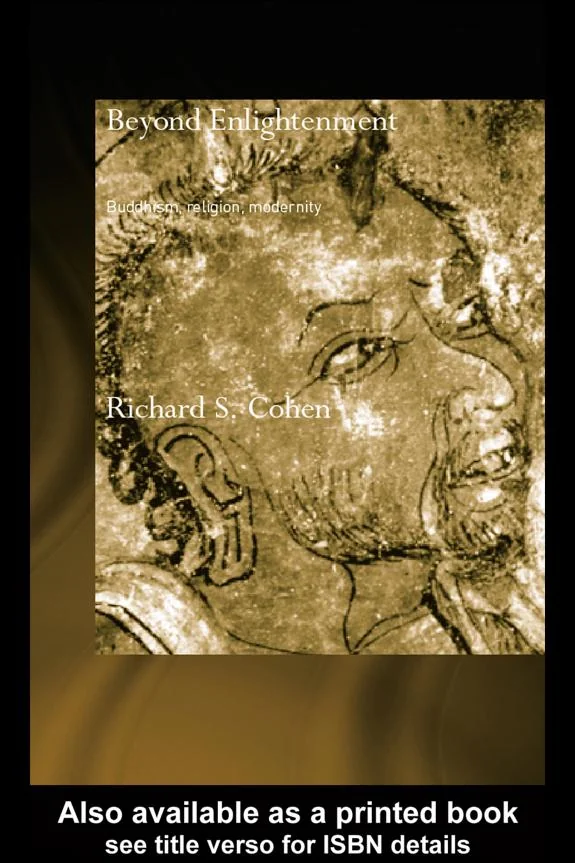
Beyond Enlightenment
 75
75

Beyond Enlightenment
Richard Cohen’s *Beyond Enlightenment* offers a bracingly analytical perspective on a concept often shrouded in mystique and platitude. Eschewing the typical hagiography, Cohen’s approach, particularly in Chapter 4, "The Anthropology of Enlightenment," is to treat the subject as a cultural artifact rather than a divine decree. He meticulously dissects the historical and social conditions that shape our understanding of this ultimate state, a welcome corrective to more effusive spiritual literature. The book’s strength lies in its intellectual rigor and its refusal to accept received wisdom at face value. However, its academic tone, while refreshing, might alienate readers seeking direct spiritual guidance or experiential accounts. The chapter titled "A Baroque Conclusion" feels somewhat abrupt, leaving the reader wanting a more substantive wrap-up after the preceding analytical groundwork. Ultimately, *Beyond Enlightenment* is a valuable, if dry, contribution for those who prefer their spiritual inquiry seasoned with critical thought.
📝 Description
75
Richard Cohen's 2006 book, Beyond Enlightenment, argues enlightenment is a socio-cultural construct.
Published in 2006, Richard Cohen's Beyond Enlightenment offers a structured analysis of the concept of enlightenment. Cohen divides his examination into six chapters, beginning with a "Benign Introduction" and concluding with "A Baroque Conclusion." He views enlightenment not as a singular, mystical state, but as a phenomenon with interwoven historical, anthropological, and theological dimensions. The book's primary goal is to demystify and place this abstract idea within a concrete context. It suits readers seeking a critical, analytical perspective on spiritual and philosophical ideas. Those who question conventional notions of enlightenment and prefer a grounded, academic viewpoint will find it valuable. Scholars in comparative religion, the anthropology of religion, and philosophy of mind will appreciate its methodical arguments. The work is for the intellectually curious who favor rigorous examination over uncritical acceptance.
Cohen's writing emerged during the mid-2000s, a time of increased public fascination with Eastern philosophies and spiritual practices, which were often commercialized. "Beyond Enlightenment" counters this trend by employing a more precise, anthropological perspective. It stands apart from the New Age movement's tendency toward an uncritical acceptance of concepts like enlightenment, advocating instead for historical and cultural specificity. The book dissects enlightenment through lenses such as socio-cultural construction, examining how diverse cultures conceptualize and pursue such states. It also investigates the links between theological systems and spiritual achievement, and it distinguishes between spiritual narratives and historical timelines.
This work engages with the broader discourse surrounding spiritual realization, particularly the concept of enlightenment that gained traction in Western popular culture from the late 20th century onward. While many popular accounts presented enlightenment as an immediate, transformative experience, Cohen's book situates it within historical and anthropological frameworks. It offers a counterpoint to less critical, often commercialized interpretations by demanding specificity and historical context. The book's approach aligns with academic traditions that scrutinize religious and spiritual phenomena through empirical and cultural lenses, rather than solely through devotional or experiential claims.
💡 Why Read This Book?
• Gain an anthropological perspective on spiritual goals, understanding how concepts like enlightenment are shaped by culture, as discussed in "The Anthropology of Enlightenment." • Explore the complex relationship between theological doctrines and spiritual attainment, a key inquiry in "What Do Gods Have to Do with Enlightenment?" • Appreciate a critical historical analysis of spiritual narratives, moving beyond simplistic notions through Cohen's examination of "A Tale of Two Histories."
⭐ Reader Reviews
Honest opinions from readers who have explored this book.
❓ Frequently Asked Questions
What is the primary argument of Richard Cohen's Beyond Enlightenment?
The book argues that enlightenment should be understood through anthropological and historical lenses, rather than as a singular, ineffable state. Cohen examines its cultural construction and the societal factors influencing its pursuit.
Who is the intended audience for Beyond Enlightenment?
The book is aimed at readers interested in a critical and analytical examination of spiritual concepts, including scholars of religion, anthropology, and philosophy, as well as intellectually curious individuals.
What distinguishes Beyond Enlightenment from typical spiritual texts?
Unlike many spiritual books, Cohen's work avoids platitudes and focuses on rigorous analysis. It contextualizes enlightenment historically and anthropologically, treating it as a subject for critical study rather than pure devotion.
Does Beyond Enlightenment offer practical advice for achieving enlightenment?
No, the book's focus is primarily analytical and theoretical. It seeks to deconstruct and understand the concept of enlightenment rather than provide direct instructions for its attainment.
When was Beyond Enlightenment first published?
Richard Cohen's book, Beyond Enlightenment, was first published on August 21, 2006.
What specific historical or anthropological concepts does the book engage with?
The book delves into the anthropology of enlightenment, exploring how it's defined across cultures, and examines the intersection of theology and spiritual attainment, particularly in Chapter 5.
🔮 Key Themes & Symbolism
Enlightenment as Cultural Construct
Cohen challenges the notion of enlightenment as a universal, monolithic experience. Instead, he posits it as a concept deeply embedded within specific cultural and historical frameworks. Chapter 4, "The Anthropology of Enlightenment," is central to this theme, suggesting that what constitutes 'enlightenment' varies significantly across different societies and belief systems. This perspective invites readers to question common assumptions and consider the social forces that shape spiritual aspirations.
Theology and Spiritual Goals
Chapter 5, "What Do Gods Have to Do with Enlightenment?" directly confronts the often-complex relationship between divine concepts and the pursuit of enlightenment. Cohen probes how theological doctrines influence understandings of spiritual attainment, questioning whether a belief in deities is necessary or even compatible with achieving an enlightened state. This section encourages a critical examination of the role of faith and cosmology in spiritual journeys.
Historical Narrative vs. Spiritual Quest
The book's exploration of "A Tale of Two Histories" suggests a divergence between linear, empirical historical accounts and the narratives of spiritual progress or attainment. Cohen likely examines how spiritual traditions construct their own histories, often distinct from conventional historical scholarship. This theme prompts reflection on how we reconcile subjective spiritual experiences with objective historical understanding.
Explaining the Ineffable
Cohen's overarching project is to bring a rational, analytical approach to a subject often characterized by ineffability and mysticism. By providing a "Benign Introduction" and structuring his arguments logically, he aims to explain enlightenment, making it accessible for critical inquiry. This theme underscores the book's role in bridging esoteric concepts with academic discourse.
💬 Memorable Quotes
Direct passages from the work, attributed to the author.
“Exploring the intersection of divine concepts and spiritual attainment.”
— This captures the essence of Chapter 5, suggesting Cohen investigates how beliefs about gods or the divine influence what individuals consider to be enlightenment.
“Reconciling spiritual narratives with empirical historical timelines.”
— This interpretation reflects the likely exploration within "A Tale of Two Histories," focusing on the potential discrepancies between traditional spiritual accounts and conventional historical records.
“Moving beyond simplistic notions of spiritual realization.”
— This reflects the book's critical stance, implying that Cohen seeks to offer a more nuanced and complex understanding of enlightenment than commonly presented.
💡 Key Ideas
Editorial paraphrase of the work's core concepts — not direct quotes.
The anthropology of enlightenment necessitates examining its varied cultural expressions.
This paraphrased concept highlights Cohen's central argument that enlightenment is not a single, universal state but is understood and pursued differently across diverse cultures and societies.
A structured, analytical approach to spiritual phenomena.
This summarizes the book's overall methodology, emphasizing Cohen's commitment to dissecting complex spiritual ideas with critical thinking rather than accepting them uncritically.
🌙 Esoteric Significance
Tradition
While not strictly belonging to a single esoteric lineage like Hermeticism or Gnosticism, *Beyond Enlightenment* engages with the *phenomenon* of esoteric pursuits. It treats 'enlightenment'—a term central to many Eastern traditions but also co-opted by Western esotericism—as a subject for critical analysis. Cohen's work departs from tradition by employing secular, academic methodologies (anthropology, history) to dissect concepts often held as sacred truths, thereby acting as a bridge between esoteric discourse and critical scholarship.
Symbolism
The book's primary 'symbol' is the very concept of enlightenment, which Cohen deconstructs. By examining its anthropological and historical variability, he reframes it from a singular, luminous goal into a complex cultural construct. This analytical approach acts as a form of demystification, stripping away layers of assumed universality to reveal the specific contexts that give the concept meaning, challenging its often-reified status in esoteric circles.
Modern Relevance
Contemporary thinkers exploring the sociology of spirituality, the commodification of religion, and critical studies of consciousness might find Cohen's work relevant. It provides a framework for analyzing the cultural narratives surrounding spiritual attainment in the 21st century, particularly in contexts influenced by globalization and the internet. His anthropological lens is useful for understanding how diverse spiritual ideas are adopted, adapted, and sometimes distorted in modern practice.
👥 Who Should Read This Book
• Students of comparative religion and anthropology seeking to understand spiritual concepts as cultural artifacts. • Skeptics and critical thinkers interested in deconstructing popular notions of enlightenment beyond New Age interpretations. • Academics and researchers examining the history of ideas and the social construction of spiritual goals.
📜 Historical Context
Richard Cohen's *Beyond Enlightenment* was published in 2006, a period when Western engagement with Eastern spirituality had become widespread, often through the lens of the New Age movement and self-help literature. This context saw a surge in popular interest in concepts like enlightenment, mindfulness, and karma, frequently stripped of their original cultural and philosophical moorings. Cohen's work positioned itself against this trend, offering a counter-narrative grounded in academic rigor. Unlike the prevalent spiritual eclecticism of figures like Deepak Chopra, Cohen's approach leaned towards critical analysis, drawing from anthropology and history. The book emerged during a time when scholars like Talal Asad were questioning universalist assumptions in religious studies, and Cohen's anthropological focus on enlightenment as a culturally-bound concept aligns with such critical currents. Its reception was likely within academic and intellectual circles interested in a more sober examination of spiritual claims.
📔 Journal Prompts
Analyze the concept of "The Anthropology of Enlightenment" within your own cultural context.
Consider the role of "Gods" in your personal understanding of spiritual attainment.
Reflect on the distinction between historical narratives and personal spiritual journeys.
Examine the "Benign Introduction" and "Baroque Conclusion" as framing devices for complex ideas.
Map the influences shaping your view of "Enlightenment" beyond the text itself.
🗂️ Glossary
Benign Introduction
The initial chapter of Cohen's book, designed to ease the reader into the subject matter with a gentle and non-confrontational approach before studying more complex analyses.
Place of Exceptional Universal Value
A concept likely explored in Chapter 2, possibly referring to a location, idea, or state that holds significant importance on a global or fundamental level within spiritual or philosophical discourse.
A Tale of Two Histories
Referred to in Chapter 3, this suggests an examination of contrasting historical perspectives, possibly juxtaposing conventional historical accounts with the narratives found within spiritual or esoteric traditions.
Anthropology of Enlightenment
The focus of Chapter 4, this involves studying enlightenment as a socio-cultural phenomenon, analyzing how different societies define, pursue, and experience it.
Gods and Enlightenment
Chapter 5 investigates the relationship between theological beliefs (concepts of gods or the divine) and the pursuit or attainment of enlightenment.
Baroque Conclusion
The final chapter, suggesting a complex, ornate, or perhaps even somewhat elaborate summary or wrap-up of the book's arguments, contrasting with a simple or minimalist ending.
Esoteric
Relating to or denoting knowledge or practice accessible only to a select group of initiated people; often associated with mysticism, occultism, and hidden meanings.
This book appears in 1 collection
🔮 Readers Also Liked
Browse all →








From the “Enlightenment” Collection
View all →








More Free Esoteric History & Biography Books
View all →