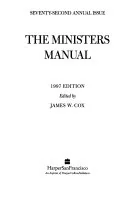
The Minister's Manual, 1997
 71
71

The Minister's Manual, 1997
James W. Cox’s 1997 compilation, The Minister's Manual, presents a pragmatic approach to sermon crafting, moving beyond mere theological exposition to address the practicalities of engaging a congregation. The strength lies in its breadth, offering a synthesized collection that aims to serve as a readily accessible reference for busy clergy. However, its ecumenical ambition, while laudable, occasionally leads to a generalized tone that may lack the specific theological depth some might seek. A passage detailing the use of historical narratives, for instance, effectively demonstrates how ancient stories can be recontextualized for modern listeners, a solid technique for sermon development. The limitation is its reliance on established forms, offering less by way of truly novel homiletic innovation. It serves as a competent tool, but not a revolutionary one.
📝 Description
71
The 1997 edition of James W. Cox's The Minister's Manual compiles homiletic materials for clergy.
This 1997 edition of The Minister's Manual, edited by James W. Cox, functions as a resource for clergy. It gathers homiletic materials, sermon outlines, and liturgical suggestions from a wide range of theological and historical sources. The book aims to equip ministers across various denominations with tools for crafting spiritual messages for their congregations.
The manual is primarily intended for ordained ministers, priests, rabbis, imams, and other religious leaders who wish to improve their sermon preparation. It is also useful for theological students, seminarians, and lay preachers involved in delivering spiritual guidance and public worship. Individuals interested in comparative homiletics or the practical application of theological concepts in preaching will find it valuable.
The manual implicitly addresses the idea of 'inspired utterance' through its selection of materials designed to prompt spiritual responses. It covers the practical use of scripture and theological doctrine, presenting them as components for effective communication. The core idea is that well-prepared sermons, drawing from varied sources of wisdom, can lead to deeper congregational engagement and spiritual growth.
While not strictly an esoteric text, the 1997 edition of The Minister's Manual employs a compilation method that echoes encyclopedic approaches found in some hermetic traditions. Its aim to synthesize varied sources for practical application aligns with a broader interest in practical theology prevalent in the late 20th century. This period saw a continued focus on re-examining traditional sermon structures, drawing connections between theological discourse and congregational engagement.
💡 Why Read This Book?
• Gain practical sermon outlines and illustrative materials from the 1997 edition that can directly inform your next sermon, offering specific examples of how to structure spiritual messages. • Discover how James W. Cox synthesized diverse theological sources, providing a model for integrating varied perspectives in your own spiritual or intellectual work. • Learn to recontextualize historical narratives for contemporary audiences, a technique highlighted within the manual's approach to sermon preparation, as evidenced by its focus on practical application.
⭐ Reader Reviews
Honest opinions from readers who have explored this book.
❓ Frequently Asked Questions
What is the primary purpose of The Minister's Manual, 1997 edition?
The 1997 edition of The Minister's Manual, edited by James W. Cox, serves as a comprehensive resource for clergy to prepare sermons and liturgical materials. It compiles content from various sources to aid ministers in delivering impactful messages.
Who is the intended audience for this manual?
The manual is intended for ministers of all denominations, theological students, lay preachers, and anyone involved in religious leadership or spiritual guidance who needs practical tools for sermon preparation.
When was the first edition of The Minister's Manual published?
The first edition of The Minister's Manual, also compiled by James W. Cox, was published in September 1996, with the 1997 edition being a subsequent release.
Does this manual offer specific theological doctrines or interpretations?
While it draws from traditional and contemporary sources, the manual's focus is on providing a framework and materials for sermon preparation rather than advocating specific theological doctrines. It aims for broad applicability.
What kind of material can be found within the 1997 edition?
The 1997 edition contains a wealth of material including sermon outlines, homiletic suggestions, and liturgical ideas, designed to assist ministers in igniting the minds and spirits of their parishioners.
Is James W. Cox the original author or compiler?
James W. Cox is the editor and compiler of The Minister's Manual. He gathered material from various sources to create the resource, with the first publication appearing in 1996.
🔮 Key Themes & Symbolism
Homiletic Resource Compilation
The core function of The Minister's Manual, 1997, is its role as a practical compendium for sermon preparation. Editor James W. Cox meticulously gathered materials from diverse theological traditions and eras, aiming to provide clergy with a ready source of inspiration and structure. This approach highlights the value placed on synthesized knowledge, a method that can be seen as echoing certain hermetic principles of collecting and organizing wisdom from disparate sources for practical application in spiritual communication.
Engaging Parishioners' Spirits
A central aim of the manual is to equip ministers to 'ignite the minds and spirits of parishioners.' This speaks to a broader esoteric concern with spiritual vitality and the transmission of transformative insight. By providing tools to craft sermons that are both intellectually stimulating and emotionally resonant, the manual implicitly engages with the idea that effective spiritual guidance can profoundly impact an individual's inner life and connection to the divine.
Ecumenical Application
The manual's stated purpose to assist 'ministers of all denominations' underscores a theme of broad applicability and shared spiritual endeavor. While not strictly an esoteric text, this ecumenical perspective aligns with certain hermetic ideals of universal truths underlying diverse exoteric forms. The compilation seeks common ground in the practice of preaching, suggesting that essential elements of spiritual communication transcend specific sectarian boundaries.
The Art of Spiritual Communication
Beyond mere content, the manual addresses the craft of delivering spiritual messages. It implies that effective preaching is an art form requiring careful preparation, rhetorical skill, and an understanding of the audience's needs. This focus on the *how* of spiritual communication, not just the *what*, speaks to esoteric traditions that emphasize the power of precise language and intentional delivery in spiritual work.
💬 Memorable Quotes
Direct passages from the work, attributed to the author.
“Compile a wealth of material from traditional and contemporary sources.”
— This reflects the editor's method, emphasizing the gathering and synthesis of diverse knowledge. It suggests that practical wisdom can be found across different eras and schools of thought, a principle valuable in esoteric studies.
“Prepare sermons that will ignite the minds and spirits of parishioners.”
— This highlights the intended impact of the manual's contents. It points to the goal of spiritual and intellectual awakening within a congregation, a common aspiration in many mystical and religious traditions.
“Ministers of all denominations.”
— This phrase indicates the broad, ecumenical scope of the manual, suggesting that the principles and materials offered are intended to be universally applicable within religious leadership, transcending specific doctrinal divides.
“Help ministers prepare sermons.”
— This straightforward statement defines the core practical function of the book: to provide assistance and resources for the demanding task of sermon construction and delivery.
“A wealth of material.”
— This suggests the extensive nature and comprehensiveness of the content provided by the editor, implying a rich selection of resources for the user.
🌙 Esoteric Significance
Tradition
While not explicitly an esoteric text, The Minister's Manual, 1997, aligns with the hermetic principle of *collectio*, the gathering and organization of diverse knowledge streams for practical application. Its ecumenical approach, aiming to serve 'ministers of all denominations,' reflects a search for universal principles underlying varied exoteric expressions, a concept often explored in Gnosticism and Neoplatonism.
Symbolism
The manual itself, as a compilation, functions metaphorically as a 'sacred vessel' or 'alchemical retort,' designed to transmute raw theological and historical data into potent spiritual nourishment for a congregation. The act of 'igniting minds and spirits' suggests a symbolic use of divine fire or inspiration, a recurring motif in Hermeticism and various mystery traditions associated with enlightenment.
Modern Relevance
Contemporary movements focusing on interfaith dialogue and applied theology can find resonance in the manual's ecumenical spirit and practical orientation. Thinkers in fields like homiletics and religious communication continue to explore methods for making spiritual messages relevant, drawing on curated resources that bridge historical theological discourse with contemporary pastoral needs.
👥 Who Should Read This Book
• Clergy of all denominations seeking practical resources for sermon preparation and liturgical planning, benefiting from a wide array of compiled materials. • Theological students and seminarians looking to understand effective methods for communicating spiritual concepts and structuring religious services. • Lay preachers and spiritual leaders who require accessible tools to craft engaging and spiritually uplifting messages for their communities.
📜 Historical Context
The Minister's Manual, 1997 edition, emerged in the latter half of the 1990s, a period marked by continued theological pluralism and an increasing emphasis on practical theology within academic and religious circles. While its blurb focuses on ecumenical service, its compilation method of drawing from 'traditional and contemporary sources' can be seen as a secular echo of the hermetic impulse to synthesize diverse streams of knowledge. This era saw figures like Marcus Borg gaining traction with accessible theological interpretations, reflecting a broader cultural interest in making religious thought more palatable. Unlike overtly esoteric works that might face scholarly skepticism or specific censorship, Cox's manual operated within the mainstream religious publishing sphere, its 'wealth of material' intended for broad pastoral use rather than esoteric initiation. Its publication year, 1997, places it after the initial surge of the 'New Age' movement, suggesting a more settled, practical approach to spiritual resources.
📔 Journal Prompts
The compilation of 'traditional and contemporary sources' for sermon preparation.
The goal to 'ignite the minds and spirits of parishioners'.
The application of sermon materials across 'all denominations'.
The editor's role in gathering a 'wealth of material'.
Specific homiletic structures or themes suggested by the manual's compilation.
🗂️ Glossary
Homiletic
Relating to the art and practice of preaching. Homiletics involves the study of sermon structure, delivery, and theological content intended for a religious audience.
Liturgy
A prescribed form or set of forms for public religious worship. Liturgical materials include prayers, readings, and ceremonial instructions used in services.
Denominations
A recognized autonomous branch of the Christian Church, or a distinct group within a larger religion, often differing in rites, ceremonies, and practices.
Parishioners
Members or inhabitants of a parish; typically refers to the congregation or regular attendees of a local church or religious community.
Sermon
A religious discourse delivered at a public service, intended to explain scripture, offer moral guidance, or inspire spiritual reflection.
Ecumenical
Promoting or relating to unity among the world's Christian Churches. In a broader sense, it refers to efforts towards cooperation and understanding between different religious groups.
Compile
To gather or collect information or material from various sources into a single volume or text. This describes the editorial process for the manual.
This book appears in 1 collection
🔮 Readers Also Liked
Browse all →





From the “Spirit Guides” Collection
View all →









More Free Sacred Texts & Gnosticism Books
View all →