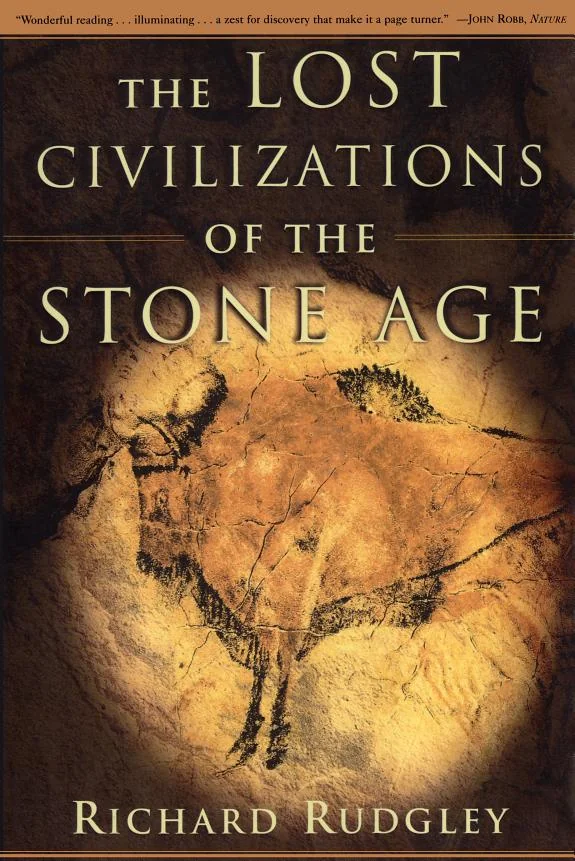
The Lost Civilizations of the Stone Age
 80
80

The Lost Civilizations of the Stone Age
Richard Rudgley's "The Lost Civilizations of the Stone Age" presents a compelling case for a re-examination of the Neolithic period, moving beyond the simplistic narrative of primitive survival. Rudgley effectively highlights instances where archaeological findings, such as evidence of advanced astronomical alignments at megalithic sites, seem to contradict the assumed cognitive limitations of Stone Age peoples. His detailed examination of specific artifacts and structures serves as a strength, prompting the reader to question established interpretations. However, the work occasionally ventures into speculative territory without always providing sufficient counter-arguments to established scientific explanations, which may alienate more conservative readers. A particular point of contention for some might be his interpretation of early cave paintings, suggesting a level of abstract thought that pushes the boundaries of current consensus. Despite this, the book succeeds in its primary aim: to stimulate critical thought about our ancient past and the potential for forgotten human achievements.
📝 Description
80
Richard Rudgley's 2000 book challenges the standard timeline of human development.
Published in 2000, "The Lost Civilizations of the Stone Age" by Richard Rudgley questions widely accepted views on prehistoric human capabilities. Rudgley argues that the Neolithic period, often seen as a time of basic survival, actually involved sophisticated understanding and skills. He examines archaeological evidence to suggest early humans were more advanced than conventional scholarship admits.
The book invites readers to reconsider the narrative of human progress, proposing that Stone Age societies possessed complex cognitive and cultural frameworks. Rudgley scrutinizes established theories, presenting a case for a higher degree of ingenuity and societal organization in these early periods. This work is for those interested in alternative perspectives on human history and the potential for overlooked knowledge in prehistory.
Within occult philosophy, this book engages with traditions that propose advanced ancient civilizations predating accepted historical accounts. It aligns with a lineage of thought that suggests humanity's past holds forgotten knowledge and capabilities, often challenging mainstream scientific and historical consensus. Rudgley's work contributes to discussions on lost epochs and the potential for a more complex understanding of early human societies than current paradigms allow.
💡 Why Read This Book?
• Gain an alternative perspective on the Neolithic Age, challenging the assumption of primitive human intellect by examining Rudgley's analysis of megalithic sites and their astronomical alignments. • Understand how conventional archaeological interpretations of Stone Age artifacts might overlook evidence of advanced cognitive and technological capabilities, as discussed in the book's exploration of tool-making. • Re-evaluate the linear progression of human development by considering Rudgley's arguments regarding potentially complex social and spiritual systems that existed prior to recorded history.
⭐ Reader Reviews
Honest opinions from readers who have explored this book.
❓ Frequently Asked Questions
What specific period of the Stone Age does Richard Rudgley focus on?
Richard Rudgley primarily focuses on the Neolithic Age, a period characterized by the development of agriculture and settled communities, though his arguments often touch upon earlier Stone Age periods to establish a broader context of human advancement.
What evidence does Rudgley present for advanced Stone Age civilizations?
Rudgley presents evidence from megalithic structures, astronomical alignments, sophisticated tool-making techniques, and interpretations of early art and symbolic systems to argue for greater cognitive and cultural sophistication than commonly accepted.
How does 'The Lost Civilizations of the Stone Age' differ from mainstream archaeology?
It challenges the mainstream view by suggesting Stone Age humans were more advanced intellectually and culturally than conventionally believed, reinterpreting evidence that often supports a simpler narrative of gradual development.
Who was Richard Rudgley?
Richard Rudgley was an author and researcher known for his work in alternative archaeology and history, focusing on challenging established timelines and interpretations of early human civilizations.
What are some of the implications of Rudgley's theories on human history?
Rudgley's theories imply a significant gap in our understanding of human potential and history, suggesting that advanced knowledge and societal structures may have existed and been lost much earlier than current paradigms allow.
Does the book include visual aids?
Yes, the original publication of 'The Lost Civilizations of the Stone Age' includes figures and photographs to illustrate the evidence and arguments presented by the author.
🔮 Key Themes & Symbolism
Re-evaluating Neolithic Intelligence
The core of Rudgley's work lies in its re-evaluation of the cognitive capacities attributed to humans during the Neolithic period. Rather than portraying them as solely focused on survival and basic agriculture, he posits evidence for complex abstract thought, advanced astronomical observation, and sophisticated understanding of natural phenomena. This challenges the established archaeological narrative of a slow, linear progression of human intellect, suggesting that significant intellectual and cultural achievements may have been present much earlier than commonly assumed.
Megalithic Structures and Cosmic Knowledge
Rudgley examines various megalithic sites, such as Stonehenge and others globally, not merely as primitive constructions but as sophisticated observatories or ritual centers. He argues that the precise astronomical alignments present in these structures indicate a deep understanding of celestial cycles, calendars, and potentially more complex cosmological models. This interpretation suggests that Stone Age societies possessed a knowledge base that allowed them to map and understand the cosmos with remarkable accuracy.
Overlooked Archaeological Evidence
A recurring theme is the idea that mainstream archaeology has historically overlooked or misinterpreted evidence that points to greater sophistication in Stone Age cultures. Rudgley suggests that artifacts, cave art, and construction methods have been categorized through a modern lens that limits our appreciation of their original context and meaning. He calls for a broader interpretation of findings, acknowledging the possibility of lost technologies and advanced societal organization.
Challenging Conventional Timelines
The book fundamentally challenges the accepted chronological progression of human civilization. By presenting evidence that suggests advanced capabilities existed during the Stone Age, Rudgley questions the neat divisions of prehistory into distinct periods defined solely by technological simplicity. This re-framing encourages readers to consider that human history might be far more complex and contain periods of advanced knowledge that have since been forgotten or suppressed.
💬 Memorable Quotes
Direct passages from the work, attributed to the author.
“The Stone Age human was more advanced than science originally thought.”
— This central thesis suggests that conventional scientific understanding underestimates the intellectual and cultural achievements of early humans, particularly during the Neolithic period. Rudgley implies a hidden history of sophisticated capabilities.
“Evidence of advanced astronomical observation in megalithic sites.”
— This highlights Rudgley's focus on structures like Stonehenge, interpreting their precise alignments not as coincidental but as deliberate markers of sophisticated knowledge of celestial mechanics and calendrical systems.
“Tool-making techniques imply greater material science understanding.”
— Rudgley suggests that the complexity and precision of some Stone Age tools point towards a deeper knowledge of materials and manufacturing processes than typically attributed to the era, hinting at lost technologies.
“Early art reveals complex abstract thought.”
— This points to Rudgley's interpretation of cave paintings and other early artistic expressions as evidence of sophisticated symbolic language and abstract reasoning, challenging views of early humans as solely focused on practical matters.
“Accepted narratives of human development need re-examination.”
— This reflects Rudgley's critical stance towards established archaeological dogma, urging a reconsideration of how human progress is understood and emphasizing the potential for overlooked evidence of early sophistication.
🌙 Esoteric Significance
Tradition
While not explicitly tied to a single esoteric lineage like Hermeticism or Gnosticism, Rudgley's work appeals to traditions that posit ancient, advanced civilizations predating current historical records. It aligns with a broader esoteric interest in lost knowledge, hidden histories, and the cyclical nature of civilization, suggesting that humanity's past may hold keys to understanding its present and future potential, often implying a spiritual or cognitive evolution distinct from purely material progress.
Symbolism
Rudgley’s work implicitly engages with the symbolism inherent in megalithic structures and early art. The precise astronomical alignments found at sites like Stonehenge can be seen as symbolic representations of cosmic order and humanity's connection to the celestial realm. Early cave paintings, often interpreted esoterically as shamanic journeys or symbolic maps of consciousness, are viewed by Rudgley as evidence of complex symbolic language and abstract thought, reflecting a deeper engagement with universal archetypes and spiritual concepts.
Modern Relevance
Contemporary thinkers and practitioners interested in archaeoastronomy, alternative archaeology, and theories of consciousness often draw upon the foundational questions raised by Rudgley's work. His emphasis on re-examining evidence and considering the cognitive sophistication of ancient peoples encourages new interpretations of historical sites and artifacts. This approach influences modern research into ancient technologies and the potential for pre-historic knowledge systems that could inform contemporary understandings of sustainability, cosmology, and human potential.
👥 Who Should Read This Book
• Students of alternative history and archaeology seeking to question established timelines and explore unconventional interpretations of human development. • Readers interested in the Neolithic period and megalithic structures who wish to understand arguments for greater ancient sophistication beyond current academic consensus. • Individuals fascinated by the concept of lost civilizations and ancient knowledge who are looking for a detailed examination of evidence that challenges conventional historical narratives.
📜 Historical Context
Richard Rudgley's "The Lost Civilizations of the Stone Age," published in 2000, emerged during a period of burgeoning interest in alternative historical narratives and challenges to established archaeological paradigms. While mainstream archaeology continued to refine its understanding of the Neolithic Revolution, focusing on gradual developments in agriculture and societal structures, Rudgley’s work tapped into a popular fascination with ancient mysteries and potentially lost civilizations. Key contemporaries in this broader discourse included authors exploring pre-Diluvian myths and ancient astronaut theories, though Rudgley aimed for a more evidence-based, if unconventional, approach. The book's reception within academic circles was likely met with skepticism, as it directly questioned foundational assumptions about human cognitive evolution. Unlike more sensationalist accounts, Rudgley's work attempted to ground its claims in the interpretation of archaeological findings, seeking to provoke a re-evaluation of existing evidence rather than solely relying on speculation. The intellectual currents of the late 20th century, which saw both increasing specialization in academia and a growing public appetite for grand historical revisions, provided the backdrop for such a book.
📔 Journal Prompts
The interpretation of megalithic structures as advanced astronomical tools.
The evidence for complex abstract thought in Neolithic art.
The concept of overlooked archaeological findings regarding Stone Age capabilities.
Rudgley's challenge to the linear progression of human cognitive development.
The potential for lost technologies hinted at by Stone Age tool-making.
🗂️ Glossary
Neolithic Age
The later part of the Stone Age, when ground or polished stone weapons and implements prevailed, and in which agriculture, village life, and domestication of animals were common.
Megalithic Structures
Large structures, such as dolmens or menhirs, built using massive stones, typically dating from the Neolithic period and Bronze Age, often associated with astronomical observation or ritualistic purposes.
Archaeological Dogma
Established beliefs, theories, or interpretations within the field of archaeology that are widely accepted and may resist contradictory evidence or alternative viewpoints.
Cognitive Sophistication
The level of complexity, abstract reasoning, and advanced mental capabilities attributed to early humans, often debated in terms of their development during prehistoric periods.
Astronomical Alignments
The precise orientation of ancient structures or monuments with respect to celestial bodies, such as the sun, moon, or stars, indicating an understanding of astronomical cycles.
Linear Progression
A model of development that assumes a steady, step-by-step advancement over time, often applied to human history and the evolution of societies and intelligence.
Material Science
The study of the properties of matter and their applications. In the context of the Stone Age, it refers to the understanding and manipulation of stone, bone, and other natural materials.
This book appears in 1 collection
🔮 Readers Also Liked
Browse all →







From the “Lost Civilizations” Collection
View all →






More Free Esoteric History & Biography Books
View all →