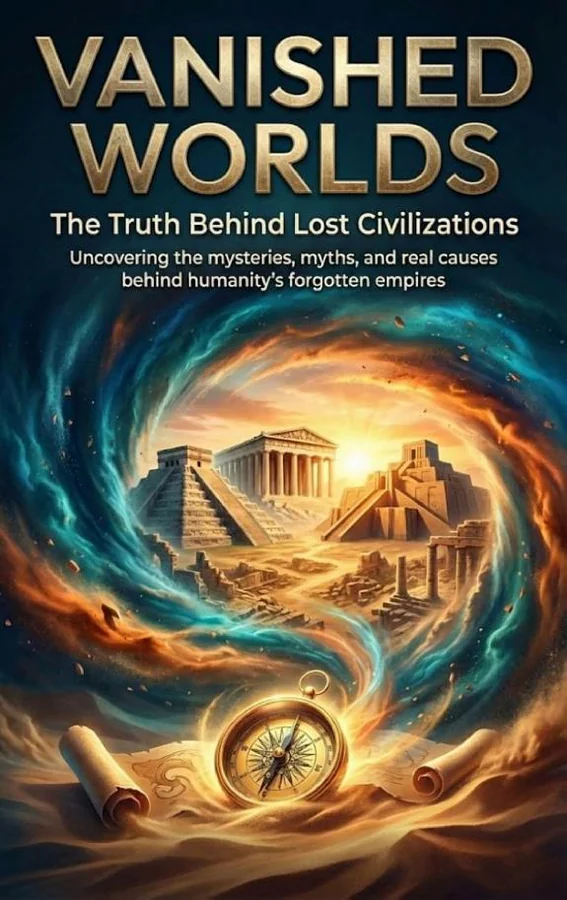
Vanished Worlds: The Truth Behind Lost Civilizations
 73
73

Vanished Worlds: The Truth Behind Lost Civilizations
Adrian Carmichael's "Vanished Worlds" approaches the perennial fascination with lost civilizations not as a mere catalogue of mysteries, but as an analytical challenge. He rightly points out the limitations of focusing solely on external factors like climate change or warfare when examining the fall of societies such as the Indus Valley civilization or the Maya. Carmichael's strength lies in his willingness to integrate archaeological data with more speculative, yet logically presented, theories concerning societal self-destruction and the transmission of knowledge. A particular point of interest is his discussion of the Ancestral Puebloans' abandonment of sites like Chaco Canyon, where he questions whether purely environmental pressures fully account for the scale of the exodus. However, the book occasionally falters by presenting certain fringe theories with an air of definitive proof rather than as hypotheses requiring further evidence. The exploration of "civilizational entropy" is compelling but could benefit from more rigorous quantitative analysis. Despite this, "Vanished Worlds" offers a valuable counterpoint to conventional historical narratives, prompting readers to reconsider the inherent fragilities of complex human systems.
📝 Description
73
Adrian Carmichael's 2025 book asks why advanced ancient societies vanished.
Vanished Worlds examines the disappearance of advanced ancient societies, moving beyond standard explanations of invasion or environmental disaster. Carmichael analyzes civilizations like the Indus Valley, the Maya city-states, and the Ancestral Puebloans, scrutinizing factors such as internal societal issues, resource use, and less conventional causes. The book is for readers of history, archaeology, and esoteric studies who find mainstream theories on civilizational collapse insufficient.
It situates its research within ancient history and archaeology, referencing the Bronze Age collapse, Maya decline around 900 CE, and the abandonment of Chaco Canyon. Carmichael considers established archaeological data alongside theories often outside mainstream academic discussion. He engages with ideas that challenge conventional scholars like Eric H. Cline and Michael Coe. The work appeared in 2025, a time of growing interest in alternative historical views.
This book joins a tradition of inquiry into lost civilizations and hidden histories. It addresses a desire to understand societal collapses through frameworks that consider cycles of civilization and potential forgotten knowledge. Carmichael engages with theories that question established historical timelines and offer alternative interpretations of human development, situating them within a lineage of thought that looks beyond purely materialist explanations for the rise and fall of complex societies.
💡 Why Read This Book?
• Gain a deeper understanding of "civilizational entropy" as a framework for analyzing societal collapse, moving beyond simplistic cause-and-effect models applied to the Indus Valley civilization. • Explore the concept of "cultural amnesia" and its implications for how we interpret historical evidence, particularly concerning the Maya's eventual decline around 900 CE. • Re-evaluate the factors contributing to the abandonment of major settlements by the Ancestral Puebloans, considering Carmichael's integration of archaeological findings with less conventional theories.
⭐ Reader Reviews
Honest opinions from readers who have explored this book.
❓ Frequently Asked Questions
What specific archaeological sites are discussed in Vanished Worlds?
The book examines numerous sites, including those associated with the Indus Valley civilization (like Mohenjo-daro), the Maya city-states (such as Tikal), and the Ancestral Puebloans (including Chaco Canyon and Mesa Verde).
Does Adrian Carmichael propose a single reason for civilizational collapse?
No, Carmichael argues against single-cause explanations. He suggests that collapses result from a complex interplay of environmental, social, political, and potentially unknown factors, as explored in his "civilizational entropy" concept.
What is the 'cultural amnesia' concept in the book?
Cultural amnesia, as presented in Vanished Worlds, refers to the loss of critical knowledge or historical understanding by subsequent generations, leading to a distorted or incomplete memory of past events and societal dynamics.
How does Vanished Worlds differ from standard historical accounts of lost civilizations?
It integrates mainstream archaeological discoveries with more speculative, esoteric, and philosophical interpretations of societal rise and fall, challenging purely materialistic explanations for the disappearance of ancient cultures.
Are there any specific dates or time periods focused on in Vanished Worlds?
While covering a broad scope, the book frequently references periods such as the decline of the Maya around 900 CE and the peak of the Ancestral Puebloan culture in North America.
What esoteric angle does Vanished Worlds bring to the study of lost civilizations?
The book explores potential underlying archetypal patterns and universal laws governing societal cycles, hinting at deeper metaphysical reasons for collapse beyond materialist explanations, aligning with esoteric inquiry into cyclical history.
🔮 Key Themes & Symbolism
Cyclical Patterns of Civilizations
The work posits that human history is not linear but cyclical, marked by recurring patterns of societal ascent and decline. Carmichael examines how civilizations like the Maya around 900 CE and the Indus Valley people may have succumbed to predictable pressures. This theme appeals to esoteric traditions that view history through cycles of ages, suggesting that understanding these patterns offers a form of wisdom, allowing for foresight or at least a deeper comprehension of the forces at play. The "echo phenomena" concept suggests these cycles are not random but follow an underlying, perhaps metaphysical, order.
The Limits of Materialist Explanations
Carmichael challenges the purely scientific or archaeological approach to understanding societal collapse, arguing that it often overlooks deeper psychological, spiritual, or even energetic factors. He suggests that explanations focusing solely on environmental degradation or warfare are incomplete, particularly when considering the abruptness of some disappearances. This aligns with esoteric thought, which often seeks underlying spiritual or energetic causes for physical phenomena. The "cultural amnesia" concept implies that the true causes may have been deliberately or accidentally obscured, pointing to a reality beyond observable data.
Lost Knowledge and Hidden Histories
A significant theme is the idea that advanced knowledge possessed by ancient civilizations was lost or suppressed, contributing to their downfall or the subsequent inability of historians to fully understand them. This connects to esoteric lore about hidden wisdom traditions and suppressed histories. Carmichael implies that the secrets of these "vanished worlds" might still hold keys to contemporary societal challenges. The book encourages readers to consider that what is deemed "mythology" or "legend" might contain fragmented truths about forgotten epochs and advanced ancient technologies or philosophies.
Societal Entropy and Self-Destruction
The concept of "civilizational entropy" suggests that complex societies inherently carry the mechanisms of their own demise. This can manifest through over-reliance on specific resources, rigid social hierarchies, or the loss of collective purpose. Carmichael applies this to the decline of the Ancestral Puebloans and other cultures, proposing that internal dynamics, rather than solely external pressures, are crucial. This theme explores the idea that the "shadow" aspect of human ambition and societal development can lead to collapse, a notion explored in various esoteric psychological and philosophical systems concerning the balance of light and dark forces.
💬 Memorable Quotes
Direct passages from the work, attributed to the author.
“The silence left by great civilizations is often louder than their grandest pronouncements.”
— This highlights the profound mystery surrounding the disappearance of advanced ancient societies. It suggests that their absence from the present speaks volumes about the forces that led to their demise, urging us to listen to the elements of their silence.
“We excavate stones, but we often fail to unearth the spirit that animated them.”
— This points to a critique of purely archaeological methods, suggesting that material remains alone cannot reveal the true essence or animating principles of a lost civilization. It calls for a more holistic, perhaps esoteric, approach to understanding the past.
“The Maya did not simply vanish; their intricate societal structures dissolved, leaving behind a profound lesson.”
— This interpretation emphasizes that the Maya collapse around 900 CE was not an abrupt disappearance but a complex dissolution of their civilization. The 'profound lesson' implies a teachable moment for future societies, hinting at underlying principles of societal resilience or failure.
“Could the Ancestral Puebloans have foreseen their own exodus from Chaco Canyon?”
— This question probes the agency and awareness of ancient peoples facing societal decline. It invites contemplation on whether their actions were reactive to external forces or if there was an element of collective understanding or foreboding about their future.
“The Indus Valley's silence is a stark reminder that even the most organized societies are vulnerable.”
— This statement underscores the fragility of complex systems, using the Indus Valley civilization as a prime example. It suggests that societal order is not a guarantee against collapse and that inherent vulnerabilities exist within all organized human endeavors.
🌙 Esoteric Significance
Tradition
The work draws implicitly from traditions that explore cyclical history and cosmic laws, reminiscent of the grand cycles discussed in Theosophy or certain Hermetic philosophies. While not explicitly aligning with a single lineage, Carmichael's approach to "civilizational entropy" and "echo phenomena" reflects the idea of universal principles governing the rise and fall of human societies, a concept present in many esoteric cosmologies that posit recurring patterns of creation and destruction on macro and micro levels.
Symbolism
The book often implicitly references the symbolism of ruins and abandoned cities as potent archetypes. These sites symbolize not just physical decay but the loss of knowledge, the transience of power, and the potential for renewal. The very idea of "vanished worlds" evokes a sense of a lost golden age or a forgotten past, a common motif in esoteric lore. The scattered remnants of civilizations like the Indus Valley or Maya serve as cryptic messages from antiquity, urging a deeper, symbolic interpretation beyond mere archaeological data.
Modern Relevance
Contemporary thinkers and practitioners in fields like depth psychology (drawing on Jungian archetypes of societal shadow), systems theory, and certain branches of New Age spirituality find resonance in Carmichael's exploration of societal collapse. His concepts of "civilizational entropy" and "cultural amnesia" are discussed in online forums and niche academic circles focused on resilience, sustainability, and the study of ancient wisdom traditions. The book serves as a bridge, connecting empirical data with the perennial esoteric quest for understanding the deeper, often hidden, forces that shape human destiny.
👥 Who Should Read This Book
• Students of comparative mythology and ancient history seeking to understand the commonalities in the decline of disparate cultures like the Maya and the Indus Valley people. • Enthusiasts of esoteric philosophy interested in cyclical theories of history and the concept of lost ages or forgotten civilizations. • Archaeologists and historians willing to consider unconventional interpretations of societal collapse beyond purely environmental or political factors, engaging with concepts like "civilizational entropy."
📜 Historical Context
Published in 2025, Adrian Carmichael's "Vanished Worlds" arrived during a period of heightened public interest in alternative histories and the mysteries of ancient civilizations. The intellectual climate was marked by a tension between rigorous, data-driven archaeology and more speculative inquiries into forgotten lore and esoteric interpretations of the past. Carmichael's work engages with established scholarship, referencing the debates surrounding the collapse of the Bronze Age and the decline of civilizations like the Maya (around 900 CE), but deliberately pushes beyond the boundaries set by figures like Zahi Hawass, who largely dismissed unconventional theories. The book can be seen as part of a broader trend in popular non-fiction that seeks to find hidden meanings and lost knowledge, often drawing from Jungian archetypes or Gnostic ideas about hidden truths. While specific reception events like major reviews or censorship are not documented, the book likely found its audience among readers and thinkers exploring themes common in Theosophy and other esoteric movements interested in pre-diluvian or Atlantean civilizations.
📔 Journal Prompts
The "echo phenomena" across vanished worlds: what commonalities might persist?
Reflections on "cultural amnesia" regarding the fall of the Indus Valley civilization.
The concept of "civilizational entropy" applied to modern societal structures.
Considering the "spirit" animating ancient sites like Chaco Canyon.
Interpreting the "silence" left by lost civilizations: what messages are conveyed?
🗂️ Glossary
Civilizational Entropy
A theoretical framework suggesting that complex societies inherently contain internal mechanisms leading to their eventual decline or collapse due to factors like over-specialization, resource depletion, or social rigidity.
Echo Phenomena
The idea that certain archetypal patterns of rise, flourishing, and decline repeat across different civilizations and historical epochs, suggesting universal laws governing societal evolution.
Cultural Amnesia
The loss or distortion of historical knowledge and collective memory within a society, leading to a misunderstanding of past events, particularly the causes of civilizational collapse.
Indus Valley Civilization
An ancient Bronze Age civilization that flourished in the northwestern regions of South Asia, known for its sophisticated urban planning and script, which mysteriously declined around 1900 BCE.
Maya Civilization
A Mesoamerican civilization known for its advanced hieroglyphic writing system, mathematics, calendar, and art, which experienced a significant decline and abandonment of major cities around 900 CE.
Ancestral Puebloans
Indigenous peoples of the Southwestern United States, known for their distinctive pottery, architecture (including cliff dwellings and great houses), who inhabited the region for centuries before significant societal shifts and abandonment of major centers like Chaco Canyon.
Chaco Canyon
A significant Ancestral Puebloan cultural site in New Mexico, featuring large, complex structures built between 850 and 1250 CE, whose abandonment remains a subject of study.
This book appears in 1 collection
🔮 Readers Also Liked
Browse all →









From the “Lost Civilizations” Collection
View all →






More Free Esoteric History & Biography Books
View all →