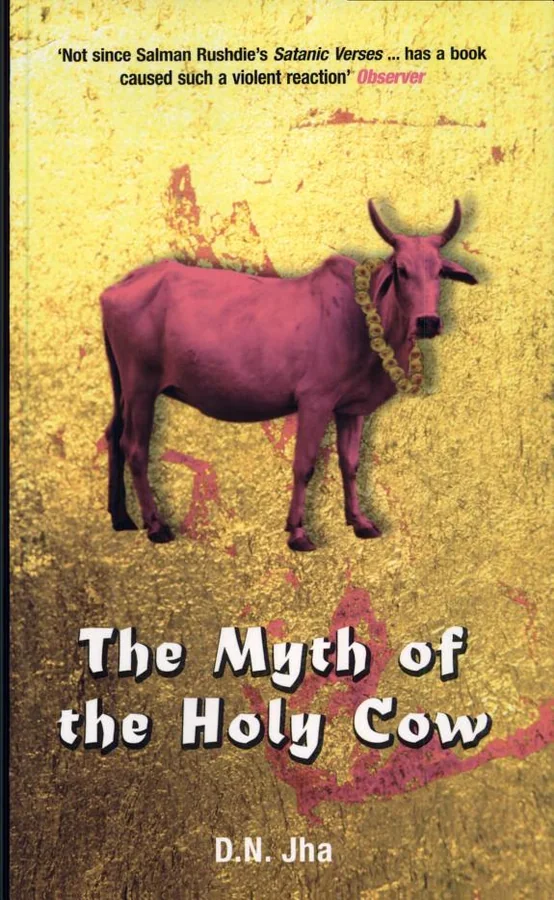
The Myth of the Holy Cow
 79
79

The Myth of the Holy Cow
D.N. Jha's "The Myth of the Holy Cow" is a stark, often unsettling, examination of religious history. The author's insistence on examining Vedic texts with a critical, secular eye, rather than through the lens of later devotional accretions, is its paramount strength. Jha systematically debunks the notion of an eternal, inherent sanctity of the cow, pointing to passages in the Rigveda that describe beef consumption and cattle sacrifice without condemnation. A particular strength lies in his careful dissection of linguistic nuances in ancient Sanskrit. However, the book's uncompromising directness, while intellectually bracing, may alienate readers accustomed to more nuanced or apologetic historical treatments of religious subjects. The section detailing ritualistic offerings, which includes beef, serves as a potent, if challenging, illustration of his thesis. This is a vital, if contentious, piece of historical scholarship that demands careful consideration.
📝 Description
79
D.N. Jha's 2004 book argues the cow was not always sacred in India.
The Myth of the Holy Cow, published in 2004 by D.N. Jha, is a scholarly study examining the historical roots of cattle veneration in India. Jha challenges common understandings by presenting evidence that cattle were not consistently regarded as sacred and that beef was consumed during ancient Vedic periods. The book draws on Vedic texts, old rituals, and social customs to trace the historical development of the cow's sacred status.
This work is for readers interested in religious history, comparative mythology, and the socio-cultural development of India. It suits academics, Indology students, and independent researchers interested in how religious beliefs and practices change. Those who value careful textual analysis and are willing to question established traditions will find the book especially rewarding. Jha's research confronted the idea of the cow's sanctity as an ancient, unchanging Hindu tenet, sparking considerable debate upon its release.
This book engages with traditions of critical historical inquiry applied to religious beliefs. It examines how practices and beliefs, often presented as ancient and immutable, are in fact products of historical development. Jha's method involves a close reading of primary texts, such as the Rigveda, to reconstruct past social and religious norms, demonstrating that notions of sanctity are contingent on historical context and societal shifts rather than being static divine pronouncements.
💡 Why Read This Book?
• Learn about the pre-2004 scholarly debate surrounding bovine sanctity in ancient India, as presented through Jha's critical analysis of Vedic texts. • Understand the historical arguments that challenge the notion of the cow's eternal sacredness, specifically referencing the Rigveda's descriptions of ritual practices. • Gain insight into how religious customs evolve over time, exemplified by the shift in the cow's status from sacrificial animal to revered symbol.
⭐ Reader Reviews
Honest opinions from readers who have explored this book.
❓ Frequently Asked Questions
What is the primary argument of D.N. Jha's "The Myth of the Holy Cow"?
The book argues that the cow was not always considered sacred in ancient India and that beef consumption was practiced in Vedic times, challenging later traditions of bovine veneration.
Which ancient texts does D.N. Jha analyze in "The Myth of the Holy Cow"?
Jha primarily focuses on Vedic texts, particularly the Rigveda, examining hymns and rituals described within them to reconstruct historical practices.
What was the reception of "The Myth of the Holy Cow" upon its publication in 2004?
The book generated significant controversy in India, with some groups demanding its prohibition, highlighting its challenge to deeply held beliefs.
Does "The Myth of the Holy Cow" suggest that Hinduism is not ancient?
No, it argues that specific practices and beliefs within what evolved into Hinduism, such as the absolute sanctity of the cow, developed over time rather than being static from antiquity.
Is "The Myth of the Holy Cow" a religious text?
No, it is a work of historical and critical scholarship that examines religious practices and texts from a secular, evidence-based perspective.
What does the book say about beef consumption in ancient India?
Jha presents evidence from Vedic texts suggesting that beef was consumed, particularly in the context of sacrifices, before it became widely taboo.
🔮 Key Themes & Symbolism
Historical Contingency of Beliefs
This theme explores how religious doctrines and practices are not static but evolve over centuries. Jha demonstrates through textual analysis that the reverence for the cow, now a central to Hindu practice, was not a constant from the Vedic period. He highlights how social needs, ritualistic interpretations, and evolving philosophical currents shaped the status of the bovine, transforming it from a potential food source and sacrificial offering into a symbol of ultimate purity and inviolability. This concept underscores that what appears immutable in religion often has a fluid, historical genesis.
Vedic Period Practices
The core of Jha's investigation lies in re-examining the earliest layers of Vedic literature, particularly the Rigveda. This theme focuses on the actual practices described or alluded to in these ancient hymns. It details instances of cattle sacrifice, where beef was likely consumed as part of ritualistic meals, and discusses the cow's primary role as a unit of wealth and a significant element in sacrifices. By presenting these early contexts, Jha contrasts them sharply with later periods where such actions became unthinkable, illustrating a significant divergence in religious norms.
The Evolution of Sacredness
This theme tracks the transformation of the cow's status from a utilitarian and ritualistic animal to a sacred icon. Jha meticulously traces the shift, suggesting that the concept of 'ahimsa' (non-violence) and the increasing emphasis on vegetarianism in later Hindu traditions contributed to the cow's elevated position. The book examines how theological and social pressures gradually cemented the idea of the cow's sanctity, moving it beyond its earlier, more pragmatic associations and making it a symbol of Hindu identity and religious devotion.
Scholarly Interpretation vs. Dogma
Jha positions his work as a critical scholarly endeavor confronting established religious dogma. This theme emphasizes the importance of empirical research and textual criticism in understanding religious history, even when it challenges deeply ingrained beliefs. The book's controversial reception, with demands for its banning, serves as a case study in the tension between academic inquiry and religious orthodoxy. It highlights the challenges faced by historians when their findings contradict widely accepted narratives or sacred traditions.
💬 Memorable Quotes
Direct passages from the work, attributed to the author.
“The Rigveda does not exhibit any prejudice against the consumption of beef.”
— This statement captures Jha's central thesis regarding the Vedic period. It directly challenges the assumption that beef was always forbidden, pointing to the absence of such prohibitions in the oldest Hindu scriptures as evidence for its historical acceptance.
“The cow was primarily a sacrificial animal in the Vedic age.”
— This highlights the functional role of the cow in early Vedic rituals. The interpretation emphasizes that its significance was rooted in its utility for sacrifice and sustenance, rather than an inherent, spiritual sacredness that precluded its use.
“The concept of the cow as a mother figure emerged much later.”
— This interpretation points to the historical development of the cow's symbolic meaning. It suggests that the maternal and divine associations, prevalent in later Hinduism, were not present in the earliest Vedic texts and developed through subsequent theological and cultural shifts.
“Arguments for the cow's eternal sanctity are not supported by Vedic evidence.”
— This interpretation directly addresses the book's core purpose: to refute claims of immemorial bovine sanctity. It asserts that scholarly examination of primary Vedic sources fails to substantiate such claims, suggesting they are later constructs.
“Later interpolations and interpretations altered the original Vedic context.”
— This interpretation suggests that the meaning and practice surrounding the cow in Vedic times were subsequently reinterpreted or modified by later generations to fit evolving religious and social ideologies.
🌙 Esoteric Significance
Tradition
While not strictly an esoteric text in the vein of Hermeticism or Kabbalah, "The Myth of the Holy Cow" engages with the historical underpinnings of what became a dominant religious tradition in India. Its significance lies in its critical examination of foundational texts that later became imbued with esoteric and exoteric meanings. By deconstructing the historical origins of a sacred symbol, it offers a method applicable to understanding the evolution of esoteric symbolism itself, questioning the immutability of ancient wisdom and revealing the human agency behind religious constructs.
Symbolism
The primary symbol is the cow, which in later Hinduism represents nourishment, motherhood, purity, and the divine feminine. Jha's work recontextualizes this symbol by revealing its earlier role as a sacrificial victim and source of sustenance in Vedic rituals. Another motif is the Rigveda itself, functioning as a symbol of pristine, unadulterated ancient wisdom. Jha's reinterpretation of its passages regarding cattle transforms it from a purely sacred text into a historical document revealing pragmatic, pre-dogmatic practices.
Modern Relevance
This work remains profoundly relevant for contemporary scholars of religion, anthropology, and history, particularly those examining the construction of religious identity and national myths. It informs ongoing debates about secularism in India and the historical accuracy of religious claims. Thinkers and practitioners interested in critical approaches to scripture, the sociology of religion, and the deconstruction of sacred cows (both literal and metaphorical) in any tradition find value in Jha's methodology and conclusions.
👥 Who Should Read This Book
• Scholars and students of Indology and comparative religion will find a rigorous, evidence-based challenge to established narratives about Hindu practices. • Readers interested in the history of food, sacrifice, and ritual across cultures will gain a unique perspective on how these elements shaped early religious thought. • Individuals curious about the historical development of religious symbols and the interplay between dogma and evidence will appreciate Jha's critical approach to sacred texts.
📜 Historical Context
Published in 2004, D.N. Jha's "The Myth of the Holy Cow" emerged during a period of intense nationalist and religious discourse in India. The prevailing academic and popular narrative often presented the sanctity of the cow as an ancient, unbroken tradition within Hinduism. Jha's work directly confronted this consensus by meticulously analyzing Vedic texts, particularly the Rigveda, to argue that beef consumption and cattle sacrifice were common in early Vedic society (c. 1500-1000 BCE). This approach stood in stark contrast to the apologetic or devotional historiography that often characterized studies of Hindu practices. The book's publication ignited a firestorm of controversy; the Indian government faced pressure to ban it, and it was widely debated in academic circles and public forums. Scholars like Wendy Doniger, who had also explored sensitive aspects of Hindu mythology and practice, were contemporaries whose work, while different in focus, contributed to a broader reassessment of traditional narratives.
📔 Journal Prompts
The Rigveda's descriptions of cattle sacrifice and consumption.
Historical contingency in religious practices versus eternal truths.
The cow as a symbol: from utility to divinity.
The impact of textual interpretation on religious dogma.
Demands for censorship of historical scholarship.
🗂️ Glossary
Rigveda
One of the oldest sacred texts of Hinduism, a collection of hymns composed in Vedic Sanskrit, believed to date from around 1500–1000 BCE. It is considered a primary source for understanding early Vedic religion and society.
Vedic Period
The period in ancient Indian history associated with the composition and compilation of the Vedas, generally considered to span from approximately 1500 BCE to 500 BCE. It is characterized by a distinct religious and social structure.
Bovine Sanctity
The concept of the cow being sacred, holy, or inviolable. In the context of the book, it refers to the historical development and eventual widespread acceptance of the cow's sacred status within Indian religious traditions.
Ahimsa
A principle of non-violence towards all living beings. While central to later Indian religions like Buddhism and Jainism, its interpretation and application regarding animal sacrifice evolved significantly within Hinduism.
Textual Criticism
The process of examining historical documents, such as religious scriptures, to determine their authenticity, original form, and historical context, often involving linguistic analysis and comparison of different versions.
Vedic Sanskrit
An archaic form of the Sanskrit language used in the composition of the Vedas. It differs significantly from Classical Sanskrit in grammar, vocabulary, and phonology, requiring specialized linguistic expertise to interpret.
Socio-cultural Evolution
The study of how societies and their associated cultural practices, beliefs, and institutions change over time. This concept is central to Jha's analysis of the cow's shifting status.
This book appears in 1 collection
🔮 Readers Also Liked
Browse all →






From the “Hinduism” Collection
View all →





More Free Esoteric History & Biography Books
View all →