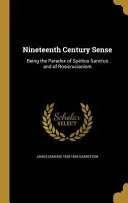
19TH CENTURY SENSE
 83
83

19TH CENTURY SENSE
James Edmund Garretson’s 19th Century Sense offers a fascinating, if somewhat densely packed, exploration of the intellectual climate surrounding esoteric thought in the Victorian era. The strength of the work lies in its meticulous cataloging of concepts and its contextualization within a period of intense spiritual and philosophical ferment. Garretson avoids romanticizing the period, instead presenting a sober account of beliefs and practices. A notable passage details the influence of figures like Eliphas Lévi, whose magical theories permeated much of the era's occult discourse. However, the book’s primary limitation is its academic tone, which, while precise, can make it less accessible to a general reader seeking a more narrative approach. The text sometimes feels like an annotated bibliography rather than a flowing historical account. Overall, 19th Century Sense is an invaluable resource for specialists, offering precise data on a complex historical subject.
📝 Description
83
James Edmund Garretson compiled 19th Century Sense, analyzing esoteric thought from the late 1800s.
19th Century Sense gathers and examines esoteric currents from the late Victorian era. Garretson details the intellectual climate that shaped occultism, spiritualism, and philosophical investigations outside conventional science and religion. The book focuses on the ideas circulating within specific groups seeking alternate realities.
This work is for students of late Victorian esotericism, philosophy historians, and those interested in the origins of modern occult practices. It provides specific terminology and conceptual frameworks from figures like Helena Blavatsky and the early Theosophical Society, aiding understanding of Western Esoteric Traditions' beginnings.
The 19th century saw a rise in spiritualism and occult interest, partly a response to scientific materialism. Movements such as Mesmerism had already begun exploring unseen forces. By the 1880s, organizations like the Hermetic Order of the Golden Dawn emerged, structuring esoteric pursuits.
The late 19th century was a fertile period for esoteric thought, driven by reactions against materialism and the perceived limits of science. Figures like Helena Blavatsky and organizations such as the Hermetic Order of the Golden Dawn were active. This era saw the formalization of spiritualist practices and a significant interest in integrating Eastern philosophies with Western occultism, creating a unique blend that Garretson's work documents.
💡 Why Read This Book?
• Understand the specific intellectual milieu that gave rise to modern Western Esotericism by examining concepts like vitalism as discussed in the text, enabling a deeper grasp of its origins than general histories provide. • Gain insight into the reception and adaptation of Eastern philosophies in the West during the 19th century, as detailed in the book, offering a nuanced perspective distinct from contemporary interpretations. • Explore the foundational ideas of ceremonial magic and psychic phenomena that were prevalent before the formal organization of groups like the Hermetic Order of the Golden Dawn, providing a unique historical lens.
⭐ Reader Reviews
Honest opinions from readers who have explored this book.
❓ Frequently Asked Questions
What is the primary focus of 19th Century Sense regarding esoteric beliefs?
The book focuses on the conceptual frameworks and intellectual currents of 19th-century esoteric thought, analyzing beliefs in vitalism, psychic phenomena, and the impact of Eastern philosophies on Western occultism.
Who were some key figures influencing the esoteric landscape described in the book?
While not always directly named, the work discusses the intellectual climate shaped by figures like Franz Mesmer and Eliphas Lévi, whose ideas on unseen forces and magical theory were influential.
How does 19th Century Sense place itself within the history of esoteric movements?
It situates itself as an analysis of the period preceding the formal establishment of major occult organizations, exploring the foundational ideas and societal influences that led to their formation.
What role did Eastern philosophies play in 19th-century esoteric thought according to this book?
The book details how translations and figures like Swami Vivekananda introduced Hinduism and Buddhism to the West, influencing esoteric thinkers and leading to syncretic spiritual systems.
Is 19th Century Sense a primary source or a secondary analysis?
It functions as a secondary analysis, compiling and interpreting esoteric thought and practice from the 19th century, rather than being a direct primary source from that era.
What is 'vitalism' as presented in 19th Century Sense?
Vitalism is presented as the belief in a distinct life force or animating principle, separate from purely physical or chemical processes, a concept central to many 19th-century esoteric philosophies.
🔮 Key Themes & Symbolism
Victorian Spiritualism and Materialism
The work explores the tension between the era's burgeoning scientific materialism and the widespread fascination with spiritualism and occult phenomena. It examines how individuals sought explanations for existence beyond purely physical laws, exploring concepts of unseen forces and psychic abilities as responses to the perceived limitations of Darwinian evolution and positivism. This theme highlights the intellectual landscape where esoteric ideas gained traction as alternative worldviews.
Influence of Eastern Religions
A significant aspect covered is the impact of newly translated Eastern texts and the arrival of figures like Swami Vivekananda on Western esoteric thought. The book details how concepts from Hinduism and Buddhism, such as karma and reincarnation, were integrated into existing Western occult frameworks, leading to syncretic spiritual systems and a broader understanding of diverse religious traditions among esoteric practitioners.
Theosophy's Precursors
19th Century Sense illuminates the intellectual environment that predated and informed the formal establishment of the Theosophical Society in 1875. It explores the ideas circulating among thinkers who would later contribute to or be influenced by Theosophy, focusing on the shared interest in ancient wisdom, hidden hierarchies, and the potential for human spiritual evolution through esoteric knowledge.
Ceremonial Magic and Vital Forces
The book examines the theoretical foundations of ceremonial magic as it evolved in the 19th century, often referencing earlier figures like Eliphas Lévi. It connects these magical practices to underlying concepts of vitalism and the manipulation of unseen energies, presenting a view of magic not merely as ritual but as a system engaging with fundamental life forces and cosmic principles.
💬 Memorable Quotes
Direct passages from the work, attributed to the author.
“The era grappled with the perceived limits of scientific materialism.”
— This highlights the core conflict driving much 19th-century esoteric interest: a dissatisfaction with purely physical explanations and a search for meaning in spiritual or unseen realms.
“Vitalism offered an alternative to purely mechanistic views of life.”
— This points to the concept of a life force as a key explanatory principle for esoteric thinkers, providing a framework for understanding consciousness and biological processes beyond simple chemistry.
“Eastern philosophies began to integrate into Western occult discourse.”
— This signifies the cross-cultural exchange occurring, where ancient Indian and Buddhist ideas were adopted and adapted by Western esoteric traditions, creating hybrid spiritual systems.
“Psychic phenomena were investigated as evidence of non-physical realities.”
— This underscores the era's fascination with telepathy, clairvoyance, and mediumship as empirical proof for a spiritual dimension, challenging the dominance of materialism.
“The groundwork was laid for formal esoteric organizations.”
— This suggests that the period analyzed was crucial in developing the concepts and attracting the individuals who would later establish structured esoteric orders and societies.
🌙 Esoteric Significance
Tradition
This work is deeply rooted in the Western Esoteric Tradition, particularly its late 19th-century manifestation. It bridges the gap between earlier Hermetic and Kabbalistic revivals and the emergent Theosophical and Golden Dawn movements. It represents an attempt to systematize and understand the diverse currents of thought that coalesced into what is often termed 'Modern Occultism,' examining how these elements were synthesized and interpreted by thinkers of the period.
Symbolism
The text implicitly engages with symbols like the 'life force' or 'vital energy,' often understood as a universal animating principle akin to the Neoplatonic 'One' or Gnostic 'Pleroma.' It also touches upon the symbolism inherent in psychic phenomena, where telepathy or clairvoyance might be seen as manifestations of an interconnected cosmic consciousness or an etheric plane, reflecting the era's fascination with hidden correspondences.
Modern Relevance
Contemporary practitioners of Western Esotericism, including those involved in ceremonial magic, modern Theosophy, and various forms of New Age spirituality, often draw upon the conceptual foundations explored in this book. Thinkers and groups who seek to understand the historical roots of their practices, or who engage in comparative studies of occult traditions, find this work essential for grasping the intellectual lineage that informs their present-day pursuits.
👥 Who Should Read This Book
• Scholars of Victorian intellectual history and the development of religious/spiritual movements, who will find detailed context for the era's alternative philosophies. • Students of Western Esotericism seeking to understand the historical underpinnings of modern occultism, providing foundational concepts that informed later traditions. • Researchers of comparative religion interested in how Eastern philosophies were integrated into Western spiritual thought during the 19th century, offering specific examples of syncretism.
📜 Historical Context
The latter half of the 19th century was a period of profound intellectual and social upheaval, marked by rapid industrialization, scientific advancement, and a concurrent surge of interest in spiritualism and the occult. This era saw a significant backlash against the perceived soullessness of scientific materialism, leading many to seek alternative explanations for existence. Movements like Mesmerism, developed earlier by Franz Mesmer, had already popularized ideas about unseen 'nervous fluids' and psychic influence. Contemporaries like Helena Blavatsky, who founded the Theosophical Society in 1875, played a central role in synthesizing Eastern religious philosophies with Western esoteric traditions. Simultaneously, figures like Arthur Conan Doyle became vocal proponents of spiritualism, demonstrating its reach into mainstream society. The establishment of organizations such as the Hermetic Order of the Golden Dawn in 1888 further indicates a growing formalization and institutionalization of esoteric practices and beliefs, often drawing from Neoplatonism and Kabbalah.
📔 Journal Prompts
The era's synthesis of Eastern philosophies: Identify one concept from Hinduism or Buddhism as presented in the text and its Western esoteric adaptation.
Reflect on the tension between scientific materialism and vitalism as described in the book.
Consider the implications of psychic phenomena for understanding consciousness, as explored in the text.
Analyze the role of figures like Eliphas Lévi in shaping 19th-century magical thought, based on the book's context.
Examine the perceived limitations of established science during the 19th century and how esoteric thought offered alternatives.
🗂️ Glossary
Vitalism
A philosophical doctrine positing that a distinct life force or animating principle, separate from physical and chemical forces, is essential to living organisms.
Psychic Phenomena
Events or abilities believed to originate from sources beyond the normal five senses, such as telepathy, clairvoyance, mediumship, and precognition.
Materialism
A philosophical view that matter is the fundamental substance in nature, and that all phenomena, including mental states and consciousness, are ultimately results of material interactions.
Spiritualism
A religious movement and belief system based on the idea that the spirits of the dead can communicate with the living, often through mediums.
Esotericism
Teachings or practices characterized by secrecy, intended only for a select group of initiates, often involving mystical or occult knowledge.
Ceremonial Magic
A form of magic involving rituals, invocations, and symbolic actions, often drawing upon ancient traditions and aimed at achieving specific spiritual or material ends.
Theosophy
A spiritual movement founded in the late 19th century, seeking to synthesize Eastern and Western religions and philosophies, emphasizing ancient wisdom and spiritual evolution.