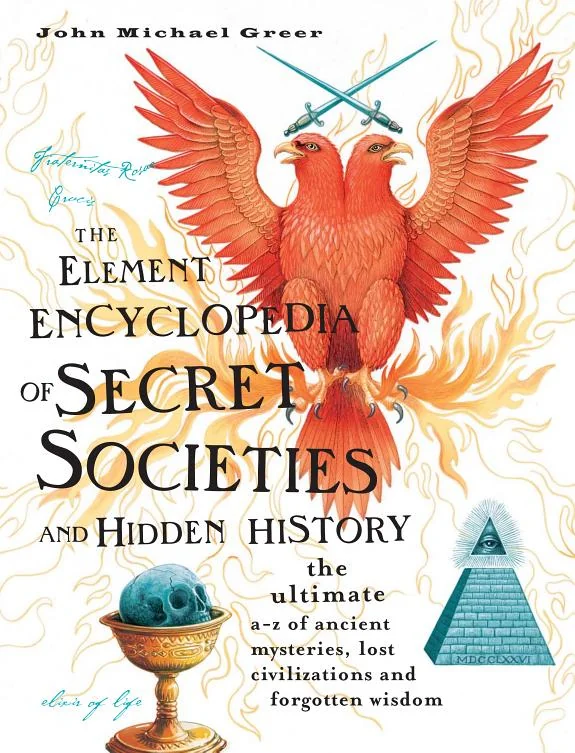
The Element Encyclopedia of Secret Societies and Hidden History
 80
80

The Element Encyclopedia of Secret Societies and Hidden History
John Michael Greer’s *The Element Encyclopedia of Secret Societies and Hidden History* is a commendable effort to bring order to a subject often swamped by unsubstantiated lore. Greer’s strength lies in his methodical approach, treating each society or theory with a degree of scholarly detachment, even when discussing phenomena like the alleged influence of the Thule Society. He rightly points out the difficulty in separating fact from fiction, particularly concerning groups whose very nature is to operate in secrecy. A notable passage is his dissection of the historical claims surrounding the Knights Templar, where he carefully weighs evidence and folklore. However, the sheer breadth of the subject means that individual entries, while informative, can sometimes feel concise to the point of being superficial. For instance, the discussion on modern conspiracy theories, while present, lacks the depth found in the historical sections. The book offers a valuable, if sometimes dry, guide for those seeking a structured overview of clandestine historical narratives.
📝 Description
80
John Michael Greer's 2006 encyclopedia examines secret societies and hidden history.
Published in 2006, John Michael Greer's The Element Encyclopedia of Secret Societies and Hidden History acts as a thorough catalog and critique of clandestine organizations and obscured historical accounts. It moves past simple sensationalism to investigate the factual basis, influential people, and theoretical structures that underlie conspiracy theories and alternative historical narratives. The book addresses secrecy within societies and the lasting effects of shadowy historical events, presenting a structured way to grasp the hidden currents of human civilization. It intends to give readers the means to distinguish verifiable facts from speculation in this often unclear area. The encyclopedia covers a wide range of groups and events, from ancient mystery cults to contemporary clandestine movements, serving as a reference for those interested in the esoteric and veiled aspects of world affairs. It separates myth from documented truth, offering a balanced viewpoint.
This encyclopedia is for readers interested in the deeper, often unrecognized forces that shape history. It appeals to students of esotericism, occultism, and comparative religion, as well as amateur historians and researchers seeking to understand the presence and impact of secret societies. People intrigued by conspiracy theories will find a critical yet informative resource that separates substantiated claims from unfounded speculation. It is also useful for those involved in symbolic analysis and the study of hidden traditions, providing context for various allegorical and mystical interpretations of historical events. The book serves as an accessible introduction for newcomers to the subject while offering depth for more experienced researchers.
This work situates itself within the broader tradition of occult and esoteric studies that seek to understand hidden structures and influences behind mainstream historical accounts. It acknowledges a lineage of inquiry into secret societies that dates back centuries, examining groups that often operate outside conventional academic scrutiny. Greer's approach attempts to provide a rational framework for evaluating claims about hidden history and esoteric knowledge, distinguishing between verifiable evidence and speculative interpretation. This aligns with a modern esoteric goal of demystifying the subject matter while still respecting the significance of hidden traditions and their impact on human culture.
💡 Why Read This Book?
• Understand the historical context and verifiable origins of groups like the Knights Templar, moving beyond popular myth to explore their documented influence and symbolic legacy. • Gain critical tools to analyze conspiracy theories by examining the specific claims and figures associated with movements like the Illuminati, distinguishing speculation from historical evidence. • Discover the symbolic language and esoteric doctrines of various secret societies, such as Rosicrucianism, and their place within broader occult traditions as detailed in the encyclopedia's extensive entries.
⭐ Reader Reviews
Honest opinions from readers who have explored this book.
❓ Frequently Asked Questions
What is the primary focus of 'The Element Encyclopedia of Secret Societies and Hidden History'?
The book functions as a comprehensive catalog and critical examination of clandestine organizations and obscured historical narratives, aiming to distinguish fact from speculation regarding their influence and aims.
Who is John Michael Greer?
John Michael Greer is an author and occult scholar known for his extensive writings on magic, esotericism, and history. He published 'The Element Encyclopedia of Secret Societies and Hidden History' in 2006.
Does the book cover ancient secret societies?
Yes, the encyclopedia explores ancient mystery cults and their potential influence on later esoteric traditions, providing context for their rituals and doctrines within the broader scope of hidden history.
How does the encyclopedia approach conspiracy theories?
It provides a factual and analytical framework for understanding prevalent conspiracy theories, examining key figures, events, and organizations involved, while critically assessing the evidence presented.
What kind of esoteric traditions are discussed?
The work covers a range of esoteric traditions, including Hermeticism, Rosicrucianism, Freemasonry, and Gnosticism, detailing their historical development and symbolic systems.
Is this book suitable for beginners interested in secret societies?
Yes, it serves as an accessible introduction for newcomers, offering a structured overview and definitions of key terms, while also providing depth for more experienced researchers.
🔮 Key Themes & Symbolism
The Nature of Secrecy
Greer meticulously dissects how and why groups maintain secrecy, examining the historical necessity and societal impact of clandestine operations. He analyzes the spectrum from voluntary hiddenness, like that of early Freemasonry, to enforced obscurity, as seen with groups potentially targeted by state suppression. The work explores how the very act of concealment shapes a group's doctrine, membership, and historical narrative, often leading to mythologizing and speculation that obscures verifiable facts about their actual aims and activities.
Esoteric Symbolism and Ritual
A significant portion of the encyclopedia is dedicated to deciphering the symbolic language and ritualistic practices common to many secret societies. Greer connects these symbols, such as the All-Seeing Eye or the pentagram, to their roots in Hermeticism, Kabbalah, and other esoteric traditions. He argues that understanding this symbolic lexicon is crucial for grasping the worldview and intended meaning behind the actions and doctrines of these groups, offering insights into their spiritual and philosophical underpinnings.
Alternative Historical Narratives
The work critically engages with alternative visions of history, from the influence of lost civilizations to the alleged machinations of shadowy cabals. Greer investigates the origins and evolution of prominent historical myths, such as those surrounding the Holy Grail or the origins of the Rosicrucians, placing them within their historical and cultural contexts. He contrasts these narratives with documented evidence, providing readers with a framework for evaluating claims about hidden historical forces and their impact on world events.
Key Figures and Organizations
Greer provides detailed entries on a vast array of historical figures and organizations central to the study of secret societies. From the enigmatic Knights Templar and the influential Rosicrucian manifestos to figures like Aleister Crowley and the historical basis for the Illuminati, the encyclopedia offers concise biographies and organizational histories. Each entry aims to present factual information, noting areas of historical debate and distinguishing between established facts and speculative theories about their roles.
💬 Memorable Quotes
Direct passages from the work, attributed to the author.
“The difference between a conspiracy theory and a historical fact often lies in the quality and quantity of available evidence.”
— This highlights Greer's critical approach, emphasizing that while many historical events may involve clandestine elements, unsubstantiated theories lack the rigorous proof required for historical acceptance.
“Many societies that begin with a spiritual or philosophical quest eventually become entangled with mundane power structures.”
— This observation points to a recurring pattern in the history of secret societies, suggesting that their initial ideals can become compromised by worldly ambitions or political maneuvering over time.
“Symbolism is the language of the hidden, a way to communicate profound truths to initiates while remaining obscure to the uninitiated.”
— This interpretation underscores the importance of symbolic interpretation in understanding esoteric traditions, framing symbols not merely as decorative elements but as vehicles for conveying complex spiritual or philosophical concepts.
“The historical record is often incomplete, leaving ample room for speculation about the roles of those who operated behind the scenes.”
— This acknowledges the inherent challenges in researching hidden history, suggesting that the gaps in documentation naturally invite theories about secret influences and unrecorded events.
“Popular culture has a tendency to simplify and sensationalize the complex histories of secret societies for broader appeal.”
— This points to the influence of media in shaping public perception, often at the expense of historical accuracy, transforming intricate historical movements into easily digestible, dramatic narratives.
🌙 Esoteric Significance
Tradition
The work fits within the broader Western Esoteric Tradition, particularly drawing from Hermetic, Gnostic, and Rosicrucian lineages. Greer's approach, however, emphasizes historical analysis and critical evaluation, seeking to ground esoteric claims within traceable historical contexts rather than purely mystical interpretations. It departs from purely devotional or initiatory texts by functioning as a reference and analytical tool, aiming to provide a structured understanding of these traditions' historical manifestations and their alleged societal impacts.
Symbolism
Key symbols explored include the serpent (often representing hidden knowledge or primordial wisdom), the circle (symbolizing unity, eternity, or the divine), and various geometric figures used in ritual and architecture. Greer elucidates how these symbols, appearing in contexts from ancient mystery cults to Masonic lodges, function as shorthand for complex metaphysical concepts, acting as keys to unlock deeper layers of meaning within esoteric doctrines and group teachings.
Modern Relevance
Contemporary practitioners of ceremonial magic, comparative religion scholars, and independent researchers investigating esoteric history continue to reference Greer's encyclopedia. Its structured approach to analyzing groups like the Freemasons or the historical claims surrounding the Illuminati provides a foundational text for understanding the evolution of occult thought and clandestine movements in the modern era.
👥 Who Should Read This Book
• Aspiring occultists and esoteric historians seeking a structured overview of major secret societies and their historical footprints. • Critical thinkers interested in dissecting conspiracy theories and understanding the factual basis behind claims of hidden historical influence. • Students of comparative religion and mythology looking to explore the symbolic language and doctrines of various clandestine spiritual traditions.
📜 Historical Context
Published in 2006, John Michael Greer's encyclopedia emerged during a period of heightened public fascination with conspiracy theories and hidden histories, amplified by internet culture and a general skepticism towards established institutions. The work engaged with a long tradition of esoteric scholarship, drawing implicitly from figures like Manly P. Hall, whose *The Secret Teachings of All Ages* (1928) had previously cataloged similar themes. Greer's approach, however, aimed for a more critical, evidence-based analysis than some earlier works, positioning itself against the purely speculative accounts that proliferated in the preceding decades. While not a direct response, it appeared in the wake of books like *The Da Vinci Code* (2003), which brought esoteric themes to mainstream attention. The academic reception of such works often placed them in a liminal space, appreciated for their comprehensiveness by enthusiasts but viewed with caution by strictly empirical historians.
📔 Journal Prompts
The historical evidence for the Knights Templar's alleged secret knowledge. Assess the quality of the sources.
Rosicrucian symbolism and its connection to alchemical traditions. Explore specific motifs.
The role of 'shadow government' concepts in contemporary conspiracy theories. Identify specific examples.
Compare and contrast the secrecy protocols of two different historical secret societies discussed in the book.
The enduring appeal of lost civilizations narratives. Analyze their underlying themes.
🗂️ Glossary
All-Seeing Eye
A symbol often depicted as an eye within a triangle, surrounded by rays of light. It represents divine providence, spiritual illumination, and the watchful eye of a higher power or guiding intelligence.
Conspiracy Theory
An explanation of an event or situation that invokes a conspiracy by sinister and powerful groups, often political in motivation, when other explanations are more probable.
Esotericism
Belief systems and practices that focus on inner, spiritual transformation and often involve secret teachings or hidden knowledge accessible only to initiates.
Hermeticism
A religious, philosophical, and esoteric tradition based on writings attributed to Hermes Trismegistus, emphasizing divine wisdom, the interconnectedness of all things, and the pursuit of spiritual enlightenment.
Illuminati
Historically, a Bavarian secret society founded in 1776. In modern conspiracy theories, the term refers to a shadowy cabal believed to control world affairs.
Knights Templar
A Catholic military order founded around 1119, famous for its role in the Crusades. Legends surround their alleged possession of secret knowledge and relics.
Rosicrucianism
An esoteric tradition founded in the early 17th century, associated with the mythical figure Christian Rosenkreuz. It emphasizes spiritual alchemy, mysticism, and occult philosophy.
This book appears in 1 collection
🔮 Readers Also Liked
Browse all →







From the “Secret Societies” Collection
View all →


More Free Esoteric History & Biography Books
View all →