Studies in Contemporary Jewry
 79
79

Studies in Contemporary Jewry
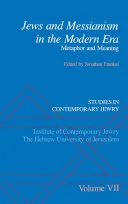
Jonathan Frankel's compilation, *Jews and Messianism in the Modern Era: Metaphor and Meaning*, offers a dense but rewarding examination of how messianic thought has persisted and transformed within Jewish communities since the modern period. The strength lies in its scholarly breadth, presenting diverse perspectives on how messianic ideals have been adapted, secularized, and metaphorically applied. A particular highlight is the nuanced discussion of how national aspirations in the 19th and 20th centuries often absorbed or mirrored messianic tropes, a point explored with considerable depth by several contributors. However, the volume's academic rigor, while commendable, can also be its limitation for a broader audience; the dense prose and specialized terminology require a dedicated reader. One particularly striking section discusses the metaphorical extension of messianic redemption to encompass social justice movements, demonstrating the concept's adaptability beyond purely theological confines. This collection serves as a crucial academic resource for understanding the enduring, albeit often transmuted, presence of messianism in modern Jewish discourse.
📝 Description
79
Published in 1991, this volume analyzes messianic ideas in modern Jewish life.
This collection, the seventh annual publication from the Institute of Contemporary Jewry, examines the enduring presence of messianic concepts in contemporary Jewish thought and practice. It brings together scholarly articles that trace the influence of messianic metaphors, ideas, and hopes on Jewish history and culture from the modern period onward. The book includes academic discussions, critical assessments of recent publications, and a bibliography of dissertations relevant to Jewish studies.
The intended audience includes academics and advanced students specializing in Jewish history, religious studies, and cultural anthropology. It will interest those who study the development of religious thought, the connections between theology and political movements, and how eschatological frameworks inform community identity. Readers looking for detailed analyses of how messianism has been adapted in both secular and religious Jewish contexts will find substantial content here.
This work engages with the complex history of Jewish messianism, a central concept in Jewish mysticism and theology that has undergone significant reinterpretation. Following the foundational scholarship of figures like Gershom Scholem, who illuminated the historical development and diverse expressions of messianic thought, this volume considers its manifestation in secular, cultural, and political spheres. It addresses how traditional eschatological hopes have been translated and adapted within modern Jewish society, reflecting ongoing debates about continuity and change in religious and intellectual traditions.
💡 Why Read This Book?
• Gain a granular understanding of how messianic concepts were reinterpreted in Jewish thought after the Enlightenment, moving beyond simplistic notions of belief. • Explore the specific ways nationalistic movements in the 19th century, as discussed in the work, adopted and secularized messianic themes for their own agendas. • Analyze the function of messianic metaphors in shaping modern Jewish cultural and political discourse, particularly concerning ideas of redemption and transformation.
⭐ Reader Reviews
Honest opinions from readers who have explored this book.
❓ Frequently Asked Questions
When was the Institute of Contemporary Jewry established?
The Institute of Contemporary Jewry at the Hebrew University of Jerusalem was established in 1965, aiming to foster comprehensive academic study of Jewish life across the modern world.
What is the primary focus of the "Jews and Messianism in the Modern Era" volume?
This volume specifically examines the significance and meaning of messianic metaphors, themes, and ideals within modern Jewish history and culture, tracing their evolution and application.
Who are some of the scholars whose work is referenced or included in this series?
While the original blurb mentions "noted scholars of Jewish history," specific names beyond the editor Jonathan Frankel are not detailed in the provided summary. However, the series context implies contributions from leading figures in Jewish studies.
What kind of content can be expected in addition to the main symposia?
Readers can expect standard academic components such as book reviews relevant to contemporary Jewry and lists of recent dissertations, alongside the primary scholarly contributions.
In what year was this specific volume, 'Jews and Messianism in the Modern Era', first published?
This volume, identified as the seventh in the series, was first published on June 13, 1991.
Does this book discuss the secularization of messianic ideas?
Yes, the work extensively explores how messianic ideals were secularized and adapted into cultural, national, and political frameworks within modern Jewish society.
🔮 Key Themes & Symbolism
Messianic Metaphorical Shift
The volume scrutinizes how messianic concepts, traditionally tied to eschatological redemption, were repurposed as metaphors in modern Jewish discourse. This includes their application to national liberation movements, social reform, and cultural revitalization, demonstrating a significant departure from purely theological interpretations. The work analyzes the mechanisms by which these potent symbols were translated into secular or quasi-secular frameworks, reflecting the era's intellectual currents and societal transformations.
Secularization of Redemption
A central theme is the process by which the idea of redemption, intrinsically linked to messianism, was secularized. Scholars examine how aspirations for a redeemed future became embedded in Zionist ideology, socialist movements, and other forms of collective Jewish striving. This exploration highlights the complex relationship between religious heritage and the formation of modern Jewish identity, often divorcing the concept of redemption from its divine origin while retaining its transformative power.
Enduring Eschatological Consciousness
Despite the rise of secularism and historical upheavals, the volume argues for the persistent influence of eschatological consciousness within modern Jewry. It investigates how the longing for an end-time, a perfected state, continued to inform Jewish self-perception and communal goals, even when articulated through non-religious language. This theme underscores the deep-seated role of messianic narratives in providing meaning, hope, and a framework for historical understanding.
Jewish Identity and Modernity
The collection situates the discourse on messianism within the broader context of Jewish engagement with modernity. It assesses how the pressures and opportunities of the modern era—including emancipation, assimilation, and antisemitism—necessitated reinterpretations of traditional beliefs. The work thus serves as a critical lens through which to view the dynamic evolution of Jewish identity, demonstrating how ancient theological concepts adapted to new realities.
💬 Memorable Quotes
Direct passages from the work, attributed to the author.
“Messianism provided a language for articulating hopes for a radically transformed future.”
— This highlights how the traditional messianic framework offered a conceptual vocabulary for expressing aspirations for fundamental societal and spiritual change, even when detached from literal theological belief.
“The metaphor of messianic redemption was applied to secular national aspirations.”
— This points to the significant trend of adopting messianic themes and imagery to imbue secular projects, such as the establishment of a Jewish state, with a sense of ultimate purpose and historical destiny.
“Modern Jewish thought grappled with translating ancient eschatological ideals into contemporary relevance.”
— This emphasizes the intellectual challenge faced by Jewish thinkers in the modern era: how to reconcile deeply rooted beliefs about a future redeemed world with the realities of secularization and historical change.
“The yearning for a perfected existence persisted, often in secularized forms.”
— This suggests that the underlying human or communal desire for an ideal state, historically expressed through messianic expectations, found new outlets and expressions in non-religious movements and ideologies.
“The meaning of messianism shifted from divine intervention to human agency.”
— This captures a key transition where the focus moved from awaiting a supernatural redeemer to actively pursuing societal improvement and liberation through human effort and political action.
🌙 Esoteric Significance
Tradition
While not strictly an esoteric text in the vein of Kabbalah or Hermeticism, this volume engages with themes that resonate deeply within esoteric traditions. Messianism, with its inherent focus on ultimate redemption, cosmic renewal, and the transformation of consciousness, shares conceptual ground with Gnostic ideas of salvation and Theosophical doctrines of world cycles. The work explores how these potent, often archetypal, narratives of hope and renewal, central to many esoteric paths, were adapted and reinterpreted within a more public, intellectual sphere.
Symbolism
The primary symbolism explored is that of the 'Messiah' or 'Messianic Age' itself. In esoteric contexts, this often symbolizes a state of perfected spiritual realization, a universal consciousness, or a rethinking. This volume examines how this potent symbol was deconstructed and reconstructed, sometimes representing national liberation, social justice, or even individual enlightenment, detached from its traditional religious moorings but retaining its symbolic weight of ultimate positive transformation.
Modern Relevance
Contemporary thinkers and movements grappling with societal transformation, collective healing, and the search for meaning in a fragmented world can find traces of this work. It is relevant to scholars of political theology, those analyzing the 'civil religion' of secular states, and anyone interested in how deeply ingrained mythological structures continue to influence contemporary aspirations for a better future. The exploration of metaphorical messianism informs discussions on hope, utopianism, and the enduring human need for narratives of redemption.
👥 Who Should Read This Book
• Students of modern Jewish history and religious thought seeking to understand the evolution of messianic concepts beyond purely theological interpretations. • Scholars of comparative religion and cultural studies interested in how religious ideas are secularized and adapted into political and social movements. • Readers focused on the interplay between eschatology and national identity, particularly within the context of 20th-century socio-political developments.
📜 Historical Context
Published in 1991, this volume emerged during a period of intense re-evaluation of Jewish history and identity in the wake of the Holocaust and amidst evolving geopolitical landscapes. The Institute of Contemporary Jewry, a significant academic hub since its founding in 1965, sought to provide scholarly rigor to understanding the complexities of modern Jewish life. This collection revisits the enduring theme of messianism, a concept central to Jewish thought but profoundly challenged and reinterpreted by modernity. It engages with the legacy of scholars like Gershom Scholem, whose work on Jewish mysticism and messianism had reshaped the field decades prior. The intellectual currents of the time included ongoing debates about secularization, the relationship between religion and nationalism, and the very definition of Jewishness in a post-religious age. The book's focus on metaphor and meaning reflects a scholarly turn towards analyzing the cultural and ideological functions of religious concepts in secular contexts, a departure from purely theological or historical accounts.
📔 Journal Prompts
The metaphorical extension of messianic redemption to secular contexts.
The role of eschatological consciousness in shaping modern Jewish identity.
Reinterpretations of messianic ideals in post-Enlightenment Jewish society.
The secularization of the concept of redemption.
How ancient messianic narratives inform contemporary aspirations for transformation.
🗂️ Glossary
Messianism
A belief in a messiah or messianic era, characterized by a future period of peace, justice, and spiritual perfection, often involving a divinely appointed redeemer.
Eschatology
The branch of theology concerned with the final destiny of the soul and of humankind, particularly the events preceding the end of the world and the ultimate judgment.
Secularization
The process whereby religious influence, beliefs, and institutions diminish in public life and within individual consciousness, often leading to the adoption of non-religious frameworks for understanding the world.
Metaphor
A figure of speech in which a word or phrase is applied to an object or action to which it is not literally applicable, used here to describe the re-application of messianic concepts to non-religious domains.
Enlightenment
An 18th-century European intellectual and cultural movement emphasizing reason, individualism, and skepticism towards traditional authority, which significantly impacted Jewish thought and society.
Zionism
A nationalist movement that emerged in the late 19th century with the aim of establishing and supporting a Jewish homeland in the territory historically known as the Land of Israel.
Redemption
The act of being saved from sin, error, or evil; in a broader sense, the process of reclaiming or restoring something to a state of wholeness or liberation.