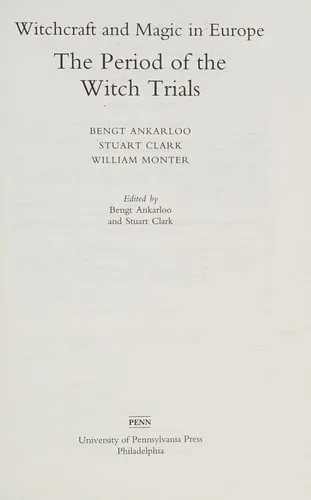
The period of the witch trials
 63
63

The period of the witch trials


Bengt Ankarloo's 'The Period of the Witch Trials' is an indispensable contribution to the esoteric library, offering a rigorous yet evocative examination of a pivotal era. Ankarloo masterfully navigates the treacherous currents of historical fact and the deeply ingrained mystical beliefs that permeated early modern society. He unearths the psychological underpinnings of mass hysteria and the societal anxieties that were projected onto accused witches, revealing how perceived supernatural forces were often invoked. This work is not merely a chronicle of injustice but a profound exploration of the human psyche under duress, and the potent symbolism embedded within accusations of witchcraft. Essential reading for serious scholars of occult history and practitioners seeking to understand the roots of modern magical thought.
📝 Description
63
Bengt Ankarloo's 1999 book analyzes the period of the witch trials.
Bengt Ankarloo's 'The Period of the Witch Trials' examines the historical events and underlying beliefs that drove the European witch hunts. The book moves beyond simple chronology to investigate the psychological and social factors contributing to the persecutions. Ankarloo considers how fear and superstition intertwined with societal anxieties and the perception of hidden knowledge.
He discusses the narratives that informed accusations and the communal atmosphere during periods of panic. The work addresses the complex relationship between the rational and the irrational, and how perceived 'other' powers fueled accusations. It considers how fear can distort perception and lead to the persecution of individuals. The book invites reflection on human nature and the persistent fascination with forbidden knowledge.
This work engages with the historical study of beliefs and practices often situated within esoteric traditions. It examines the social and psychological mechanisms that led to the persecution of individuals accused of witchcraft. The book analyzes the cultural context in which concepts of hidden powers and mystical influences were understood and feared, placing the witch trials within a broader history of how societies have grappled with the perceived supernatural and the 'other'.
💡 Why Read This Book?
Uncover the hidden currents of belief that shaped the witch trials. Explore the psychology of fear and persecution, and understand the lasting impact of these events on esoteric traditions. This book is essential for seekers of historical truth, occult scholars, and practitioners interested in the roots of magical practice and societal control.
⭐ Reader Reviews
Honest opinions from readers who have explored this book.
❓ Frequently Asked Questions
What geographical regions are primarily covered in this study?
While the book offers a broad overview, it significantly details the witch trials in Great Britain, France, and other European regions, providing a comprehensive understanding of the pan-European phenomenon.
Does the book focus on the legal aspects or the mystical beliefs?
Ankarloo skillfully interweaves both. The book meticulously examines the jurisprudence of the trials while also delving deeply into the prevalent mystical beliefs, folk magic, and perceived supernatural practices of the time.
Is this book suitable for beginners interested in witchcraft history?
Yes, while scholarly, the book is written in an accessible yet evocative style, making it suitable for beginners eager to understand the historical context of witchcraft accusations and beliefs.
What time period does 'The Period of the Witch Trials' primarily cover?
The book primarily focuses on the peak of the witch trials, spanning the 15th, 16th, and 17th centuries, with a particular emphasis on the intense persecutions of the latter half of the 17th century.
Does the book offer insights into the accused individuals themselves?
Absolutely. Ankarloo brings to life the stories of individuals caught in the maelstrom of accusations, offering glimpses into their lives, their alleged practices, and the societal forces that condemned them.
🔮 Key Themes & Symbolism
The Alchemy of Fear: Societal Hysteria and the Accused
This theme explores the psychological contagion of fear that swept through communities, transforming suspicion into outright terror. It examines how societal anxieties, economic hardship, and religious fervor were channeled into accusations of witchcraft, demonizing individuals who deviated from the norm or were perceived to possess 'other' powers. The 'alchemy' lies in how ordinary circumstances were transmuted into evidence of demonic pacts and malevolent intent, revealing the potent, often irrational, forces that drove these persecutions and the wide impact on the accused.
Whispers of the Otherworld: Folk Magic and Esoteric Beliefs
Beyond the legal proceedings, Ankarloo illuminates the body of folk magic, herbalism, and esoteric beliefs that were central to the accusations. This theme explores how traditional practices, often rooted in ancient pagan traditions or misunderstood Christian theology, were reinterpreted as evidence of diabolical influence. It examines the symbolic language of witchcraft, the perceived connection to nature spirits, and the clandestine rituals that were believed to be performed by witches, offering a window into the spiritual field of the time.
The Shadow of the Court: Jurisprudence and the Perversion of Justice
This theme critically analyzes the legal frameworks and judicial processes that enabled and perpetuated the witch trials. It scrutinizes the rules of evidence, the reliance on confessions (often extracted under duress), and the theological justifications used to condemn the accused. Ankarloo reveals how jurisprudence, intended to uphold order, became a tool for mass persecution, demonstrating the profound and tragic intersection of law, faith, and the manipulation of power in the pursuit of perceived evil.
💬 Memorable Quotes
Direct passages from the work, attributed to the author.
“The Devil's pact was often a projected shadow of societal discontent.”
— Suggests that accusations of demonic pacts were a way for communities to externalize their own internal conflicts, anxieties, and dissatisfactions, blaming an unseen force for their troubles.
“Herbs whispered secrets the learned ignored.”
— Points to the value of folk knowledge and natural remedies, often practiced by marginalized individuals, which were subsequently misinterpreted as dark magic by those in positions of authority.
“Justice, in those times, wore a mask of condemnation.”
— A poignant statement on how the legal system, meant to be impartial, was often biased and driven by prejudice, leading to predetermined outcomes of guilt and punishment.
“The line between healer and heretic was perilously thin.”
— Illustrates the precarious position of those who possessed knowledge of healing or spiritual practices, easily crossing into accusations of witchcraft when viewed through a lens of suspicion and religious dogma.
💡 Key Ideas
Editorial paraphrase of the work's core concepts — not direct quotes.
Fear is a potent architect of reality.
This quote highlights how collective fear can shape perceptions and create a shared, albeit distorted, understanding of events, leading to the construction of an 'other' that is then demonized.
🌙 Esoteric Significance
Tradition
This work is deeply rooted in the historical study of Western esotericism, particularly its manifestations in folk magic, demonology, and the perceived interactions with supernatural forces. It examines how occult beliefs, often intertwined with pre-Christian traditions and misunderstood Christian theology, were interpreted and prosecuted. The book sheds light on the historical development of concepts like the sabbat, pacts with the Devil, and the use of magical amulets and incantations, providing essential context for understanding the evolution of magical practices.
Symbolism
The witch trials are imbued with potent symbolism. Accusations of flying, shape-shifting, and consorting with demons represent the fear of the 'other' and the unknown. The witch's mark, often a physical anomaly, symbolized a perceived pact with the infernal. The trial itself became a ritualistic purging of perceived societal impurities, with symbols of innocence (like the white cock) contrasted with those of guilt (like the black cat). The symbolism explored highlights humanity's deep-seated need to understand and control the forces that lie beyond rational comprehension.
Modern Relevance
The legacy of the witch trials resonates profoundly today. The book's exploration of mass hysteria, scapegoating, and the dangers of unchecked religious or ideological fervor serves as a crucial cautionary tale. Understanding how fear and prejudice can be weaponized against 'outsiders' is vital in navigating contemporary societal challenges. Furthermore, the historical context of these trials offers insights into the enduring human fascination with magic, the occult, and the quest for hidden knowledge, informing modern practices and beliefs in witchcraft and paganism.
👥 Who Should Read This Book
This comprehensive volume is essential for a diverse readership. For the **occult scholar**, it provides meticulous historical grounding and deepens understanding of the roots of magical practice and societal fear. **Seekers of historical truth** will find an unflinching account of a dark period, revealing the complex interplay of belief and power. **Practitioners of witchcraft and related traditions** will gain invaluable context for their lineage, understanding the historical persecution and the resilience of esoteric knowledge. **Beginners** interested in the history of magic will find an accessible yet profound introduction to a crucial period, useful the societal forces that shaped perceptions of the 'witch'.
📜 Historical Context
The period of the witch trials, primarily spanning the 15th to the 18th centuries, was a tumultuous era in European history marked by profound religious upheaval, social unrest, and shifting political landscapes. The Reformation and Counter-Reformation intensified religious fervor and suspicion, while economic hardships and demographic changes fueled societal anxieties. This volatile environment created fertile ground for scapegoating, with marginalized individuals, particularly women, often becoming the targets of fear and superstition. The legal and theological frameworks of the time, influenced by works like the Malleus Maleficarum, provided the 'justification' for widespread accusations and brutal persecutions, transforming communities into arenas of paranoia and injustice. Understanding this context is crucial to grasping the complex interplay of belief, power, and human behavior that defined this dark chapter.
📔 Journal Prompts
Reflect on a modern-day 'witch hunt' - how are individuals or groups ostracized or demonized for being different?
Consider the role of fear in your own life and community. How does it influence perceptions and actions?
Explore the symbolism of the 'witch' in contemporary culture. What archetypes are still being explored or subverted?
How might the legal and societal frameworks of the witch trials have influenced the development of secret societies and esoteric orders?
Imagine you are an accused individual from the 17th century. What would be your most potent defense, and why?
🗂️ Glossary
Malleus Maleficarum
A notorious treatise on witchcraft, first published in 1487, widely used as a handbook by witch hunters. It codified beliefs about witches and provided methods for their detection and prosecution.
Sabbat
In the context of witch trial accusations, the Sabbat was a mythical nocturnal gathering of witches where they allegedly met with the Devil, engaged in dark rituals, and performed acts of sorcery.
Witch's Mark
A supposed physical abnormality or blemish on the body of an accused witch, believed to be the spot where the Devil had touched or suckled them. It was often used as 'evidence' of guilt.
Demonic Pact
An alleged agreement made between a witch and the Devil, in which the witch renounced their faith and pledged allegiance to Satan in exchange for supernatural powers or knowledge.
Jurisprudence
The theory or philosophy of law. In the context of witch trials, it refers to the legal principles, procedures, and precedents that guided the prosecution and sentencing of accused witches.
This book appears in 5 collections
🔮 Readers Also Liked
Browse all →







From the “Ritual Magic” Collection
View all →








More Free Magic & Ritual Books
View all →