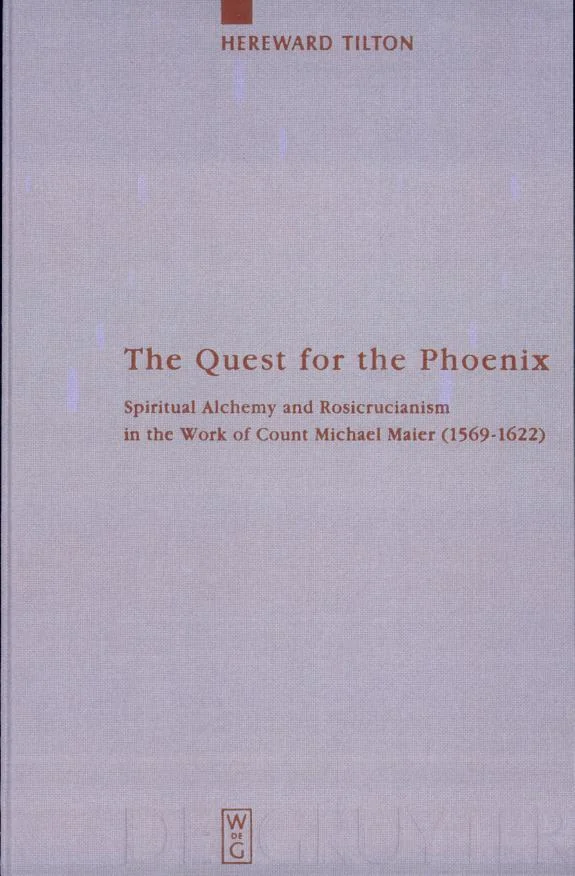
The Quest for the Phoenix
 77
77

The Quest for the Phoenix
Hereward Tilton’s study of Michael Maier, *The Quest for the Phoenix*, offers a rigorous examination of a pivotal figure in early modern esotericism. The author’s strength lies in meticulously tracing Maier’s intellectual development through his service at the court of Emperor Rudolf II, providing a rich contextualization often missing in studies of such figures. The detail with which Tilton dissects Maier’s alchemical symbolism, particularly in relation to the Rosicrucian movement, is commendable. A notable limitation, however, is the dense academic prose, which, while accurate, can make the material inaccessible to a less specialized reader. The exploration of Maier’s *Atalanta Fugiens* is particularly illuminating, demonstrating the author's deep engagement with primary sources. Tilton successfully argues for Maier's significant role in disseminating Rosicrucian ideas, moving beyond mere biographical sketches. This is an essential text for specialists, though its accessibility might deter the casual inquirer.
📝 Description
77
Hereward Tilton's 2018 book examines Count Michael Maier's alchemical and Rosicrucian contributions.
This academic biography of Count Michael Maier, a Lutheran alchemist and physician, details his significant role in Western esotericism. The author traces the development of Maier's Hermetic philosophy, placing it within the context of his service at the imperial court of Emperor Rudolf II and Moritz of Hessen-Kassel. The book also addresses the complex nature of early Rosicrucianism, analyzing Maier's part in its dissemination.
The work is designed for students and scholars of Western esotericism, alchemy, and the history of philosophy. It will interest those who study the connections between science, religion, and mysticism in the late Renaissance and early Baroque eras. Readers looking for an in-depth academic study of a specific historical figure and movement, rather than a general introduction, will find this book particularly useful.
Tilton situates Maier within the intellectual environment of late 16th and early 17th century Europe, a period marked by alchemical inquiry and the beginnings of Rosicrucianism. Maier's life and writings are examined against the backdrop of the Thirty Years' War and the patronage of Emperor Rudolf II, whose court attracted alchemists and natural philosophers. The book engages with historical discussions about the authenticity and origins of the Rosicrucian manifestos.
This book places Michael Maier within the Hermetic tradition, a philosophical and spiritual framework rooted in texts like the Hermetic Corpus and Neoplatonism. Maier's alchemical work is understood not just as a practical pursuit but as a symbolic path toward spiritual change. The study analyzes Rosicrucianism, a movement characterized by allegory and mystery, examining Maier's engagement with its early manifestations and literature during a period of intense intellectual and religious upheaval in Europe.
💡 Why Read This Book?
• Gain specific insights into the Hermetic worldview as articulated by Michael Maier, understanding its development during his service at Emperor Rudolf II's court. • Grasp the historical complexities of early Rosicrucianism by examining Maier's direct involvement and promotional efforts, as detailed in the text. • Learn about the alchemical symbolism employed by Maier, such as the allegorical meanings within his work *Atalanta Fugiens*, providing a concrete example of esoteric practice.
⭐ Reader Reviews
Honest opinions from readers who have explored this book.
❓ Frequently Asked Questions
Who was Count Michael Maier and why is he important?
Count Michael Maier (1568–1622) was a German physician, alchemist, and writer. He is significant for his role in promoting Rosicrucian ideas and for his extensive alchemical writings, which sought to synthesize Hermetic philosophy with Christian theology.
What is the historical period covered in this book?
The book primarily covers the late 16th and early 17th centuries, a period of intense intellectual ferment in Europe marked by the rise of Hermeticism, alchemy, and the enigmatic Rosicrucian movement.
How does the book discuss Rosicrucianism?
It addresses the nature of early Rosicrucianism by detailing Michael Maier's influential role in disseminating and interpreting its tenets, particularly through his writings and connections at imperial courts.
What is the author's approach to studying esotericism?
The author employs an academic, intellectual biography approach, situating Maier's Hermetic worldview within its specific historical and courtly contexts, rather than presenting a purely philosophical or practical guide.
Does the book focus solely on Michael Maier?
While Maier is the central figure, the book also explores Western esotericism in general, touching upon alchemy and Rosicrucianism as broader movements influenced by and influencing Maier's work.
What specific courts are mentioned in relation to Maier?
The book details Maier's service and intellectual activities at the courts of Emperor Rudolf II and Moritz of Hessen-Kassel, highlighting the patronage and environment that shaped his Hermetic worldview.
🔮 Key Themes & Symbolism
Michael Maier's Hermeticism
This theme centers on the intellectual biography of Count Michael Maier, analyzing the development of his Hermetic worldview. It explores how his philosophical and spiritual framework was shaped by his engagement with ancient Hermetic texts and contemporary alchemical traditions. The work contextualizes Maier's thought within his service at significant European courts, demonstrating how patronage and political environments influenced esoteric ideas. It examines Maier's synthesis of mystical, philosophical, and scientific pursuits characteristic of the era's intellectual landscape.
Alchemy and Spiritual Transformation
The book investigates alchemy not merely as a proto-scientific endeavor but as a symbolic language for spiritual and psychological transformation. It looks at Maier's specific alchemical theories and practices, interpreting his allegorical writings and diagrams as pathways to inner realization. The study highlights how alchemical symbolism, as employed by Maier, served as a vehicle for expressing complex metaphysical concepts and achieving a higher state of consciousness, aligning with broader Hermetic goals.
The Rosicrucian Enigma
A significant focus is placed on the early Rosicrucian movement and Michael Maier's a central role in its promotion and interpretation. The work addresses the historical debate surrounding the origins and nature of Rosicrucianism, analyzing Maier's writings and actions in this context. It explores how Maier contributed to the mystique and spread of Rosicrucian ideals, examining his attempts to connect these esoteric currents with established religious and political structures of the time.
Courtly Esotericism
This theme examines the patronage and intellectual milieu of the courts where Maier served, particularly those of Emperor Rudolf II and Moritz of Hessen-Kassel. It illustrates how esoteric knowledge, including alchemy and Hermetic philosophy, was cultivated and circulated within these aristocratic circles. The book highlights the complex relationship between esoteric practitioners, rulers, and the broader political and religious range of the late Renaissance and early Baroque periods.
💬 Memorable Quotes
Direct passages from the work, attributed to the author.
“Maier's Hermetic worldview developed within the context of his service at the courts of Emperor Rudolf II and Moritz of Hessen-Kassel.”
— This highlights the crucial interplay between personal intellectual development and the socio-political environment of court patronage, suggesting that esoteric ideas were nurtured and shaped by these elite circles.
“The work addresses the nature of early Rosicrucianism with reference to Maier's role in its promotion.”
— This points to the book's focus on clarifying historical debates surrounding the Rosicrucian movement by analyzing the significant contributions of a key figure, Michael Maier.
“The study charts the development of Maier's Hermetic worldview.”
— This indicates an intellectual biography approach, tracing the evolution of a complex philosophical and spiritual system within a specific historical individual.
“Alchemy is presented as integral to understanding Western esotericism.”
— This signifies the book's perspective on alchemy not just as a chemical art but as a fundamental component of broader esoteric traditions and philosophies.
“The book examines Maier's contributions to both alchemy and Rosicrucianism.”
— This emphasizes the dual focus of the study, exploring Maier's engagement with two of the most significant esoteric movements of his era.
🌙 Esoteric Significance
Tradition
This work falls squarely within the Hermetic tradition, exploring its manifestation through alchemy and the Rosicrucian current in early modern Europe. It represents a scholarly engagement with how Hermetic principles, derived from the *Corpus Hermeticum* and Neoplatonism, were synthesized with Christian theology and alchemical practice by figures like Michael Maier. The book fits within the lineage of studies examining the transmission and adaptation of esoteric ideas across different historical periods and cultural contexts.
Symbolism
Key symbols explored include the Phoenix, representing cyclical rebirth, spiritual regeneration, and the ultimate alchemical goal of perfection. The serpent, often symbolizing wisdom, transformation, and the unification of opposites (as in the Ouroboros), is another significant motif. The work also looks at the symbolic language of alchemical processes themselves, interpreting them as allegorical representations of spiritual purification and enlightenment, central to the Hermetic quest for hidden knowledge.
Modern Relevance
Contemporary scholars and practitioners of Western esotericism continue to draw on studies like this for their rigorous historical analysis of foundational figures and movements. Thinkers interested in the historical roots of alchemy, Rosicrucianism, and Hermetic philosophy find Maier's work, as elucidated here, essential for understanding the evolution of these traditions. The book's contextualization of esoteric ideas within courtly and religious structures provides a valuable framework for contemporary discussions on the relationship between spirituality, power, and knowledge.
👥 Who Should Read This Book
• Scholars of Western Esotericism: Those researching the history of alchemy, Hermeticism, and the Rosicrucian movement will find this an indispensable academic resource detailing Michael Maier's significant contributions. • Students of Early Modern Intellectual History: Readers interested in the complex interplay of religion, philosophy, science, and mysticism in the 16th and 17th centuries will benefit from the book's contextualization of Maier's life and work. • Practitioners of Alchemy and Hermetic Arts: Individuals seeking to understand the historical underpinnings and symbolic language of alchemical traditions will gain deeper context from this detailed study of a key historical figure.
📜 Historical Context
Hereward Tilton's *The Quest for the Phoenix* emerges from a period of renewed scholarly interest in Western esotericism, particularly in the late 20th and early 21st centuries. The book situates Michael Maier within the vibrant, yet often clandestine, intellectual milieu of the late 16th and early 17th centuries. This era was characterized by intense alchemical speculation, the rise of Hermetic philosophy, and the mysterious appearance of the Rosicrucian manifestos around 1614. Maier, a physician and alchemist, served at the courts of Emperor Rudolf II in Prague and Moritz of Hessen-Kassel, environments known for their patronage of natural philosophers and mystics. His work engaged with competing intellectual currents, including Paracelsianism and the burgeoning scientific revolution. Unlike purely philosophical treatises, Maier's writings were deeply embedded in the political and religious upheavals of the time, including the lead-up to the Thirty Years' War. The reception of Maier's work and the Rosicrucian movement itself was complex, marked by both fascination and suspicion.
📔 Journal Prompts
Maier's synthesis of Hermetic philosophy and Lutheran theology.
The symbolic meaning of the Phoenix in Maier's work.
Court patronage and its influence on esoteric development.
The portrayal of early Rosicrucianism through Maier's lens.
Alchemical allegory as a path to spiritual transformation.
🗂️ Glossary
Hermeticism
A religious, philosophical, and esoteric tradition based on writings attributed to Hermes Trismegistus. It emphasizes divine knowledge, the interconnectedness of all things, and the pursuit of spiritual enlightenment through understanding the cosmos.
Alchemy
An ancient tradition involving the study of matter and its transformations, often aiming for the creation of the philosopher's stone, but also encompassing spiritual and philosophical pursuits related to purification and perfection.
Rosicrucianism
A spiritual and philosophical movement that emerged in Europe in the early 17th century, characterized by mysticism, esoteric knowledge, and the pursuit of spiritual wisdom, often expressed through allegory and symbolism.
Intellectual Biography
A form of biography that focuses on the intellectual development, ideas, and scholarly contributions of its subject, tracing the evolution of their thought within its historical context.
Hermetic Worldview
A comprehensive perspective on reality influenced by Hermetic principles, emphasizing correspondences between the macrocosm (universe) and microcosm (human), divine wisdom, and the potential for human spiritual ascent.
Allegory
The use of symbols and symbolic narratives to convey hidden meanings, often moral, spiritual, or political. In alchemy, allegorical language was used to describe spiritual processes.
Emperor Rudolf II
Holy Roman Emperor (reigned 1576–1612) known for his patronage of arts, sciences, and occult studies, including alchemy, attracting figures like Michael Maier to his court in Prague.
This book appears in 3 collections
🔮 Readers Also Liked
Browse all →







From the “Spiritual Alchemy” Collection
View all →







More Free Esoteric History & Biography Books
View all →