Sinconis'tee
 71
71

Sinconis'tee
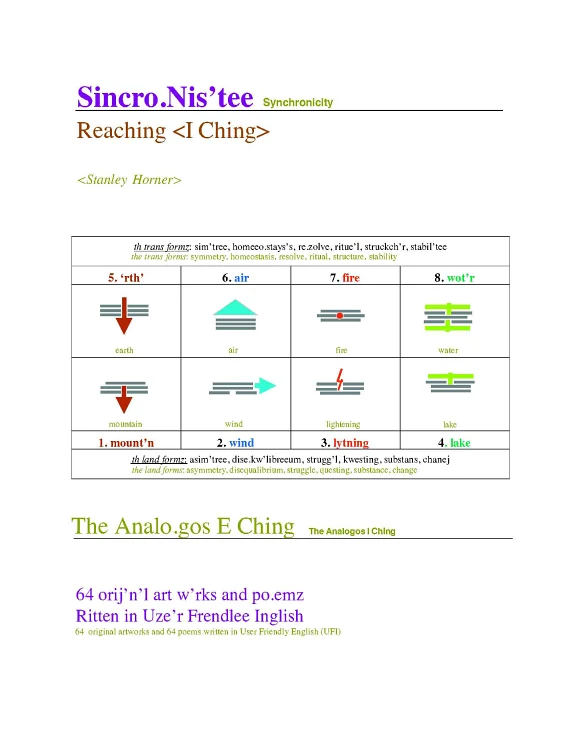
Stanley Horner’s Sinconis'tee makes a bold claim by presenting what he terms "iiae"—an integration of artwork and poetry for each of the I Ching’s 64 hexagrams. The ambition is palpable; Horner has clearly invested considerable effort in creating a parallel visual and lyrical commentary on this foundational text. The artworks themselves, while varied in style, often capture an essence of the hexagram's associated imagery or philosophical thrust. For instance, the visual for Hexagram 1, Qian (The Creative), successfully evokes a sense of upward movement and celestial power, which is mirrored to some degree in its accompanying poem. However, the primary limitation lies in the inconsistent depth of interpretation. While some poems offer fresh perspectives, others feel more like descriptive verses rather than profound elaborations on the I Ching's complex symbolic language. The term "iiae" itself, while novel, doesn't always feel fully justified by the execution, occasionally blurring the line between inspired interpretation and mere artistic illustration. The work is ultimately an interesting, if uneven, attempt to revitalize engagement with the Book of Change through a dual artistic medium.
📝 Description
71
Published in 2000, Stanley Horner's Sinconis'tee presents 64 artworks and poems interpreting the I Ching.
Stanley Horner's 2000 book, Sinconis'tee, offers a unique interpretation of the ancient Chinese Book of Change. It contains 64 distinct artworks, each one paired with an original poem, corresponding to the 64 hexagrams of the I Ching. Horner developed this method to create what he termed "iiae" or integrated interpretive art-expression, where the visual and poetic elements work together to convey the hexagrams' meanings.
This volume is designed for those interested in the confluence of art, philosophy, and divination. It will appeal to students of Chinese philosophy, comparative religion scholars, and artists who engage with classical texts through synesthetic approaches. It also serves those who appreciate esoteric practices and symbolic interpretation, providing a rich sensory experience of a text with long-standing influence.
Sinconis'tee emerged at the turn of the millennium, a time when Western esoteric circles saw renewed interest in Eastern philosophies and divination. The I Ching, already a widely translated text, was reexamined through contemporary artistic and psychological lenses. Horner's work fits into a late 20th and early 21st century trend of reinterpreting traditional texts beyond purely academic or divinatory uses, incorporating artistic expression into the understanding of these systems.
💡 Why Read This Book?
• Understand the I Ching through a unique synesthetic lens: Learn how Horner’s 64 artworks and 64 poems, presented as "iiae," offer a complementary visual and lyrical interpretation of each hexagram, going beyond traditional textual analysis. • Explore the concept of "iiae": Grasp Horner's specific term for integrated interpretive art-expression and how it aims to capture the essence of each I Ching principle through combined visual and poetic elements. • Engage with a 21st-century artistic interpretation of ancient wisdom: Discover how contemporary artists like Horner re-envision classical texts like the Book of Change, offering a bridge between ancient philosophy and modern aesthetic sensibilities.
⭐ Reader Reviews
Honest opinions from readers who have explored this book.
❓ Frequently Asked Questions
What is "iiae" as presented in Sinconis'tee?
"iiae" stands for integrated interpretive art-expression. Stanley Horner uses this term to describe his unique method in Sinconis'tee, where each of the 64 I Ching hexagrams is represented by a singular body of work combining original artwork and poetry.
How does Sinconis'tee relate to the traditional I Ching?
Sinconis'tee offers a contemporary artistic and poetic interpretation of the 64 hexagrams of the I Ching, also known as the Book of Change. It complements traditional understanding by providing visual and lyrical associations for each symbol.
Who is Stanley Horner and when was Sinconis'tee first published?
Stanley Horner is the author and artist behind Sinconis'tee. The book was first published in the year 2000, presenting his unique approach to the I Ching.
Is Sinconis'tee a practical guide for I Ching divination?
While it offers new perspectives, Sinconis'tee is primarily an artistic and philosophical exploration rather than a straightforward divination manual. Its value lies in its interpretive depth and creative synthesis.
What makes the artworks in Sinconis'tee significant?
The 64 artworks are created specifically to correspond with each hexagram of the I Ching. They are intended to visually embody the concepts and archetypes associated with these ancient symbols.
Can Sinconis'tee be used by Western audiences familiar with the I Ching?
Yes, the book is particularly valuable for Western readers familiar with the I Ching, offering a modern, artistically driven commentary that can deepen their understanding and appreciation of this ancient Chinese classic.
🔮 Key Themes & Symbolism
The I Ching as Visual Art
Horner's work posits the I Ching not just as a text for divination or philosophy, but as a source of visual inspiration. Each hexagram is translated into a distinct artwork, demonstrating how abstract principles can be given concrete form. This challenges the traditional reliance on textual commentary by offering a parallel aesthetic interpretation, suggesting that the archetypal energies of the Book of Change can be perceived and communicated through visual language alongside the written word.
Synesthetic Interpretation
The core of Sinconis'tee lies in its creation of "iiae" – integrated interpretive art-expression. This approach seeks to unify visual and poetic elements, suggesting that the meaning of an I Ching hexagram is best understood when experienced through multiple sensory and intellectual channels. Horner's poems are designed to echo the sentiments and imagery evoked by his paintings, creating a holistic interpretive experience that moves beyond a single mode of understanding.
Modernizing Ancient Wisdom
Published in 2000, Sinconis'tee represents a late 20th-century effort to engage with foundational Eastern philosophical texts through contemporary artistic means. It reflects a broader trend of reinterpreting classical wisdom for a modern audience, moving beyond purely academic or spiritual applications. Horner's work provides a bridge, allowing individuals to connect with the enduring principles of the I Ching through a format that is both aesthetically engaging and intellectually stimulating.
The Hexagram as a Unified Concept
Rather than treating the 64 hexagrams as isolated symbols, Horner presents them as complete conceptual units, each encapsulated by its corresponding artwork and poem. This integrated approach emphasizes the many-sided nature of each hexagram's meaning, suggesting that its essence can be conveyed through a fusion of visual representation and poetic articulation. The book argues for a holistic understanding, where art and poetry serve as equally valid interpretive tools as the classical texts themselves.
💬 Memorable Quotes
Direct passages from the work, attributed to the author.
“The artwork and poem together form a singular body of work for each hexagram.”
— This statement expresses Horner's central thesis: that the visual and lyrical components are not separate additions but a unified expression, intended to convey a more complete understanding of the I Ching's principles.
“Horner coined the term 'iiae' for his integrated interpretive art-expression.”
— This highlights the novel terminology Horner introduced to describe his specific method of combining visual art and poetry for each hexagram, aiming for a holistic interpretive outcome.
“The first full-fledged example of iiae.”
— This assertion frames Sinconis'tee as a pioneering work in its specific approach, claiming originality for its comprehensive integration of art and poetry in the interpretation of the I Ching.
“The Book of Change, still used today extensively in both Modern China and the West.”
— This reflects the enduring relevance and widespread influence of the I Ching, providing context for Horner's contemporary artistic engagement with this ancient text.
💡 Key Ideas
Editorial paraphrase of the work's core concepts — not direct quotes.
An exploration of the Book of Change through 64 artworks and 64 poems.
This paraphrased concept highlights the book's structure and subject matter, emphasizing the dual artistic mediums Horner employed to re-interpret the ancient Chinese text.
🌙 Esoteric Significance
Tradition
Sinconis'tee engages with the Hermetic principle of correspondence, particularly the idea that 'as above, so below.' While not strictly Hermetic, its approach to the I Ching aligns with esoteric traditions that seek symbolic parallels between the macrocosm (universal patterns) and the microcosm (human experience and expression). It departs from purely textual or ritualistic engagement by emphasizing art as a valid channel for transmitting esoteric understanding, viewing the hexagrams as archetypal forms that can be expressed across different media.
Symbolism
The primary symbols are the 64 hexagrams themselves, each representing fundamental archetypal forces and situational dynamics. Horner's artworks aim to visualize these concepts – for example, the dynamic interplay of Yin and Yang lines in hexagrams like 'The Cauldron' (Ding) or 'The Abysmal' (Kan). His accompanying poems further elucidate these symbolic meanings, often focusing on the inherent tension, transformation, or balance depicted within each hexagram's structure.
Modern Relevance
Contemporary artists, designers, and thinkers interested in generative art, symbolic systems, and interdisciplinary approaches to ancient texts draw inspiration from Horner's "iiae" concept. It appeals to modern practices that explore the intersection of technology, art, and philosophy, particularly within fields like consciousness studies and digital humanities, where symbolic representation and pattern recognition are key.
👥 Who Should Read This Book
['• Students of Eastern philosophy and comparative religion: Gain a unique visual and poetic perspective on the I Ching, complementing traditional textual studies and understanding its influence beyond academic discourse.', '• Visual artists and poets: Explore how classical symbolic systems can inspire contemporary creative work, offering a model for integrating different artistic disciplines to interpret complex ideas.', '• Practitioners of esoteric traditions: Discover a novel method for engaging with archetypal patterns, using art and poetry as tools for personal insight and understanding of universal principles.']
📜 Historical Context
Sinconis'tee emerged in 2000, a period when Western esoteric and philosophical circles showed increasing interest in Eastern traditions, particularly the I Ching. While translations like Richard Wilhelm's had long been available, Horner's approach offered a novel, art-centric engagement. This occurred within a broader late 20th-century movement that sought to integrate traditional wisdom with contemporary artistic expression, moving beyond purely academic study or traditional divinatory practices. Unlike the more direct philosophical analyses prevalent in scholarship, or the pragmatic focus of many divination guides, Horner’s work prioritized synesthetic interpretation. His "iiae" concept can be seen as a contemporary response to the symbolic richness of the I Ching, akin to how Jungian psychology explored archetypes through various lenses. There was no significant documented critical reception or censorship event surrounding Horner's work at its release, but it contributed to the growing body of literature that reinterpreted classical texts for a modern, visually oriented audience.
📔 Journal Prompts
The artwork and poem for Hexagram 1, Qian (The Creative): how do these dual expressions inform your understanding of initiation?
Reflect on the symbolic interplay between visual art and poetry in representing the 64 hexagrams.
Consider the concept of "iiae" as a method for interpreting any complex system.
How does Horner's interpretation of the I Ching's archetypes differ from other sources you know?
Explore the balance of Yin and Yang in a specific hexagram's artwork and poem.
🗂️ Glossary
I Ching
Also known as the Book of Change, an ancient Chinese divination text and philosophical classic, comprising 64 hexagrams formed by combinations of six stacked "lines" (solid for Yang, broken for Yin).
Hexagram
A figure composed of six stacked horizontal lines, each line being either solid (Yang) or broken (Yin). There are 64 possible hexagrams in the I Ching.
iiae
An acronym coined by Stanley Horner for 'integrated interpretive art-expression,' referring to his method of combining original artwork and poetry to interpret each I Ching hexagram.
Yang
In I Ching symbolism, represented by a solid line (—), often associated with the masculine, active, light, and creative principles.
Yin
In I Ching symbolism, represented by a broken line (— —), often associated with the feminine, passive, dark, and receptive principles.
Book of Change
An alternative and common name for the I Ching, emphasizing its function as a guide to understanding and navigating life's transformations.
Line
The basic component of an I Ching hexagram, depicted as either solid (Yang) or broken (Yin), carrying specific symbolic meaning within the larger structure.
This book appears in 1 collection
🔮 Readers Also Liked
Browse all →







From the “I Ching” Collection
View all →









More Free Occult Philosophy Books
View all →