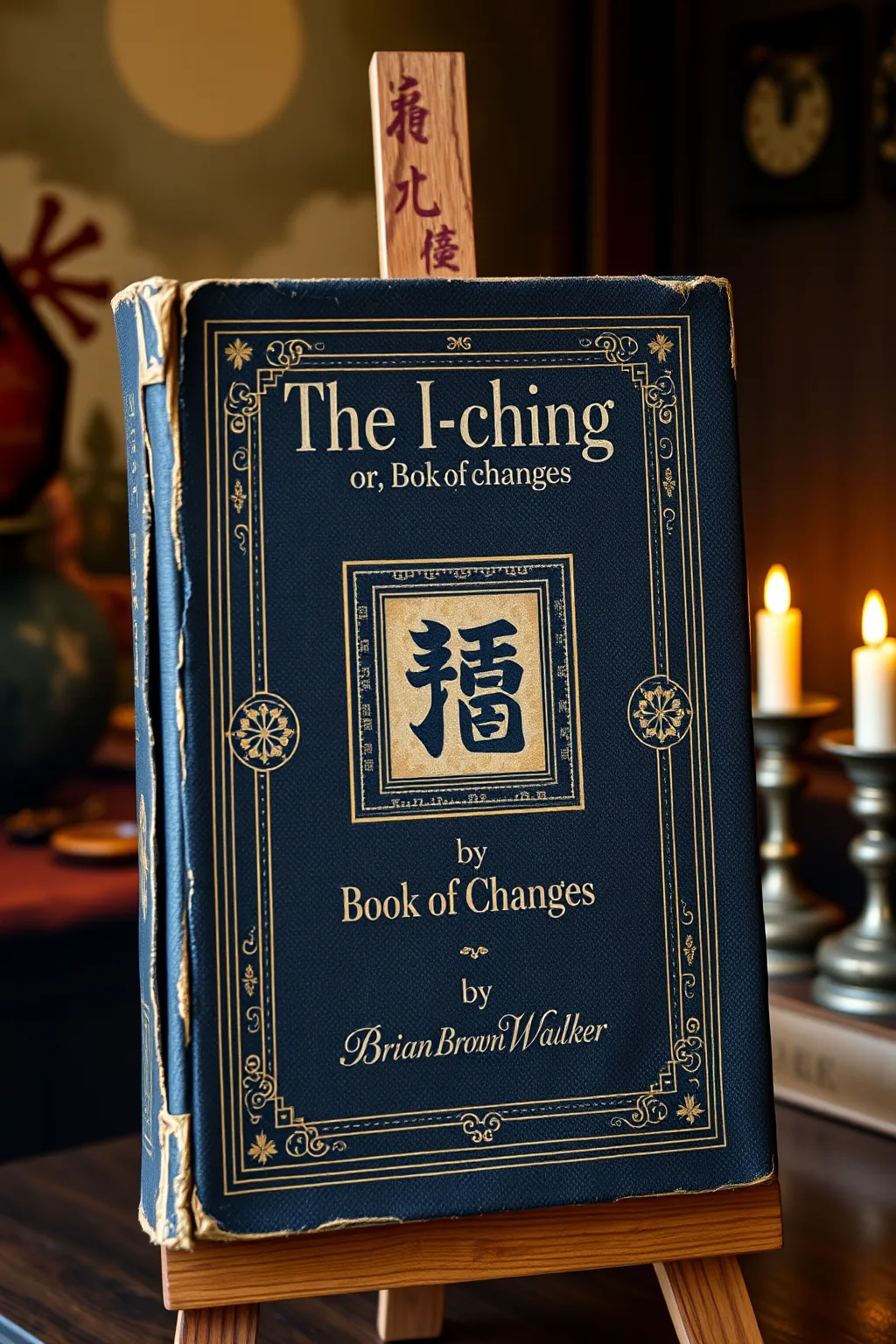
The I ching, or, Book of changes
 61
61

The I ching, or, Book of changes



Brian Browne Walker's *The I Ching, or, Book of Changes* stands as a luminous beacon in the often-obscure landscape of ancient wisdom. Walker's profound understanding of the text's esoteric underpinnings is evident in every carefully chosen word. He masterfully deciphers the complex symbolism, revealing the profound philosophical and spiritual insights embedded within the hexagrams. This edition transcends mere translation; it is an invitation to a deep, meditative engagement with the Oracle. Its strength lies in its clarity and accessibility, making the profound wisdom of the *I Ching* available to both seasoned practitioners and curious newcomers seeking guidance on life's most intricate questions. A truly indispensable resource for anyone on a path of self-discovery and spiritual growth.
📝 Description
61
Brian Browne Walker's 1993 translation of the I Ching offers a clear rendering of this ancient Chinese text.
Brian Browne Walker's translation of the *I Ching*, or *Book of Changes*, presents this classic Chinese text with a focus on practical understanding. Walker's aim was to make the hexagrams accessible, moving beyond mere fortune telling to show how the text functions as a system for comprehending the Tao, the underlying principle of existence. The book details each of the 64 hexagrams, explaining their imagery and meaning.
The translation works to clarify the language of the *I Ching*, so readers can engage with its insights on causality and personal growth. It invites a contemplative approach, encouraging users to connect with the text's philosophical underpinnings. This edition is suited for individuals interested in the *I Ching*'s philosophical depth and its potential for guidance in daily life. It addresses themes of destiny, change, and living in harmony with natural patterns.
The *I Ching* is a foundational text in Chinese philosophy and divination, dating back over 2,500 years. It is regarded as a primary source for understanding the principles of change and balance in the universe, often referred to as the Tao. Its methods involve casting yarrow stalks or coins to generate hexagrams, which are then interpreted to offer insight into situations and potential future developments. This system has influenced various esoteric traditions, including Taoism and Confucianism, and has been adopted by Western occultists and philosophers seeking a framework for understanding cosmic order and personal transformation.
💡 Why Read This Book?
Unlock the secrets of cosmic harmony and personal destiny. This *I Ching* offers profound, actionable wisdom for navigating life's challenges and opportunities. It's an essential guide for seekers of ancient knowledge, students of philosophy, and practitioners of divination seeking deeper understanding and intuitive guidance. Transform your perception and align with the universal flow.
⭐ Reader Reviews
Honest opinions from readers who have explored this book.
❓ Frequently Asked Questions
What is the I Ching?
The *I Ching*, or *Book of Changes*, is an ancient Chinese text used for divination and wisdom. It comprises 64 hexagrams, each representing a fundamental situation and offering guidance on how to act in accordance with the natural order of the universe.
Who was Brian Browne Walker?
Brian Browne Walker was a respected scholar and translator dedicated to making esoteric and philosophical texts accessible. His translations are known for their clarity, depth, and preservation of the original work's spiritual essence.
How is the I Ching used for divination?
Traditionally, divination involves casting yarrow stalks or coins to generate a hexagram. This hexagram, along with its changing lines, is then consulted for insight into a specific question or situation.
Is this translation suitable for beginners?
Yes, Brian Browne Walker's translation is lauded for its clarity and comprehensive explanations, making it an excellent starting point for those new to the *I Ching*, while still offering depth for experienced practitioners.
What are the philosophical implications of the I Ching?
The *I Ching* explores themes of change, balance, causality, and the Tao. It teaches that life is in constant flux and encourages adaptability, introspection, and alignment with natural principles for harmonious living.
🔮 Key Themes & Symbolism
The Nature of Change and Transformation
Fundamentally, the *I Ching* is a profound exploration of change, not as a disruptive force, but as the fundamental essence of existence. It illustrates how all things are in a perpetual state of flux, transforming from one form to another. The hexagrams serve as archetypal representations of these transformations, offering guidance on how to navigate periods of transition with wisdom and resilience. This theme encourages an understanding of impermanence, fostering adaptability and acceptance of life’s inherent dynamism. It teaches that by understanding the patterns of change, one can align themselves with the cosmic flow, leading to greater harmony and effectiveness in all endeavors.
Cosmic Harmony and the Tao
The *I Ching* is deeply rooted in the concept of the Tao, the ineffable principle that governs the universe. It posits that true wisdom lies in understanding and aligning oneself with this natural order. The hexagrams act as a map of cosmic forces, revealing the underlying principles that shape events and human experience. By studying these patterns, individuals can learn to live in greater harmony with themselves, others, and the universe. This theme emphasizes the interconnectedness of all things and the importance of balance, moderation, and spontaneity in achieving a state of profound well-being and spiritual realization.
The Art of Wise Action and Decision-Making
Beyond mere prediction, the *I Ching* is a sophisticated guide to wise action and decision-making. Each hexagram provides a unique perspective on a given situation, along with advice on the most appropriate course of action. It encourages introspection, self-awareness, and a deep consideration of consequences. The text doesn't dictate fate but empowers the individual to make informed choices by understanding the prevailing energies and potential outcomes. This theme highlights the *I Ching* as a practical tool for ethical conduct, personal growth, and working through the complexities of life with clarity, intention, and a profound sense of responsibility.
💬 Memorable Quotes
Direct passages from the work, attributed to the author.
“When the way is clear, the path is easy.”
— This emphasizes the importance of clarity in intention and purpose. When one understands their true direction, obstacles become less daunting, and progress is more fluid and natural.
“The wise man is not content to be happy, but seeks to do good.”
— This profound statement elevates the purpose of wisdom beyond personal contentment to a commitment to ethical action and contributing positively to the world, reflecting a higher spiritual aspiration.
💡 Key Ideas
Editorial paraphrase of the work's core concepts — not direct quotes.
The superior man understands the changes of things.
This quote highlights the core principle of the *I Ching*: the ability to perceive and adapt to the ever-present shifts in life. It speaks to developing foresight and wisdom to navigate transitions.
To know oneself is to know the Tao.
This quote connects inner self-knowledge with understanding the universal principles of the Tao. It suggests that the path to cosmic understanding begins with deep introspection and self-awareness.
Change is the only constant.
A succinct expression of the *I Ching*'s fundamental philosophy, this quote reminds us that life is dynamic and that embracing change is key to navigating existence effectively and finding peace within flux.
🌙 Esoteric Significance
Tradition
The *I Ching* is a core part of Chinese esoteric traditions, including Taoism and later, esoteric Buddhism. It is deeply intertwined with principles of Yin and Yang, the Five Elements, and the concept of the Tao. Its practice involves not just divination but also meditation, introspection, and the cultivation of inner harmony to align with cosmic forces. It serves as a sacred text for understanding the subtle energies that govern both the macrocosm and the microcosm, guiding practitioners toward spiritual enlightenment and effective action within the world.
Symbolism
The hexagrams, composed of six lines (broken for Yin, solid for Yang), are rich with symbolic meaning. Each of the 64 hexagrams represents a universal archetype or situation. The trigrams (three-line combinations) symbolize fundamental elements like Heaven, Earth, Water, Fire, and Thunder. These symbols are not static but represent dynamic forces in constant interplay, offering a visual language for understanding the complexities of life, cosmic patterns, and the interconnectedness of all phenomena, serving as keys to unlocking deeper wisdom.
Modern Relevance
In the modern era, the *I Ching* continues to offer profound relevance as a tool for introspection, ethical guidance, and working through the complexities of contemporary life. It provides a framework for understanding change, making balanced decisions, and fostering personal growth in a rapidly evolving world. Its timeless wisdom on adaptability, resilience, and finding harmony speaks directly to the anxieties and challenges faced by individuals today, offering a pathway to greater self-awareness and a more meaningful existence.
👥 Who Should Read This Book
This edition of the *I Ching* is a treasure for a diverse range of readers. For the absolute beginner, Brian Browne Walker's clear prose and comprehensive explanations provide an accessible entry point into this ancient system. Scholars of philosophy, comparative religion, and East Asian studies will find it an authoritative and insightful resource. Spiritual seekers and practitioners of divination will discover a profound tool for self-discovery, ethical contemplation, and navigating life's uncertainties with wisdom. Anyone interested in the perennial wisdom traditions and seeking a deeper connection to the underlying patterns of existence will find immense value within its pages.
📜 Historical Context
The *I Ching*, or *Book of Changes*, emerged from ancient Chinese culture, with its origins stretching back possibly to the Shang Dynasty (c. 1600–1046 BCE). Its earliest layers likely consist of divination records and philosophical musings. By the Zhou Dynasty (c. 1046–256 BCE), it had evolved into a more structured text, with the addition of commentaries like the Ten Wings, attributed to Confucius and his disciples. This period saw the *I Ching* transition from a purely divinatory tool to a profound philosophical and ethical guide. Its influence permeated Chinese society, impacting governance, warfare, personal conduct, and the development of Taoism and Confucianism. Throughout imperial China, it remained a central text for scholars, statesmen, and mystics, its wisdom continually reinterpreted and applied to new challenges, solidifying its status as a foundational pillar of East Asian thought and spiritual practice.
📔 Journal Prompts
Reflect on a recent significant change in your life. How does the energy of a specific hexagram resonate with this experience?
Consider a current dilemma. What core principles of Yin and Yang are at play, and how can balance be achieved?
How can you apply the wisdom of the *I Ching*'s emphasis on 'wise action' to a decision you face today?
Explore the concept of 'cosmic harmony' in your daily life. Where do you feel most aligned, and where are there opportunities for greater balance?
Meditate on the idea of 'change as the only constant.' How does this perspective shift your approach to challenges and uncertainties?
🗂️ Glossary
Hexagram
A six-line symbol composed of trigrams, representing one of the 64 fundamental archetypes or situations described in the *I Ching*, used for divination and wisdom.
Trigram
A basic three-line symbol (composed of solid Yang lines and broken Yin lines) that forms the building blocks of the hexagrams in the *I Ching*. There are eight primary trigrams.
Tao (or Dao)
The fundamental, ineffable principle of the universe in Chinese philosophy, representing the natural order, the 'Way,' and the source of all existence.
Yin
In Taoist philosophy and the *I Ching*, Yin represents the passive, receptive, dark, feminine, and yielding aspects of reality, often symbolized by a broken line.
Yang
In Taoist philosophy and the *I Ching*, Yang represents the active, creative, light, masculine, and assertive aspects of reality, often symbolized by a solid line.
This book appears in 2 collections
🔮 Readers Also Liked
Browse all →









More by Brian Browne Walker
All books →
From the “I Ching” Collection
View all →









More Free Divination & Tarot Books
View all →