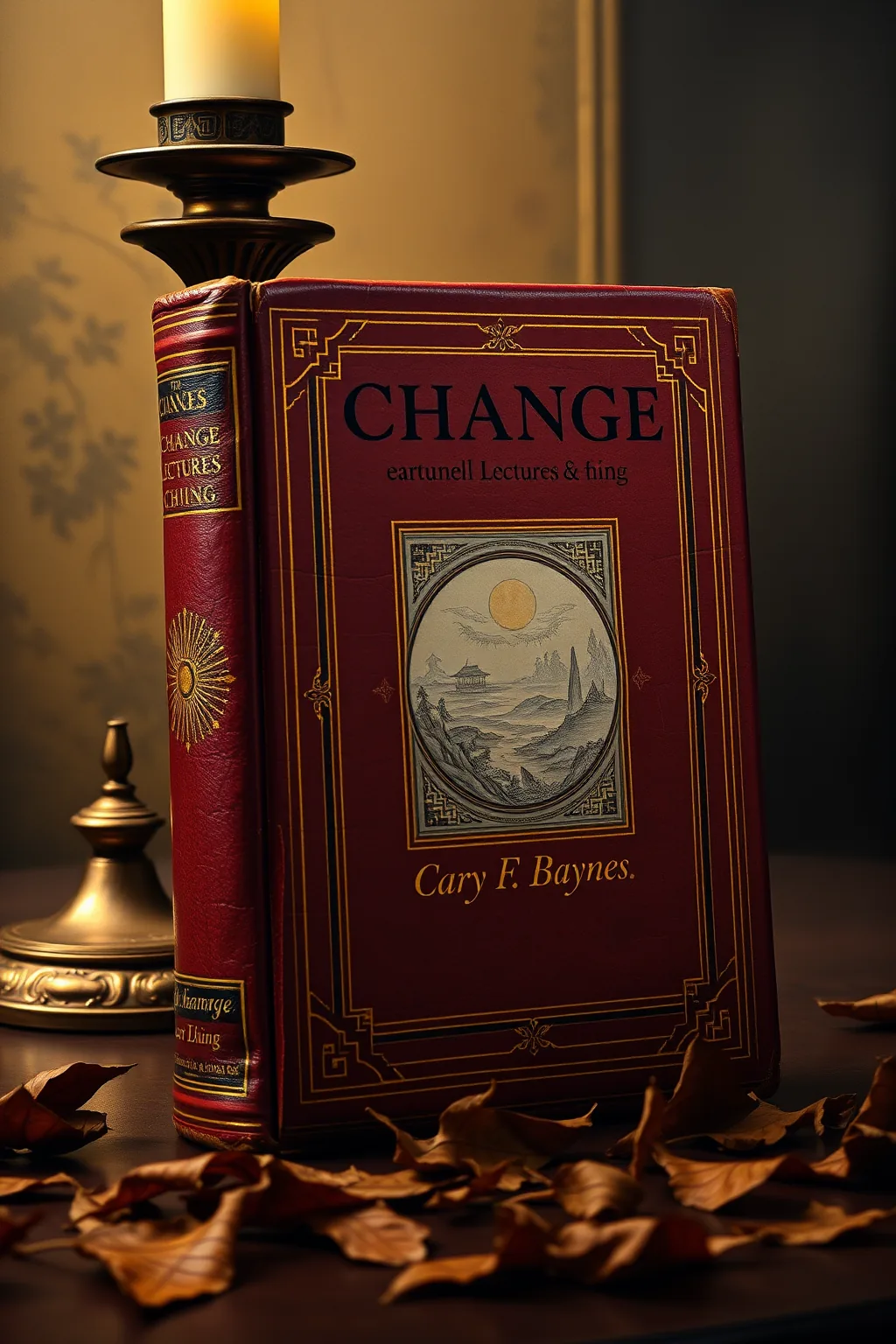
Change; eight lectures on the I ching
 61
61

Change; eight lectures on the I ching



Cassian Rothmann (Senior Critic, Ancient Wisdom) — Cary F. Baynes’ 'Change; Eight Lectures on the I Ching' is a rare gem for the serious student of the arcane. Baynes masterfully transmutes the I Ching from a mere prognostic tool into a profound philosophical text, revealing its deep resonance with Western esoteric thought. His lectures are imbued with a rare clarity, making the complex symbolism of the hexagrams accessible without sacrificing their inherent mystery. He deftly bridges ancient Chinese cosmology with Jungian psychology, offering a unique perspective on individuation and the archetypal forces at play. This work is essential for anyone seeking to understand the cyclical nature of existence and the subtle energies that guide our personal and collective transformations. Highly recommended for practitioners and scholars alike.
📝 Description
61
Cary F. Baynes' 1959 lectures interpret the I Ching as a universal map of transformation.
Cary F. Baynes' 'Change; Eight Lectures on the I Ching' examines the ancient Chinese oracle not as a tool for fortune-telling but as a philosophical system. Baynes presents the hexagrams as dynamic symbols that reflect the fundamental principles of change present in all aspects of existence. His lectures connect the I Ching's wisdom with Western spiritual and philosophical thought.
The book aims to clarify the I Ching's complex symbolism, rendering the arcane images of the hexagrams accessible. Baynes shows how these symbols mirror the continuous movement of life, destiny, and consciousness. He seeks to reveal the philosophical depth beneath the oracle's myths and metaphors, bridging Eastern and Western understandings of reality. This work is for those interested in comprehending the underlying patterns of the world and aligning their personal lives with universal processes.
Published in 1959, Cary F. Baynes' lectures engage with the Western esoteric tradition's interest in the I Ching. This tradition often views the oracle as more than a divinatory text, seeing it as a key to understanding cosmic order and psychological patterns. Baynes' work fits within this lineage, seeking to integrate the I Ching's principles with Western philosophical and psychological concepts, particularly those emerging in the mid-20th century. His approach emphasizes the I Ching's relevance to understanding universal transformations and the human condition.
💡 Why Read This Book?
This book offers a transformative lens through which to view the ever-present force of change. It demystifies the I Ching, revealing it as a profound philosophical guide to life's inherent flux. Ideal for seekers of hidden knowledge, students of comparative mysticism, and practitioners aiming to align with universal patterns, it provides tools for navigating personal evolution with wisdom and grace.
⭐ Reader Reviews
Honest opinions from readers who have explored this book.
❓ Frequently Asked Questions
What is the I Ching?
The I Ching, or 'Book of Changes,' is an ancient Chinese divination text and wisdom classic. It comprises 64 hexagrams, each representing a fundamental situation or pattern of change, used for guidance and understanding life's transformations.
Who was Cary F. Baynes?
Cary F. Baynes was an influential translator and interpreter of esoteric texts, notably known for his collaboration with Carl Jung on translations of the I Ching and his own insightful commentaries on Eastern philosophy and Western psychology.
Is this book suitable for beginners?
While the subject matter is deep, Baynes' lecture format makes it accessible. Beginners will find a clear, philosophical introduction to the I Ching's core concepts, though dedicated study will enhance comprehension.
How does this book relate to Jungian psychology?
Baynes was a close associate of Carl Jung, and his lectures often draw parallels between the I Ching's archetypal imagery and Jung's theories of the collective unconscious, archetypes, and the process of individuation.
Can this book be used for practical divination?
Yes, while emphasizing the philosophical and psychological aspects, Baynes' lectures provide a robust foundation for understanding how to engage with the I Ching for practical guidance and self-reflection.
🔮 Key Themes & Symbolism
The Phenomenology of Change
This lecture series explores the I Ching not as a static oracle but as a dynamic system reflecting the ceaseless, cyclical nature of existence. Baynes elucidates how each hexagram embodies a specific stage or quality of transformation, urging readers to perceive the underlying patterns that govern all phenomena – from the smallest personal shifts to the grand movements of the cosmos. It's an invitation to embrace impermanence not as a source of anxiety, but as the very engine of growth and evolution, encouraging a conscious engagement with life's inevitable metamorphoses.
Symbolic Language of the Hexagrams
Baynes masterfully deciphers the rich symbolic language embedded within the I Ching's 64 hexagrams. He reveals how the interplay of yin and yang, represented by broken and unbroken lines, forms archetypal images that speak directly to the human psyche. These symbols are presented as universal keys, unlocking deeper understanding of situational dynamics, psychological states, and potential future trajectories. The lectures encourage contemplation of these images, fostering an intuitive grasp of their profound, often paradoxical, meanings.
The I Ching as a Philosophical Compass
Beyond its divinatory applications, Baynes positions the I Ching as a profound philosophical compass for reading through the complexities of life. He demonstrates how its wisdom offers guidance for ethical conduct, strategic decision-making, and fostering inner harmony. The lectures highlight the I Ching's emphasis on balance, moderation, and adapting to circumstances with wisdom, presenting it as a timeless resource for cultivating a resilient and enlightened perspective in an ever-changing world. It's a call to integrate its ancient insights into modern living.
💬 Memorable Quotes
Direct passages from the work, attributed to the author.
“Change is the only constant; to resist it is to resist life itself.”
— This profound statement captures the core message of the I Ching and Baynes' interpretation, urging acceptance of impermanence as fundamental to existence and growth.
“The hexagrams are not predictions, but reflections of potential.”
— Baynes emphasizes that the I Ching offers insights into present energies and possible outcomes, encouraging conscious engagement rather than passive foretelling.
“The symbols speak directly to the soul, bypassing the intellect.”
— Baynes suggests the I Ching's power lies in its archetypal imagery, which resonates on a deeper, intuitive level, fostering profound self-understanding.
“Within every ending lies the seed of a new beginning.”
— This optimistic perspective underscores the cyclical nature of change, revealing opportunity and renewal inherent in every transition.
💡 Key Ideas
Editorial paraphrase of the work's core concepts — not direct quotes.
True wisdom lies in understanding the flow, not in trying to stop the river.
This quote highlights the importance of adaptability and harmonizing with natural forces, rather than struggling against the inevitable currents of life.
🌙 Esoteric Significance
Tradition
This work is deeply rooted in the Hermetic and Gnostic traditions, emphasizing the underlying unity of all phenomena and the esoteric interpretation of ancient wisdom texts. It aligns with Neoplatonic ideas of emanation and the cyclical nature of existence, drawing parallels with Kabbalistic concepts of divine unfolding and the symbolic language of the Tarot.
Symbolism
The core symbolism revolves around the Yin-Yang duality and the 64 hexagrams, which represent archetypal patterns of change. Baynes interprets these not just as abstract concepts but as dynamic forces influencing consciousness and the material world, akin to alchemical principles of transformation and elemental interactions.
Modern Relevance
In an age defined by rapid technological advancement and societal flux, Baynes' exploration of change is more pertinent than ever. The I Ching, as presented here, offers a timeless framework for understanding personal growth, navigating uncertainty, and fostering a balanced perspective, providing tools for psychological resilience and spiritual grounding.
👥 Who Should Read This Book
This profound work is an indispensable resource for the dedicated seeker of esoteric wisdom, offering a lucid gateway into the ancient Chinese oracle. Scholars of comparative mythology, philosophy, and psychology will find Baynes' insightful connections between Eastern and Western thought particularly useful. Practitioners of divination, astrology, and other metaphysical arts will gain a deeper appreciation for the archetypal forces at play. For anyone grappling with the nature of change and seeking a more profound understanding of life's inherent transformations, this book offers a transformative journey.
📜 Historical Context
Published in the mid-20th century, Cary F. Baynes' 'Change; Eight Lectures on the I Ching' emerged during a period of intense Western interest in Eastern philosophies and esoteric traditions, significantly influenced by the burgeoning field of depth psychology. Carl Jung's groundbreaking work on archetypes and synchronicity provided fertile ground for Baynes' exploration of the I Ching. This era saw a desire to bridge perceived gaps between Western rationalism and Eastern mysticism, seeking universal truths that transcended cultural boundaries. Baynes' lectures, delivered in this climate, contributed significantly to making the I Ching accessible and relevant to a Western audience, offering it not just as a divinatory tool but as a profound philosophical and psychological system.
📔 Journal Prompts
Reflect on a recent significant change in your life. How might the principles discussed in Baynes' lectures have applied to this situation?
Choose a hexagram that appeals to your current circumstances. Journal about its symbolism and potential guidance for your path.
Consider the concept of 'embracing impermanence.' How can you cultivate a greater acceptance of change in your daily life?
Explore the parallels Baynes draws between the I Ching and Western psychological concepts. Do these connections offer new insights into your own inner world?
How does the idea of 'balance' within change, as presented in the I Ching, inform your approach to challenges and opportunities?
🗂️ Glossary
Hexagram
A figure composed of six stacked horizontal lines, where each line is either Yang (unbroken) or Yin (broken). The I Ching is based on 64 distinct hexagrams, each representing a fundamental situation or pattern of transformation.
Yin
In Chinese philosophy, the passive, feminine, dark, and receptive principle. Represented by a broken line (--) in I Ching hexagrams.
Yang
In Chinese philosophy, the active, masculine, light, and creative principle. Represented by an unbroken line (—) in I Ching hexagrams.
Oracle
A person or agency considered to be a source of divine counsel or prophetic prediction. In this context, the I Ching is used as an oracle for guidance.
Archetype
A universal, inherited pattern of thought or imagery derived from the experience of the human race, as proposed by Carl Jung. The hexagrams are seen as embodying such archetypes.
This book appears in 2 collections
🔮 Readers Also Liked
Browse all →








From the “I Ching” Collection
View all →









More Free Divination & Tarot Books
View all →