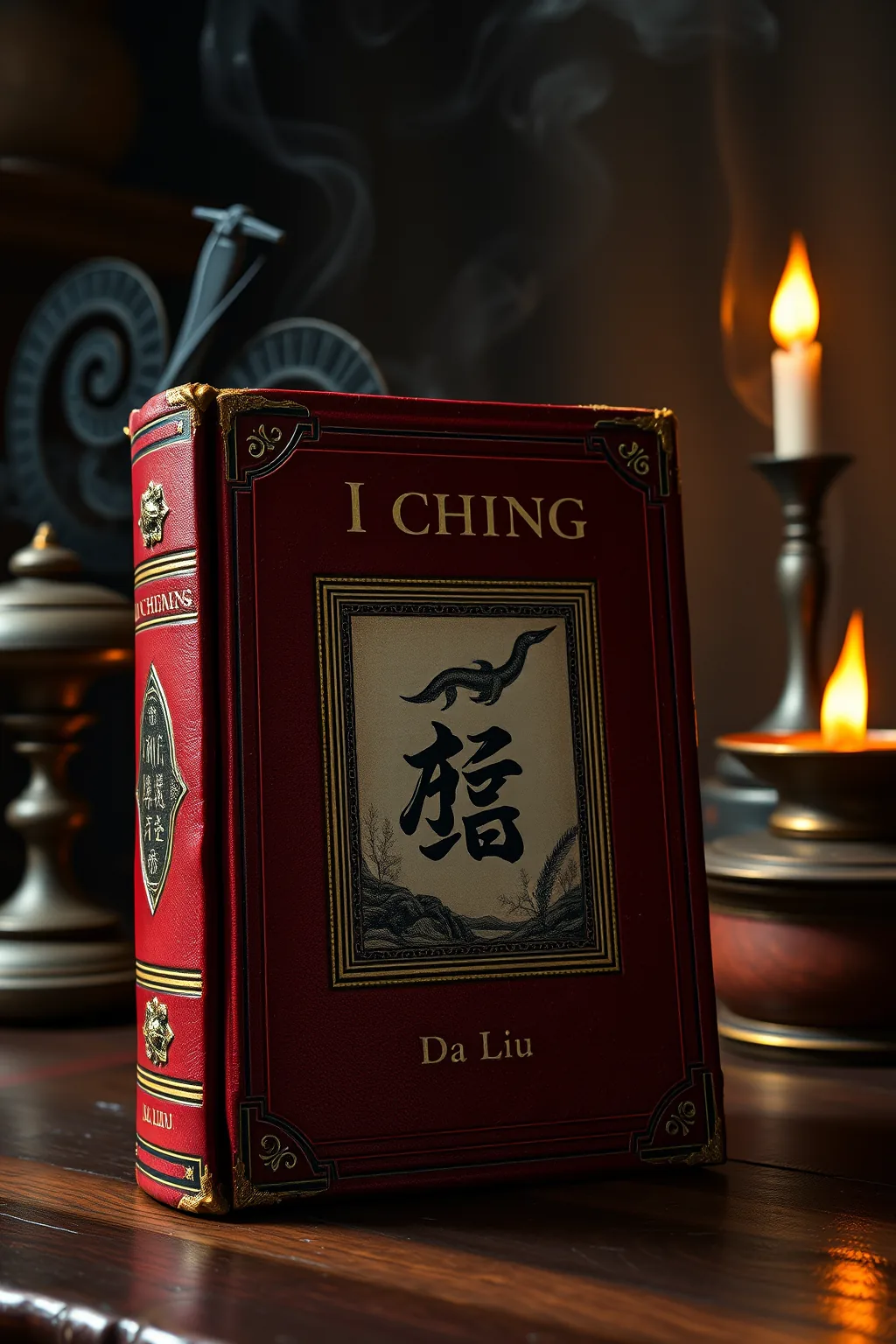
I ching and human affairs =
 61
61

I ching and human affairs =



Isolde Whitaker, Sacred Texts Editor: Da Liu's 'I Ching and Human Affairs' stands as a monumental contribution to the study of this ancient Chinese oracle. Eschewing superficial interpretations, Liu offers a deeply insightful exploration of the Yi Jing's philosophical underpinnings and its profound relevance to the human condition. His exposition of the hexagrams is both scholarly and spiritually resonant, revealing their intricate symbolic language as a map of consciousness and destiny. This work is an indispensable resource for anyone serious about understanding the I Ching beyond mere prediction, offering a pathway to self-discovery and a more profound connection to the cosmic order. Highly recommended for serious students and practitioners.
📝 Description
61
Da Liu's 1978 book explains the I Ching's application to personal growth and understanding.
Published in 1978, 'I Ching and Human Affairs' by Da Liu examines the Book of Changes not just as a divinatory tool, but as a system for understanding life's patterns. Liu breaks down the meaning of the hexagrams and their lines, showing how they reflect universal principles at play in human experience. The book discusses how the I Ching's wisdom can inform decisions, foster personal development, and help individuals find balance. It moves beyond simple fortune-telling to address the philosophical underpinnings of fate and free will.
Liu's approach connects the ancient text to practical concerns, suggesting that familiarity with the I Ching's structure can lead to a deeper awareness of one's circumstances. The work details how the cycles represented by the hexagrams mirror the shifts and transformations individuals encounter. It aims to provide a framework for interpreting these changes and aligning oneself with a natural order. The text is written for those interested in applying the I Ching's insights to their daily lives and personal philosophies.
This book fits within the tradition of Western interpretations of Chinese esoteric texts, particularly the I Ching, which gained significant attention in the mid-20th century. Following scholars like Richard Wilhelm and C.G. Jung, Da Liu presents the I Ching as a psychological and philosophical system with broader implications for understanding existence. It aligns with a broader interest in applying ancient oracles and wisdom traditions to modern life, moving beyond purely religious or ritualistic contexts to explore their relevance for personal insight and cosmic connection.
💡 Why Read This Book?
Unravel the profound wisdom of the I Ching, an oracle that has guided humanity for millennia. 'I Ching and Human Affairs' offers more than divination; it provides a framework for understanding life's cosmic currents and your place within them. Ideal for spiritual seekers, practitioners of esoteric arts, and scholars yearning for authentic insights into ancient Chinese philosophy. Discover how to navigate life's challenges with wisdom and align your personal journey with universal principles.
⭐ Reader Reviews
Honest opinions from readers who have explored this book.
❓ Frequently Asked Questions
What is the I Ching?
The I Ching, or Book of Changes, is an ancient Chinese divination text and one of the oldest of the Chinese classics. It is a complex system of symbols and philosophy used for understanding the past, present, and future, and for guiding decisions.
Is this book suitable for beginners?
While it delves deeply, Da Liu's clear exposition makes it accessible to dedicated beginners eager to learn the I Ching's fundamental principles and symbolic language.
How does the I Ching relate to human affairs?
The I Ching posits that hexagrams represent archetypal situations and forces in the universe, mirroring the dynamics of human life. By consulting it, one can gain insight into current circumstances and potential future developments.
What is the philosophical significance of the I Ching?
Its philosophy centers on the concept of constant change, balance, and the interplay of Yin and Yang. It teaches adaptability, foresight, and the importance of acting in harmony with natural cosmic cycles.
Can this book be used for practical divination?
Yes, Da Liu provides the framework and understanding necessary to use the I Ching as a practical tool for divination, offering guidance and wisdom for everyday life and significant decisions.
🔮 Key Themes & Symbolism
The Cosmic Dance of Change
At the core of 'I Ching and Human Affairs' lies the profound understanding that existence is a perpetual state of flux. Da Liu elucidates how the I Ching's 64 hexagrams are not static pronouncements but dynamic representations of universal principles in constant interplay. This theme emphasizes the interconnectedness of all phenomena, from the celestial movements to the subtle shifts in individual consciousness. Readers are invited to perceive their own lives as part of this grand cosmic dance, learning to adapt, flow, and find harmony amidst inevitable transformations. The book offers a philosophical anchor in a world of change, revealing the inherent order within apparent chaos.
Symbolism as a Divine Language
Da Liu reveals the I Ching's hexagrams and their constituent trigrams as a sophisticated symbolic language, a divine script that speaks directly to the soul. Each line and combination carries layers of meaning, reflecting archetypal human experiences and cosmic forces. This theme explores how these visual and conceptual symbols act as keys to unlock hidden truths about oneself and the universe. By deciphering this intricate lexicon, practitioners can gain clear insights into the subtle energies at play in their lives, enabling them to make more conscious and aligned choices. The book serves as a detailed look in interpreting this ancient, sacred symbolic system.
Navigating Destiny with Wisdom
This central theme posits that while destiny may be influenced by cosmic currents, human agency and wisdom play an important role in navigating its path. 'I Ching and Human Affairs' empowers readers by demonstrating how the I Ching can serve as a profound guide for decision-making and self-cultivation. It moves beyond simple prediction, offering a framework for understanding the underlying causes of situations and suggesting the most auspicious course of action. The book encourages a proactive approach to life, fostering an understanding that by aligning oneself with natural principles, one can consciously shape their future and live a more purposeful existence.
💬 Memorable Quotes
Direct passages from the work, attributed to the author.
“Within each hexagram lies the echo of the universe's grand design.”
— This suggests that the symbolic structures of the I Ching are not arbitrary but contain fundamental truths and patterns of cosmic order.
“To understand the changes is to master the art of living.”
— This emphasizes the practical application of I Ching wisdom, implying that adaptability and foresight are key to a well-lived life.
“The sage consults the oracle not to escape fate, but to understand its currents.”
— This differentiates true wisdom from mere fortune-telling, highlighting the I Ching's purpose as a tool for informed decision-making and self-awareness.
“Each line is a whisper from the Tao, guiding the seeker.”
— This poetic line portrays the individual components of the hexagrams as divine messages, offering subtle yet profound guidance from the fundamental principle of the universe.
💡 Key Ideas
Editorial paraphrase of the work's core concepts — not direct quotes.
The I Ching is a mirror reflecting the ceaseless flow of creation.
This quote highlights the I Ching's role as a reflective tool, showing how all existence is in a state of constant, dynamic change and creation.
🌙 Esoteric Significance
Tradition
Rooted deeply in Taoist philosophy and ancient Chinese cosmology, the I Ching represents a central to East Asian esoteric thought. It is considered a 'Book of Wisdom' and a sacred oracle, integral to practices of divination, philosophy, and self-cultivation. Its esoteric nature lies in its ability to map the energetic patterns of the universe and human experience, offering insights into the interplay of Yin and Yang, the Five Elements, and the concept of the Tao itself, the fundamental, ineffable principle of existence.
Symbolism
The primary symbolism of the I Ching revolves around its 64 hexagrams, each composed of six lines, either broken (Yin) or solid (Yang). These lines and their combinations represent archetypal situations, natural phenomena, and human relationships. The trigrams (three-line figures) are foundational, symbolizing Heaven, Earth, Water, Fire, Mountain, Lake, Thunder, and Wind. Understanding these symbols allows one to interpret the subtle energetic shifts and forces influencing events, offering a profound symbolic language for navigating life's complexities and understanding universal patterns.
Modern Relevance
In contemporary times, the I Ching continues to offer profound relevance as a tool for psychological insight, ethical guidance, and spiritual development. It provides a timeless framework for understanding change, decision-making, and the interconnectedness of personal actions with universal forces. For those seeking to work through the complexities of modern life, its principles of adaptability, balance, and mindful action offer a powerful antidote to stress and uncertainty. The I Ching remains a vital source for cultivating wisdom, fostering self-awareness, and aligning one's life with natural rhythms and cosmic order.
👥 Who Should Read This Book
This useful text is a treasure for a diverse array of seekers. For the **beginner** venturing into the world of the I Ching, Da Liu's clear prose and structured approach provide an accessible entry point. **Scholars** of Eastern philosophy and comparative religion will find a rich, authoritative source for understanding this foundational text. **Spiritual seekers** and practitioners of esoteric arts will discover clear insights into divination, cosmic patterns, and self-discovery. Those grappling with life's **transitions** or seeking greater **clarity** in decision-making will find invaluable wisdom and guidance within its pages, making it an essential read for anyone on a path of conscious evolution.
📜 Historical Context
Published in the mid-20th century, 'I Ching and Human Affairs' emerged during a period of burgeoning global interest in Eastern philosophies and esoteric traditions. Following the significant translations and popularization efforts by figures like Richard Wilhelm, the I Ching was gaining traction in Western intellectual and spiritual circles. Da Liu’s work contributed to this wave by offering a comprehensive and accessible interpretation, bridging the gap between the ancient Chinese text and a modern, often Western, audience seeking deeper meaning and guidance. The era saw a spiritual renaissance, where individuals actively sought alternative perspectives to understand life, consciousness, and the universe, making books like this highly influential.
📔 Journal Prompts
Reflect on a recent challenge: Which hexagram, if any, speaks to its underlying energies? How can its wisdom inform your approach?
Consider the interplay of Yin and Yang in your daily life. Where do you see imbalance, and how can you cultivate harmony?
What does 'change' mean to you? How does the I Ching's philosophy of flux challenge or affirm your current perspective?
If you were to consult the I Ching for guidance on a current decision, what question would you ask, and why?
How can the archetypal situations represented by the trigrams be applied to understanding your personal relationships or inner state?
🗂️ Glossary
I Ching
An ancient Chinese text of divination and philosophy, also known as the Book of Changes. It uses 64 hexagrams to represent various situations and offer guidance.
Hexagram
A figure composed of six horizontal lines, either solid (Yang) or broken (Yin). Each of the 64 hexagrams represents a unique cosmic or human situation.
Trigram
A figure composed of three horizontal lines, representing eight fundamental cosmic forces or elements such as Heaven, Earth, Water, and Fire.
Yang
In I Ching philosophy, Yang represents the active, masculine, light, and assertive principle, symbolized by a solid line (—).
Yin
In I Ching philosophy, Yin represents the passive, feminine, dark, and receptive principle, symbolized by a broken line (--).
This book appears in 3 collections
🔮 Readers Also Liked
Browse all →








More by Da Liu
All books →



From the “Tarot” Collection
View all →





More Free Divination & Tarot Books
View all →