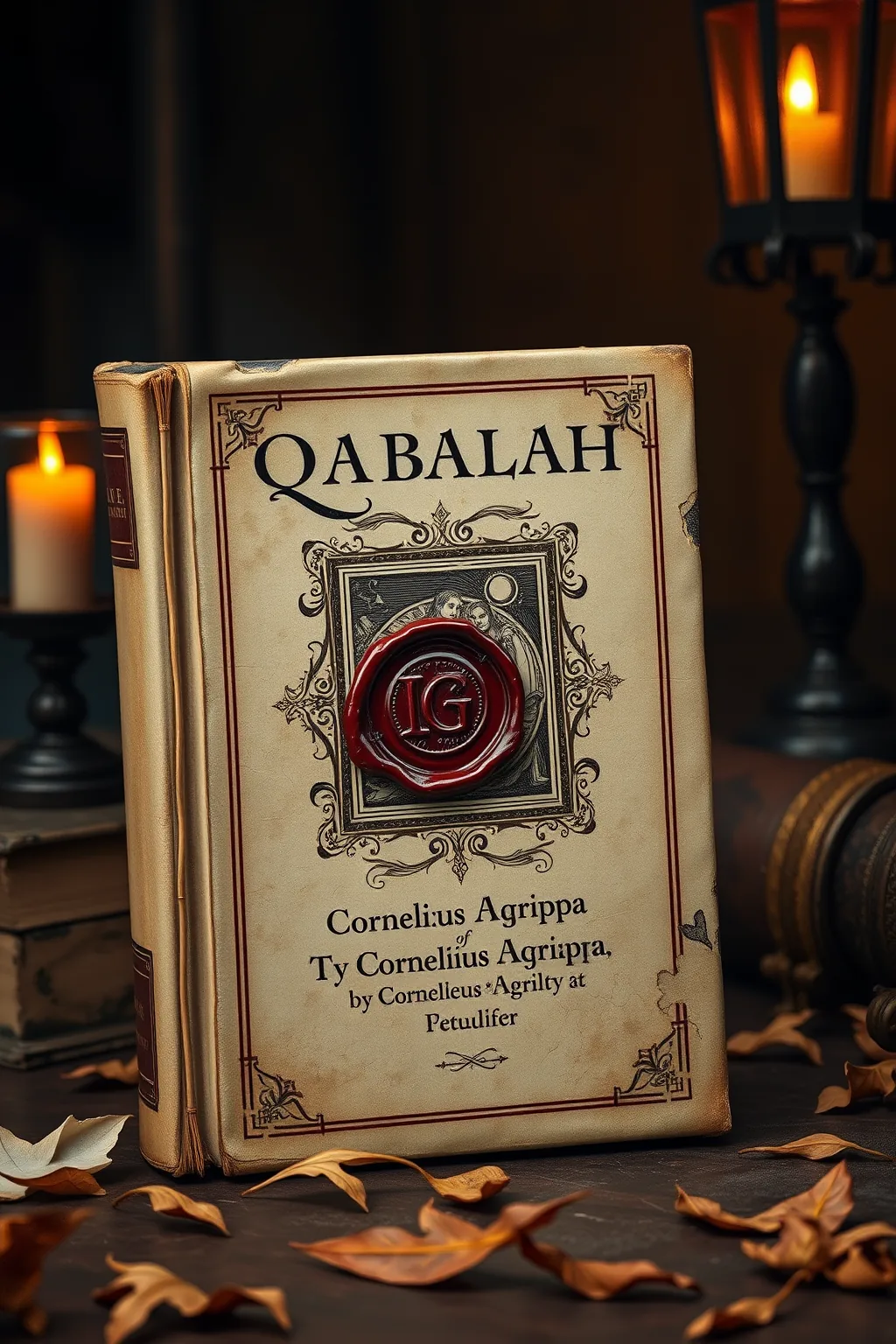
Qabalah -the Three Books of Occult Philosophy
 61
61

Qabalah -the Three Books of Occult Philosophy


Isolde Whitaker, Sacred Texts Editor: Agrippa's 'Three Books' remains an indispensable cornerstone of Western magical and philosophical inquiry. This meticulously crafted compendium offers unparalleled insights into the Renaissance understanding of the occult, seamlessly integrating Kabbalah with Hermeticism and Neoplatonism. Its strength lies in its systematic approach, demystifying complex concepts and providing a practical framework for understanding divine emanations and their influence on the material world. Essential for serious students of esotericism, occult history, and comparative mysticism, this work is a vital resource for unlocking the symbolic language of the universe.
📝 Description
61
Cornelius Agrippa published 'The Three Books of Occult Philosophy' in 1533, detailing a system of magic.
Cornelius Agrippa's 'The Three Books of Occult Philosophy', first printed in 1533, is a foundational text for Western esotericism. It presents a complex system derived from Neoplatonic, Hermetic, and Kabbalistic sources. Agrippa aimed to reconcile these traditions into a coherent philosophical and magical framework.
The work is divided into three books. The first discusses natural magic, the properties of the world, and the human soul. The second covers celestial magic, including astrology, planetary influences, and the use of talismans. The third book focuses on divine magic, addressing angels, divine names, and the ascent of the soul.
Agrippa uses extensive symbolism, numerology, and correspondences to explain the hidden order of the universe. His goal was to demonstrate how the material and spiritual worlds are interconnected and how humans can interact with divine forces through proper understanding and ritual.
Published in the early 16th century, Agrippa's work synthesized a broad spectrum of esoteric traditions that were gaining renewed interest during the Renaissance. It drew heavily on the Hermetic Corpus, Neoplatonic philosophy, and Jewish Kabbalah, alongside elements of Christian theology and natural philosophy. Agrippa sought to create a unified magical philosophy, presenting magic not as mere superstition but as a legitimate intellectual pursuit grounded in the study of nature and divine order. This synthesis became a crucial reference point for later occultists.
💡 Why Read This Book?
Embark on a transformative journey into the heart of Western esotericism. Agrippa's masterpiece unveils the profound interconnectedness of the cosmos, offering a systematic approach to understanding divine emanations, angelic hierarchies, and the practical application of occult philosophy. Ideal for seekers of hidden knowledge, practitioners of ceremonial magic, and scholars of mystical traditions seeking foundational texts.
⭐ Reader Reviews
Honest opinions from readers who have explored this book.
❓ Frequently Asked Questions
What is the primary focus of Agrippa's 'Three Books of Occult Philosophy'?
The primary focus is the systematic exploration of occult philosophy, integrating Kabbalah, Hermeticism, and Neoplatonism to explain the interconnectedness of the divine, celestial, and terrestrial realms through magic, symbolism, and numerology.
Is this book suitable for beginners?
While dense, it is foundational. Beginners should approach with patience and potentially a guiding commentary, as it requires dedicated study to fully grasp its complex philosophical and magical systems.
What is the role of Kabbalah in Agrippa's work?
Kabbalah provides a crucial framework for understanding divine emanations, the structure of the cosmos, and the Hebrew alphabet's mystical significance, underpinning many of Agrippa's magical and philosophical theories.
How does Agrippa connect the earthly and celestial realms?
He posits a profound correspondence, suggesting that celestial influences and divine intelligences can be understood and, to some extent, channeled through terrestrial means, particularly through sympathetic magic and ritual.
What practical applications can be found within this text?
Agrippa outlines principles of natural magic, talismans, incantations, and planetary correspondences, offering insights into how one might engage with and influence the subtle energies of the universe.
🔮 Key Themes & Symbolism
The Tripartite Nature of Reality
Agrippa posits a universe structured into three interconnected realms: the divine, the celestial (or intellectual), and the terrestrial (or material). He meticulously details the correspondences and sympathies that bind these planes, arguing that understanding these links is key to unlocking the secrets of magic and the divine order. This tripartite view forms the bedrock of his occult system, illustrating how macrocosmic forces manifest and can be accessed within the microcosm of human experience and the physical world.
The Power of Sympathetic Magic
Central to Agrippa's philosophy is the concept of sympathy, the idea that like attracts like and that hidden forces connect disparate elements within the cosmos. He explores how sympathetic magic operates through the use of correspondences – the alignment of specific materials, celestial influences, divine names, and symbolic forms – to achieve desired effects. This theme emphasizes the universe as an interconnected web of energies, where carefully constructed rituals and talismans can tap into these subtle currents.
The Hierarchical Structure of the Cosmos
Agrippa presents a divinely ordered cosmos, populated by a hierarchy of beings, from God and his angels down to elemental spirits and earthly creatures. He meticulously maps these hierarchies, particularly drawing on Kabbalistic concepts of divine emanations and angelic orders. Understanding this structure is presented not just as theoretical knowledge, but as a practical necessity for the occult practitioner, enabling them to invoke, communicate with, and harness the power of these higher and lower spiritual intelligences.
💬 Memorable Quotes
Direct passages from the work, attributed to the author.
“The world is but a great creature, and the earth its flesh, the sea its blood, the air its breath, and the fire its spirit.”
— This poetic metaphor illustrates the living, organic nature of the universe as perceived in esoteric traditions, viewing the cosmos as a single, unified entity.
“Nature is the art of God.”
— A concise expression of the Renaissance view that the natural world is a manifestation of divine creation, imbued with inherent order and purpose that can be studied and understood.
“There are three books from which we ought to learn: the book of God, the book of Nature, and the book of Man.”
— This statement outlines Agrippa's comprehensive approach to knowledge, emphasizing the divine, the external world, and the internal human experience as essential sources of wisdom.
“He is a magician who can do all these things.”
— This simple yet profound statement defines the magician not just by knowledge, but by the ability to enact and manifest the principles and forces discussed in occult philosophy.
💡 Key Ideas
Editorial paraphrase of the work's core concepts — not direct quotes.
For there is nothing in the highest heavens which is not contained within the lower.
This quote captures the Hermetic principle of 'As Above, So Below,' highlighting the interconnectedness and mirroring of celestial patterns within the earthly realm.
🌙 Esoteric Significance
Tradition
This work is a central to Western Esotericism, synthesizing Neoplatonism, Hermeticism, and Kabbalah into a comprehensive system of occult philosophy. It represents a peak of Renaissance magical thought, aiming to provide a unified understanding of the cosmos through divine emanations, angelic hierarchies, and the practical application of sympathetic magic and ritual. Its influence extends to ceremonial magic, alchemy, and philosophical mysticism.
Symbolism
Agrippa masterfully employs a collection of symbolism drawn from various traditions. Key symbols include the Hebrew alphabet and divine names from Kabbalah, planetary and astrological correspondences, geometric figures, alchemical elements, and the concept of the 'celestial machine.' These symbols are not mere decorations but integral tools for understanding the hidden forces and correspondences that link the divine, celestial, and terrestrial realms, serving as keys to unlock magical operations.
Modern Relevance
Despite its historical roots, Agrippa's 'Three Books' remains remarkably relevant. Its exploration of universal interconnectedness, the power of consciousness, and the symbolic language of the cosmos appeals to contemporary seekers of meaning. Modern practitioners of magic, meditation, and esoteric studies find in its pages a sophisticated framework for understanding spiritual principles and developing a deeper relationship with the subtle energies of existence.
👥 Who Should Read This Book
This important work is essential for serious students of Western Esotericism, occult history, and comparative mysticism. Scholars will find it an invaluable primary source for understanding Renaissance magical beliefs and their intellectual underpinnings. Aspiring practitioners of ceremonial magic and hermetic arts will discover a foundational text that maps out complex systems of correspondences and ritualistic practices. Seekers interested in the philosophical dimensions of spirituality and the interconnectedness of all things will be profoundly illuminated by Agrippa's intricate worldview.
📜 Historical Context
Cornelius Agrippa's 'Three Books of Occult Philosophy,' first published in the mid-16th century, emerged during the vibrant intellectual ferment of the Renaissance. This era witnessed a profound reawakening of interest in classical antiquity, leading to the rediscovery and translation of ancient Greek and Hebrew texts, including Hermetic writings and Kabbalistic lore. The printing press facilitated the widespread dissemination of these esoteric ideas, challenging the dominant scholastic paradigms. Agrippa, a scholar and physician, synthesized these diverse streams of thought – Neoplatonism, Hermeticism, Kabbalah, and even elements of medieval magic – into a cohesive, albeit complex, system. His work became a foundational text for subsequent generations of occultists, alchemists, and mystics, profoundly influencing figures like John Dee and the Rosicrucians, and shaping the trajectory of Western esoteric thought for centuries.
📔 Journal Prompts
Reflect on a time when you felt a strong connection between seemingly unrelated events or objects. How might the principle of sympathy apply?
Consider the concept of 'As Above, So Below.' How do you see celestial or universal patterns reflected in your daily life or personal experiences?
Map out a personal hierarchy of values or influences in your life. How does this structure compare to the cosmic hierarchies Agrippa describes?
What 'symbols' hold significant meaning for you, and how do they connect you to deeper concepts or feelings?
Explore the idea of nature as a 'book.' What lessons or messages do you believe the natural world offers that might be overlooked?
🗂️ Glossary
Kabbalah
A complex system of Jewish mysticism that explores the nature of God, creation, and the relationship between the divine and the material world through esoteric interpretation of religious texts and symbolic frameworks.
Hermeticism
A philosophical and religious tradition based on the purported teachings of Hermes Trismegistus, emphasizing divine wisdom, universal interconnectedness, and the pursuit of spiritual enlightenment through knowledge and practice.
Neoplatonism
A school of philosophy founded by Plotinus, which interpreted Plato's teachings in a mystical and transcendental way, focusing on emanation from a supreme, ineffable One and the soul's journey towards divine union.
Sympathy (Occult)
In occult philosophy, the principle of interconnectedness and mutual attraction between things that share similar qualities or are linked by celestial or divine influence, forming the basis of sympathetic magic.
Emanation
The concept in many mystical traditions, particularly Neoplatonism and Kabbalah, that all existence flows or radiates from a single divine source in a hierarchical manner, rather than being created ex nihilo.
This book appears in 1 collection
🔮 Readers Also Liked
Browse all →









From the “Kabbalah” Collection
View all →





More Free Kabbalah & Jewish Mysticism Books
View all →