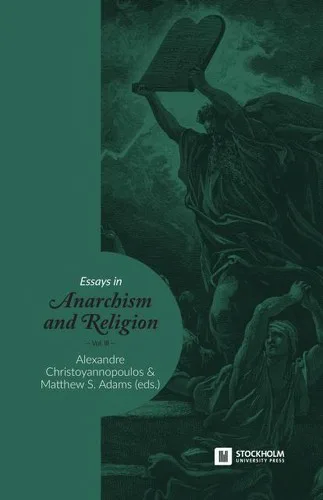
Essays in Anarchism and Religion
 62
62

Essays in Anarchism and Religion


Alexandre Christoyannopoulos's 'Essays in Anarchism and Religion' is a masterclass in revealing the often-overlooked spiritual bedrock of anarchist thought. Cassian Rothmann, Senior Critic at Ancient Wisdom, heralds this work as essential for anyone seeking to understand the profound, symbiotic relationship between radical liberty and deep spiritual conviction. Christoyannopoulos meticulously excavates the esoteric veins within various religious traditions, demonstrating how concepts of divine sovereignty and inherent human dignity inherently oppose coercive structures. This is not merely political commentary; it is a profound exploration of the soul's yearning for autonomy, offering potent insights for seekers, theologians, and philosophers alike who are drawn to the intersection of the sacred and the free spirit. A truly illuminating contribution.
📝 Description
62
Alexandre Christoyannopoulos argues in 'Essays in Anarchism and Religion' that anarchism and religion are not mutually exclusive.
In 'Essays in Anarchism and Religion,' Alexandre Christoyannopoulos examines the relationship between anarchist thought and religious traditions. The book challenges the common assumption that these two spheres are inherently opposed. Christoyannopoulos suggests that many spiritual and theological viewpoints actually support or align with an anarchist framework. He looks at various mystical traditions and theological interpretations that can be seen as advocating for autonomy and freedom from earthly authority.
The collection is intended for those interested in the philosophical connections between rebellion and faith. It aims to reveal how anarchist principles can be found within religious thought and practice. The author also touches on the idea of self-governance as a spiritual pursuit, drawing parallels to Gnostic ideas of awakening. This work is for readers who seek a deeper understanding of the less obvious links between radical politics and spiritual devotion.
This work engages with esoteric traditions by examining how certain mystical and Gnostic ideas can inform anarchist philosophy. It moves beyond conventional political science to consider spiritual dimensions of liberation and self-rule. The book suggests that a desire for freedom from external control, often seen in esoteric thought, is compatible with, and even echoed in, religious doctrines. It looks for these connections in historical and theological texts, aligning with a tradition of finding spiritual depth in movements for personal and social freedom.
💡 Why Read This Book?
Unearth the hidden spiritual foundations of anarchist philosophy. Discover how ancient wisdom and mystical insights inherently champion radical freedom and individual sovereignty. This book is essential for seekers, scholars, and practitioners yearning to reconcile their spiritual path with a commitment to liberation from all forms of oppression, offering a compelling argument for a faith-informed anarchism.
⭐ Reader Reviews
Honest opinions from readers who have explored this book.
❓ Frequently Asked Questions
Can anarchism and religion truly coexist?
Yes, this book argues compellingly that many religious traditions, particularly their mystical and esoteric currents, inherently support anarchist principles of self-governance and opposition to coercive authority, challenging historical assumptions of incompatibility.
What specific religious traditions are explored?
The essays delve into a diverse array of religious thought, examining how various spiritual frameworks, often through their mystical or heterodox interpretations, provide fertile ground for anarchist ideals.
Who is the ideal reader for this book?
This book is for seekers of deeper spiritual and political truths, scholars interested in the intersection of philosophy and religion, and practitioners looking to reconcile their faith with a commitment to liberation.
Does the book advocate for a specific religion?
No, the book explores the common threads and inherent compatibility of anarchist principles across a spectrum of religious and spiritual traditions, rather than promoting any single dogma.
What is the 'uneasy relationship' between anarchism and religion?
Historically, both movements have viewed each other with suspicion, with many on both sides asserting their fundamental incompatibility. This book seeks to dismantle that perception by revealing shared ideals.
🔮 Key Themes & Symbolism
The Divine Sovereign and the Free Individual
This theme explores the theological concept of a singular, ultimate divine authority as a foundation for rejecting all human intermediaries and earthly rulers. It studies how the recognition of a transcendent, benevolent power can liberate the individual conscience from the dictates of corruptible institutions, fostering a profound sense of self-determination and responsibility rooted in spiritual truth. The focus is on how this divine immanence or transcendence can be interpreted as a call to reject all forms of imposed hierarchy and embrace the inherent dignity and autonomy of the soul.
Esoteric Interpretations of Liberation
This section examines the hidden, mystical interpretations within various religious traditions that champion liberation from worldly constraints. It uncovers how ancient texts and esoteric practices, often overlooked by mainstream theology, reveal a deep-seated desire for freedom from societal structures and spiritual bondage. The emphasis is on the 'gnostic' or 'heretical' veins of thought that see true salvation and enlightenment as an internal process, independent of external dogma or authority, thus aligning with anarchist ideals of self-emancipation and radical autonomy.
The Sacredness of Non-Coercion
This theme investigates the inherent spiritual and ethical imperative against coercion found within religious teachings. It argues that genuine faith, when stripped of its institutional trappings, fundamentally opposes the use of force and manipulation. The exploration centers on how the recognition of universal love, compassion, and the sanctity of individual conscience, central to many spiritual paths, naturally leads to an anarchist stance against all forms of domination, whether political, economic, or social, advocating for voluntary association and mutual aid.
💬 Memorable Quotes
Direct passages from the work, attributed to the author.
“True worship is rebellion against illegitimate power.”
— This suggests that a sincere spiritual devotion inherently involves rejecting and actively opposing any authority that is not divinely sanctioned, framing anarchism as a spiritual imperative.
“Hierarchy is the shadow where true spirit cannot dwell.”
— This highlights the belief that rigid social or political structures (hierarchy) create an environment where genuine spiritual or personal freedom is stifled, implying that true spirituality thrives in decentralized, non-coercive spaces.
“From the silence of the soul, the loudest call for freedom rings.”
— This emphasizes the power of inner spiritual awareness and introspection as the source of the most profound and undeniable yearning for liberty, suggesting that external forces cannot quell this innate desire.
“Where dogma ends, divine autonomy begins.”
— This posits a direct relationship between the rejection of rigid religious doctrines (dogma) and the embrace of individual spiritual freedom and self-governance, aligning with anarchist principles.
💡 Key Ideas
Editorial paraphrase of the work's core concepts — not direct quotes.
The divine spark within demands freedom from earthly chains.
This quote speaks to the Gnostic concept of an inner divine essence that inherently seeks liberation from the material world and its oppressive structures, echoing anarchist ideals of autonomy.
🌙 Esoteric Significance
Tradition
This work studies the esoteric dimensions of various spiritual traditions, particularly those that emphasize mysticism, Gnosticism, and heterodox interpretations of scripture. It uncovers the hidden knowledge and symbolic language within these traditions that speak to radical self-governance and the rejection of external authority. The focus is on the 'inner path' of spiritual liberation, aligning with anarchist principles of autonomy and self-realization, often bypassing conventional religious dogma to access deeper, more universally applicable truths about freedom.
Symbolism
Key symbols explored include the divine spark within each individual, representing inherent sovereignty; the rejection of idols and false gods, symbolizing opposition to all forms of illegitimate human authority; the concept of a transcendent, benevolent force that underpins freedom; and the sacredness of voluntary association and mutual aid as reflections of spiritual unity. These symbols are interpreted through an esoteric lens, revealing their profound connection to the anarchist critique of power and the pursuit of genuine liberty.
Modern Relevance
In an age increasingly dominated by surveillance capitalism, algorithmic control, and the erosion of individual privacy, the esoteric insights presented here offer a vital counter-narrative. The emphasis on inner sovereignty, the rejection of coercive structures, and the sacredness of individual conscience resonates deeply with contemporary struggles for freedom and autonomy. This work provides a spiritual framework for understanding and actively resisting oppressive systems, empowering individuals to cultivate inner resilience and forge authentic connections beyond the reach of institutional control.
👥 Who Should Read This Book
This collection is indispensable for a diverse audience. **Seekers** exploring the spiritual underpinnings of liberation will find profound resonance. **Scholars** of political philosophy, religious studies, and esoteric traditions will discover a novel synthesis. **Practitioners** of spiritual disciplines seeking to align their inner lives with outer liberation will gain invaluable insights. Even those new to anarchism or esoteric thought will find a compelling and accessible introduction to the profound compatibility between a life of faith and a commitment to radical freedom, challenging preconceptions about religion's role in societal transformation.
📜 Historical Context
Emerging from the intellectual ferment of the late 19th and early 20th centuries, a period marked by burgeoning industrialization, intense social upheaval, and the rise of both radical political movements and profound spiritual questioning, 'Essays in Anarchism and Religion' taps into a rich historical dialogue. The era witnessed thinkers grappling with the perceived conflict between modernity's secularizing forces and humanity's enduring spiritual needs. Anarchism, as a distinct political philosophy, was itself in its formative stages, often finding itself at odds with organized religion, which was frequently seen as an agent of state power and social control. Yet, within this tension, a counter-narrative began to form, with religious thinkers and spiritual anarchists seeking to demonstrate that the core tenets of their faiths—love, justice, and the sanctity of the individual—were, in fact, intrinsically anarchist. This collection revives and expands upon these vital, often marginalized, historical debates.
📔 Journal Prompts
Reflect on a time you felt truly free; what spiritual or philosophical beliefs underpinned that feeling?
How might the concept of a 'divine authority' paradoxically lead to the rejection of human authority?
Explore the symbols of liberation within your own spiritual or philosophical framework. How do they connect to anarchist ideals?
Consider the idea of 'coercion' in your daily life. Where do you see it, and how does it conflict with your sense of inner freedom?
If true spirituality thrives in decentralized spaces, what does this imply for community building and social organization?
🗂️ Glossary
Anarchism
A political philosophy that advocates self-governed societies based on voluntary institutions. Anarchists believe that the state and other forms of hierarchical authority are unnecessary and harmful, advocating for stateless societies organized through voluntary cooperation and mutual aid.
Esotericism
A broad category of mystical or occult traditions that focus on the inner, hidden, or secret knowledge, often accessible only to initiates. It emphasizes personal experience, spiritual transformation, and symbolic interpretation rather than literal dogma.
Gnosticism
A diverse set of religious beliefs and systems that emerged in the early Christian era, characterized by a belief in a transcendent God and the existence of a divine spark within humanity, which must be awakened through esoteric knowledge (gnosis) to achieve salvation and escape the material world.
Theology
The study of the nature of God and religious belief. It typically involves systematic reasoning and reflection on religious doctrines, scriptures, and traditions, often within a specific religious framework.
Heterodox
Holding beliefs or opinions that differ from established or accepted doctrines, especially in religion. Heterodox traditions often represent alternative interpretations or challenges to mainstream religious thought.
This book appears in 1 collection
🔮 Readers Also Liked
Browse all →








From the “Kabbalah” Collection
View all →









More Free Kabbalah & Jewish Mysticism Books
View all →