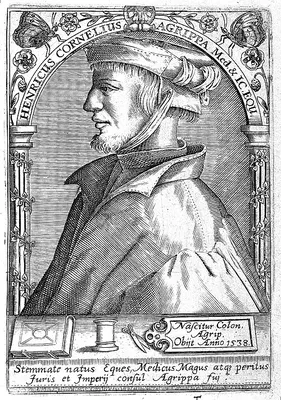
Cornelius Agrippa
Cornelius Agrippa was a Renaissance scholar and occult writer whose influential 'Three Books of Occult Philosophy' blended Kabbalah, Hermeticism, and Neoplatonism.
Heinrich Cornelius Agrippa von Nettesheim was a German Renaissance scholar, physician, and writer known for his significant contributions to occult literature. Born in 1486, he pursued a wide-ranging education and career, engaging with fields such as law, theology, and military service. Agrippa's intellectual journey led him to explore various philosophical and mystical traditions, including Kabbalah, Hermeticism, and Neoplatonism, which profoundly shaped his most famous work. His writings, particularly 'Three Books of Occult Philosophy,' became highly influential among esoteric thinkers in the early modern period. Despite his scholarly pursuits, Agrippa faced opposition and accusations of heresy throughout his life, often stemming from his theological and intellectual stances, which sometimes brought him into conflict with religious authorities. He died in 1535, leaving behind a complex legacy as a multifaceted intellectual figure.
Early Life and Intellectual Development
Born Heinrich Cornelius Agrippa von Nettesheim in 1486 near Cologne, he hailed from a family of minor nobility. His early education at the University of Cologne, a center of Thomist and Albertist thought, likely sparked his interest in esoteric studies, influenced by the Albertist tradition and texts like Albertus Magnus's 'Speculum.' He later studied in Paris, reportedly participating in a secret society focused on the occult. Agrippa's academic path was marked by a broad range of interests, including theology, law, and medicine, reflecting the polymathic spirit of the Renaissance. His early engagement with humanist scholars and mystical traditions laid the groundwork for his later influential writings on occult philosophy.
Scholarly and Military Pursuits
Agrippa's life was characterized by diverse experiences, including military service and academic pursuits across Europe. He served as a mercenary and captain in the army of Emperor Maximilian I, earning the title of knight. Academically, he lectured on Hebrew scholar Johann Reuchlin's work and received a doctorate in theology. His early writings, such as 'On the Nobility and Excellence of the Feminine Sex,' utilized cabalistic ideas and aimed to impress patrons. Agrippa traveled extensively, studying with figures like Johannes Trithemius and engaging with the works of Marsilio Ficino and Pico della Mirandola, further deepening his knowledge of Neoplatonism and Kabbalah. His lectures at the University of Pavia on the 'Pimander' of Hermes Trismegistus were cut short by political events.
Occult Philosophy and Later Life
Agrippa's most significant contribution to esoteric thought is his 'Three Books of Occult Philosophy,' a comprehensive synthesis of Kabbalah, Hermeticism, and Neoplatonism. This work sought to reconcile skepticism with a divinely sourced form of natural magic. Throughout his career, Agrippa faced accusations of heresy and opposition from religious authorities, leading to conflicts and forced relocations. He served in various capacities, including as a town advocate and physician, but his controversial opinions often led to disputes. Despite facing imprisonment for debt and the condemnation of his writings by the Inquisition, Agrippa continued to publish and engage with intellectual debates. He died in Grenoble in 1535, leaving behind a body of work that profoundly influenced subsequent esoteric traditions.
Key Ideas
- Synthesis of Kabbalah, Hermeticism, and Neoplatonism in occult philosophy
- Exploration of natural magic as divinely sourced
- Skeptical critique of the certainty of sciences and arts
Notable Quotes
“But of magic I wrote whilst I was very young three large books, which I called Of Occult Philosophy, in which what was then through the curiosity of my youth erroneous, I now being more advised, am willing to have retracted, by this recantation; I formerly spent much time and costs in these vanities. At last I grew so wise as to be able to dissuade others from this destruction. For whosoever do not in the truth, nor in the power of God, but in the deceits of devils, according to the operation of wicked spirits presume to divine and prophesy, and practising through magical vanities, exorcisms, incantations and other demoniacal works and deceits of idolatry, boasting of delusions, and phantasms, presently ceasing, brag that they can do miracles, I say all these shall with Jannes, and Jambres, and Simon Magus, be destinated to the torments of eternal fire.”
Books by Cornelius Agrippa
21 free public domain books · Read online or download