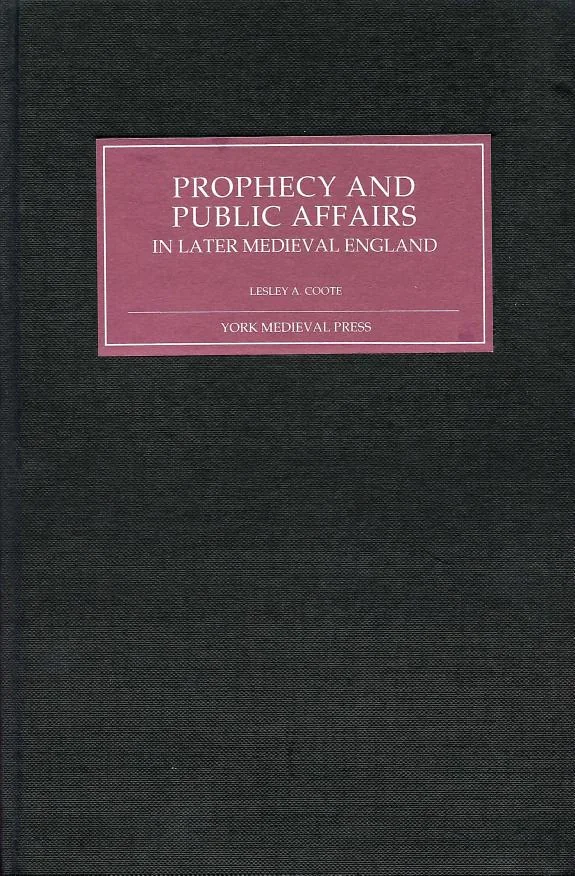
Prophecy and Public Affairs in Later Medieval England
 75
75

Prophecy and Public Affairs in Later Medieval England
Lesley Ann Coote's "Prophecy and Public Affairs in Later Medieval England" offers a much-needed scholarly examination of how pronouncements of future events influenced political discourse. The book excels in its detailed analysis of manuscript evidence, demonstrating how prophecies functioned as a potent form of political communication. Coote's meticulous comparison of prophetic language with other contemporary discourses, such as legal or homiletic texts, is particularly illuminating. A standout aspect is the exploration of how different audiences received and interpreted these prophecies, revealing a complex interplay between divine pronouncement and human agency. However, the work's dense academic prose, while precise, may present a barrier for readers less familiar with medieval textual analysis. The treatment of specific prophecies, such as those concerning the House of Lancaster, is compelling but could benefit from broader contextualization beyond England. Ultimately, this is a rigorous and essential contribution to understanding medieval political culture.
📝 Description
75
Lesley Ann Coote's 2019 study examines how prophecy influenced politics in late medieval England.
This book analyzes the role of political prophecy in late medieval England, a subject not systematically studied in almost a century. Coote details how pronouncements of divine foresight affected public discourse and contemporary affairs. The study considers not only the content of prophecies but also their various audiences and interpretations.
Coote places political prophecy within the context of late medieval England's dynastic conflicts and shifting alliances. The work connects to broader medieval European interests in apocalyptic thought and the use of omens to support or question authority. By examining prophecies, the book reveals the anxieties of a society facing instability, where divine pronouncements could hold significant sway.
The analysis focuses on prophecy as a form of political language. It details how prophetic statements were created, circulated, and understood by different social groups. The book argues that these prophecies were active political instruments, influencing how rulers and the ruled perceived events and potentially guiding their actions.
Political prophecy in late medieval England operated at the intersection of the sacred and the secular. These pronouncements, often rooted in biblical interpretation or astrological observation, were not confined to religious circles. Instead, they entered public affairs, serving as tools to legitimize rulers, challenge existing power structures, or express societal anxieties. The belief that divine will could be revealed through signs and visions gave prophecy a unique authority, allowing it to shape perceptions of political legitimacy and historical direction within a society deeply concerned with divine order.
💡 Why Read This Book?
• Learn how specific prophecies, like those circulating during the deposition of Richard II, were strategically employed to legitimize or contest political power, offering insight into medieval media manipulation. • Understand the reception of prophecy by examining how varied audiences, from court circles to monastic communities, interpreted divine pronouncements, revealing different levels of engagement with political events. • Discover how prophetic discourse functioned as a unique political language, distinct from legal or administrative texts, providing a novel lens through which to view the construction of authority and dissent in 14th and 15th-century England.
⭐ Reader Reviews
Honest opinions from readers who have explored this book.
❓ Frequently Asked Questions
What specific period in medieval England does Coote's book focus on?
The book primarily examines political prophecy in Later Medieval England, focusing on the period from the late 14th century through the 15th century, a time of significant political upheaval and dynastic change.
How did prophecy function as a political tool in medieval England?
Prophecy served as a potent political tool by offering divine sanction for rulers, challenging existing authority, or shaping public opinion during times of crisis and succession disputes.
What types of manuscripts does Coote analyze?
Coote analyzes a range of extant manuscripts, including chronicles, sermon collections, and independent prophetic texts, to reconstruct the discourse and reception of political prophecy.
Who were the primary audiences for political prophecies?
Audiences varied, encompassing royal courts, noble circles, monastic institutions, and potentially broader literate populations who engaged with prophecies as expressions of political hope or anxiety.
Does the book discuss specific prophetic figures or events?
Yes, the work explores prophecies linked to significant events and figures, such as prophecies surrounding the deposition of Richard II and the rise of the House of Lancaster.
What is the significance of analyzing prophecy as a 'political language'?
Treating prophecy as a 'political language' reveals how it was used to articulate power, influence perceptions, and mobilize support or opposition, functioning akin to modern political rhetoric.
🔮 Key Themes & Symbolism
Prophecy as Political Language
This theme explores how pronouncements of future events were not merely passive predictions but active components of political discourse. Coote demonstrates how prophetic utterances were crafted, disseminated, and interpreted to serve specific political agendas, functioning as a distinct 'language' for articulating power, legitimacy, and dissent. The analysis reveals how these prophecies could influence public perception and shape political narratives during turbulent periods, offering a unique lens into the mechanisms of medieval power struggles.
Audience Reception and Interpretation
A central focus is understanding who consumed these prophecies and how they were received across different social strata. The work moves beyond the prophetic texts themselves to examine their circulation and varied interpretations. Whether in royal courts, monastic scriptoria, or among literate laypeople, the reception of prophecy was nuanced. This theme highlights how the same prophecy could be understood differently, reflecting the social, political, and religious contexts of its audience, thus revealing the dynamic relationship between text and reader.
Manuscript Culture and Transmission
The study is grounded in an examination of extant manuscripts, showcasing the material forms through which political prophecies were preserved and transmitted. Coote investigates various manuscript types, from chronicles to collections of marginalia, to trace the lineage and evolution of prophetic traditions. This theme underscores the importance of manuscript studies in understanding the historical agency of these texts, revealing how scribal practices, compilation methods, and physical circulation influenced the content and impact of political prophecy.
Legitimation and Contestation of Power
This theme addresses the direct role of prophecy in the mechanisms of medieval governance and opposition. Prophecies were frequently invoked to legitimize the claims of ruling dynasties, such as the Tudors, or to challenge existing regimes, as seen in texts related to the deposition of Richard II. By analyzing these instances, the book illustrates how divine foresight was strategically employed to bolster authority, justify rebellion, or predict future political outcomes, thereby revealing prophecy's crucial function in the contest for power.
💬 Memorable Quotes
Direct passages from the work, attributed to the author.
“The discourse of prophecy functioned as a political language.”
— This statement captures the book's core argument: that medieval prophecies were not simply random pronouncements but sophisticated tools deliberately used for political communication and influence.
“Examining the reception of prophecies reveals their varied impact across different social groups.”
— This highlights the methodological approach, emphasizing that understanding prophecy requires considering not just its creation but how it was understood and utilized by diverse audiences in medieval society.
“Prophecy offered a framework for interpreting political instability and divine will.”
— This interpretation points to the theological underpinnings of political prophecy, suggesting it provided a means for medieval people to reconcile earthly chaos with a perceived divine order or plan.
“Manuscript evidence provides crucial insights into the circulation and adaptation of prophetic texts.”
— This emphasizes the scholarly foundation of the work, underscoring that the study relies on close textual analysis of surviving documents to reconstruct the history and function of political prophecy.
“Political prophecy played a significant role in discussions of public affairs.”
— This is a direct assertion of the book's central thesis, confirming that prophetic utterances were integral to the broader conversations and debates surrounding governance and state matters in medieval England.
🌙 Esoteric Significance
Tradition
While not strictly an esoteric text in the modern sense, "Prophecy and Public Affairs" engages with a tradition that bridges the secular and the sacred, a hallmark of many esoteric practices. Medieval prophecy, as analyzed here, shares roots with earlier forms of divination and divine communication found in Hermetic, Gnostic, and Judaeo-Christian prophetic streams. The work explores how pronouncements of future events, purportedly from a divine source, were integrated into the political machinery, echoing esoteric traditions that seek hidden knowledge to influence worldly outcomes or understand cosmic order.
Symbolism
The book implicitly touches upon symbolic language prevalent in prophecies, such as apocalyptic imagery of beasts, celestial disturbances, or figures of royalty undergoing transformation. These symbols often carried dual meanings, interpretable on both a literal political level and a more spiritual or cosmic one. For instance, prophecies concerning the fall of kings or the rise of a new ruler often employed symbolic language that resonated with biblical narratives of judgment and salvation, providing a framework for understanding societal change.
Modern Relevance
Contemporary scholars of political communication, religious studies, and medieval history continue to draw on Coote's meticulous analysis. Her work provides a foundational understanding for those exploring the enduring influence of belief systems on political discourse, a theme highly relevant today, of 'fake news' and ideological messaging. Thinkers examining the historical roots of conspiracy theories or the performative aspects of political rhetoric can find valuable precedents in Coote's dissection of medieval prophecy's public function.
👥 Who Should Read This Book
• Historians of medieval England: Gain a comprehensive understanding of how prophecy shaped political discourse and power dynamics during a critical period, informed by detailed manuscript analysis. • Scholars of political communication and rhetoric: Discover the historical precedents for using belief and divine claims to influence public opinion and legitimize authority. • Students of medieval literature and manuscript studies: Access a rigorous examination of prophetic texts as literary and material artifacts, exploring their transmission and interpretation.
📜 Historical Context
Lesley Ann Coote's work emerges from the scholarly milieu of the late 20th century, building upon decades of research into medieval literature, history, and political thought. It revisits a field that had seen limited general surveys since the early 20th century. The book engages implicitly with medieval intellectual currents, particularly the pervasive influence of apocalyptic expectations and the theological frameworks that allowed for divine intervention in human affairs. This context is crucial for understanding why political prophecy held such sway. Contemporaries like Jean Gerson, a prominent theologian and chancellor of the University of Paris, also grappled with the interpretation and use of prophecy, though often with a more cautious, ecclesiological focus. Coote's study is particularly relevant in light of the political instability of the 14th and 15th centuries, a period marked by dynastic crises and the Wars of the Roses, where prophecies could serve as powerful tools for legitimation or subversion.
📔 Journal Prompts
The function of political prophecy as a language.
Variations in the reception of prophecy across medieval English society.
The role of manuscript transmission in shaping prophetic meaning.
How prophecies legitimized or contested specific claims to power.
Comparing medieval prophetic discourse with modern political rhetoric.
🗂️ Glossary
Political Prophecy
Pronouncements concerning future political events, often attributed to divine inspiration, used to influence public opinion, legitimize rulers, or challenge authority in medieval England.
Discourse
In this context, refers to the written and spoken communication surrounding prophecy, including its creation, circulation, interpretation, and its function within the broader social and political landscape.
Manuscript Culture
The practices, social structures, and material conditions surrounding the production, circulation, and reading of handwritten texts in the medieval period.
Reception
How a text, in this case, a prophecy, was understood, interpreted, and utilized by its various audiences, reflecting their own social, political, and religious contexts.
Legitimation
The process by which a ruler, regime, or political claim is recognized as valid or rightful, often through appeals to tradition, law, or, in this case, divine sanction via prophecy.
Contestation
The act of challenging or disputing the legitimacy of a ruler, regime, or political claim, where prophecy could be employed by opposition groups.
Extant Manuscripts
Manuscripts that still survive from the medieval period, serving as the primary source material for historical analysis of texts like political prophecies.
This book appears in 1 collection
🔮 Readers Also Liked
Browse all →







From the “Prophecy” Collection
View all →




More Free Esoteric History & Biography Books
View all →