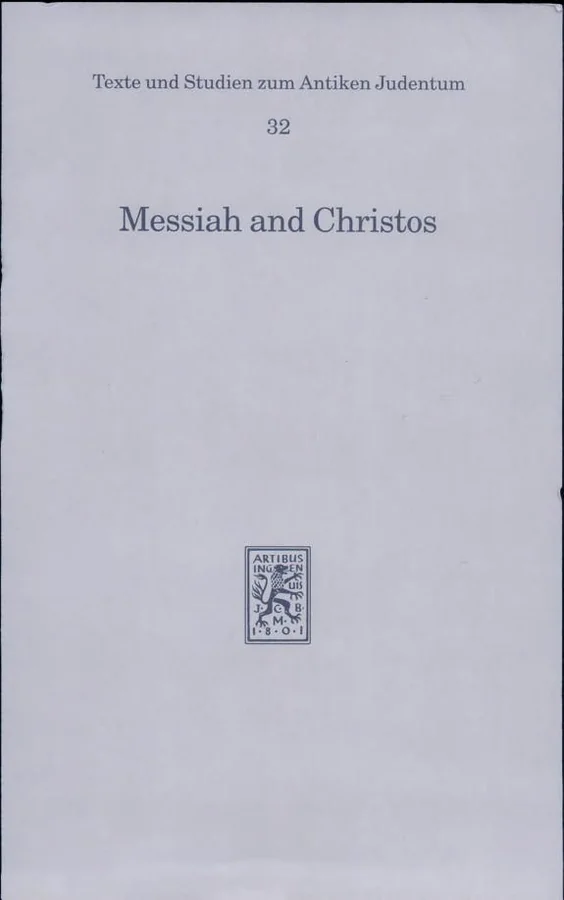
Messiah and Christos
 80
80

Messiah and Christos
The enduring scholarship of Gruenwald, Shaked, and Stroumsa in Messiah and Christos provides a rigorous, if at times dense, exploration of two foundational concepts in Western religious thought. The authors excel at delineating the semantic shifts and historical layering that transformed a Jewish concept of an anointed king into the complex Christological figure of early Christianity. Their comparative approach, drawing parallels with Hellenistic thought and Gnostic traditions, is particularly illuminating. However, the book's academic rigor can also be its limitation; readers unfamiliar with the specific historical periods and scholarly debates may find the prose demanding. The detailed analysis of the term "Christos" in its Greek context, for instance, while crucial, requires careful attention. Ultimately, Messiah and Christos remains a vital reference for understanding the intellectual genealogy of messianic ideas.
📝 Description
80
Ithamar Gruenwald, Shaul Shaked, and Guy G. Stroumsa published Messiah and Christos in 1992.
Messiah and Christos, published in 1992, offers a scholarly examination of the terms "Messiah" and "Christos" across various religious and philosophical traditions. The authors move beyond simple theological definitions to analyze the historical development and varied interpretations of these figures and their roles in different belief systems. They look at the semantic range of these terms and how they changed, providing a comparative view that shows both similarities and differences.
The book was published during a time of increased academic attention to the historical Jesus and the various messianic movements of ancient times. Scholars were beginning to look more closely at how Christian doctrine grew from its Jewish origins, favoring historical and sociological analysis over purely theological accounts. Gruenwald, Shaked, and Stroumsa's work supported this critical reassessment by placing the concepts of Messiah and Christos within the complex intellectual environment of the Hellenistic and Roman periods. They engaged with research that highlighted the many different messianic expectations present then.
This work examines the development of messianic concepts, particularly within Jewish and early Christian contexts, which are central to many esoteric traditions. It situates these ideas within the broader landscape of Hellenistic and Roman religious thought, a period that saw the cross-pollination of various spiritual and philosophical systems. By dissecting the semantic range and historical transformations of "Messiah" and "Christos," the book illuminates how divine saviors and enlightened figures were understood in antiquity, offering insight into the roots of later Gnostic and mystical interpretations.
💡 Why Read This Book?
• Gain a nuanced understanding of the semantic evolution from the Hebrew "Mashiach" to the Greek "Christos," as detailed in the comparative analyses of early religious texts. • Grasp the historical context of messianic expectations in the Hellenistic and Roman periods, moving beyond simplistic interpretations of figures like Jesus. • Analyze the influence of "divine man" concepts in Hellenistic philosophy on early Christian Christology, a key distinction made within the text.
⭐ Reader Reviews
Honest opinions from readers who have explored this book.
❓ Frequently Asked Questions
When was Messiah and Christos first published and who are the authors?
Messiah and Christos was first published in 1992. The authors are Ithamar Gruenwald, Shaul Shaked, and Guy G. Stroumsa, renowned scholars in religious studies and history.
What is the primary focus of the book Messiah and Christos?
The book focuses on the historical development and comparative analysis of the concepts of "Messiah" and "Christos" across various religious and philosophical traditions, particularly within Jewish and early Christian contexts.
Does the book discuss Gnostic interpretations of Christ?
Yes, the work explores the broader landscape of messianic ideas, which includes engaging with Gnostic traditions and their unique interpretations of salvific figures.
Is Messiah and Christos suitable for beginners in religious studies?
The book is primarily aimed at academics and advanced students. Its scholarly depth and detailed textual analysis may be challenging for those new to the subject matter.
What historical periods does the book cover regarding messianic concepts?
It covers the historical development from ancient Jewish traditions through the Hellenistic and Roman periods, examining the formation of messianic and Christological doctrines.
What is the relationship between 'Mashiach' and 'Christos' as explored in the book?
The book meticulously traces how the Greek term 'Christos,' a translation of the Hebrew 'Mashiach' (anointed one), acquired distinct theological meanings and evolved within different cultural and religious contexts.
🔮 Key Themes & Symbolism
Messianic Expectations
The work meticulously traces the varied expectations surrounding messianic figures, moving beyond a singular interpretation. It examines how these expectations were shaped by political, social, and spiritual contexts in antiquity. The authors highlight the diversity of roles envisioned for a messiah, ranging from a military leader to a spiritual redeemer, and how these concepts shifted over time and across different communities, particularly within Jewish and nascent Christian circles.
Christological Development
This theme explores the historical process by which the concept of 'Christos' emerged and solidified within early Christianity. It analyzes the theological and philosophical underpinnings that contributed to the deification and unique role attributed to Jesus as Christ. The book investigates the influence of existing religious and philosophical frameworks, such as Hellenistic ideas of the 'divine man,' in shaping early Christology and differentiating it from earlier messianic notions.
Comparative Religious Semantics
Gruenwald, Shaked, and Stroumsa engage in a deep semantic analysis of the terms 'Messiah' and 'Christos.' This involves examining their etymological roots, their translation across languages (Hebrew to Greek), and the distinct connotations they acquired in different traditions. The exploration highlights how the meaning and function of these central terms were negotiated and transformed through intercultural and interreligious dialogue in the ancient world.
Ancient Intellectual Currents
The book situates the discourse on messiahship and Christology within the broader intellectual range of the Hellenistic and Roman eras. It considers the impact of various philosophical schools, apocalyptic literature, and syncretic religious movements on the formation of these concepts. Understanding these ancient currents is crucial for appreciating the complex origins and development of core tenets in Western religious history.
💬 Memorable Quotes
Direct passages from the work, attributed to the author.
“The term Christos, a Greek translation of Mashiach, underwent significant semantic shifts.”
— This statement underscores the book's focus on linguistic evolution, illustrating how a direct translation could acquire entirely new theological weight and meaning as it moved between cultures and belief systems.
“Messianic expectations were not monolithic but diverse and often contradictory.”
— This interpretation highlights the scholarly approach of the authors, emphasizing their rejection of simplistic narratives and their commitment to revealing the many-sided and sometimes conflicting nature of ancient messianic hopes.
“The 'divine man' concept in Hellenistic thought provides a comparative lens for early Christology.”
— This points to a key analytical tool used by the authors, suggesting parallels between pre-Christian philosophical ideals and the emerging Christian understanding of Jesus's unique status.
“Understanding the interplay between Jewish and Hellenistic thought is crucial for Christological studies.”
— This highlights the book's core methodology: a deep engagement with the synthesis and tension between different intellectual traditions in the formation of religious concepts.
💡 Key Ideas
Editorial paraphrase of the work's core concepts — not direct quotes.
The historical context of the 1st century CE was fertile ground for diverse messianic movements.
This paraphrased concept emphasizes the socio-historical conditions that gave rise to various interpretations of messianic figures, framing the development of these ideas within a specific, dynamic era.
🌙 Esoteric Significance
Tradition
While primarily a work of historical and comparative religious scholarship, Messiah and Christos significantly informs esoteric traditions by providing a critical foundation for understanding the origins of Christological concepts. It intersects with Gnostic and Hermetic studies by meticulously dissecting the evolution of salvific figures and divine intermediaries, offering scholarly grounding for esoteric interpretations that often draw from these ancient roots. The work respects the historical development of these ideas without necessarily endorsing specific esoteric claims.
Symbolism
The book engages with the concept of 'anointing' (Mashiach/Christos) as a potent symbol of divine commission and authority. It also implicitly explores the symbolism of the 'redeemer' figure, a recurring motif in many esoteric systems, detailing how this role was conceptualized and evolved. The authors' analysis of the Greek "Christos" as a translation also touches upon the power of language and symbol to carry and transform meaning across cultural divides.
Modern Relevance
Contemporary esoteric thinkers and practitioners, particularly those engaged with Gnosticism, Christian esotericism, or comparative messianism, find value in this book's detailed historical and semantic analysis. It provides a scholarly counterpoint to more mythologized or decontextualized understandings of Christ and messianic figures, enabling a deeper appreciation of their historical and conceptual roots. Scholars of modern esoteric movements also reference its findings when tracing intellectual lineages.
👥 Who Should Read This Book
['• Advanced students of religious history and comparative theology: Gain a sophisticated understanding of the historical trajectories of messianic and Christological concepts, essential for academic research.', '• Scholars of Gnosticism and early Christianity: Access detailed textual and historical analysis that clarifies the distinctions and connections between Jewish messianism and emergent Christian doctrines.', '• Esoteric practitioners seeking historical context: Understand the scholarly foundations behind various interpretations of Christ and messianic figures, enriching personal study and practice.']
📜 Historical Context
Published in 1992, Messiah and Christos emerged in an academic climate increasingly focused on the historical Jesus and the plurality of early Christian origins. Scholars like E.P. Sanders and Geza Vermes had already paved the way for rigorous historical analysis, challenging purely theological interpretations. Gruenwald, Shaked, and Stroumsa's work contributed by providing a detailed examination of the semantic and conceptual shifts from Jewish messianism to Christian Christology, situating these developments within the complex milieu of Hellenistic Judaism and the broader Greco-Roman world. This was a departure from earlier, more ideologically driven scholarship that often presented a more linear progression. The book implicitly engaged with the ongoing debates surrounding the influence of Gnosticism and other esoteric movements on early Christianity, offering a scholarly counterpoint to more speculative theories prevalent in some circles.
📔 Journal Prompts
The evolution of the term 'Christos' from 'Mashiach'.
The concept of the 'divine man' in Hellenistic thought.
Diversity of messianic expectations in antiquity.
The role of translation in shaping religious concepts.
Early Christian engagement with existing philosophical ideas.
🗂️ Glossary
Mashiach
The Hebrew term for "anointed one," referring historically to figures like kings and priests consecrated for a specific role. It is the root of the term "Messiah."
Christos
The Greek translation of "Mashiach." In early Christianity, it became a title for Jesus, signifying his divine mission and role as savior, evolving beyond its original Hebrew meaning.
Hellenistic Period
The historical era following Alexander the Great's conquests (c. 323 BCE to 31 BCE), characterized by the spread of Greek culture and language throughout the Mediterranean and Near East, influencing local traditions.
Gnosticism
A diverse set of religious and philosophical movements in the early Christian era that emphasized secret knowledge (gnosis) for salvation, often featuring complex cosmologies and dualistic worldviews.
Apocalyptic Literature
A genre of literature, prominent in ancient Judaism and early Christianity, that typically reveals divine mysteries, often concerning the end times, divine judgment, and the establishment of a new cosmic order.
Divine Man
A concept in Hellenistic philosophy and religion referring to individuals possessing extraordinary, often divine, qualities or powers, sometimes seen as intermediaries between gods and humans.
Christology
The branch of Christian theology concerned with the nature, person, and work of Jesus Christ, particularly his divinity and humanity.
This book appears in 1 collection
🔮 Readers Also Liked
Browse all →








From the “Messianism” Collection
View all →





More Free Esoteric History & Biography Books
View all →