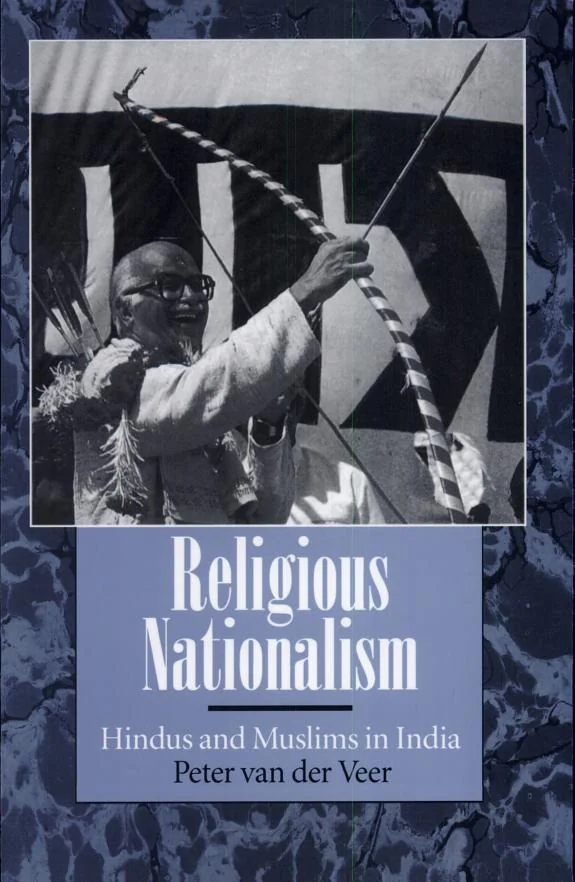
Religious Nationalism
 74
74

Religious Nationalism
Peter van der Veer's "Religious Nationalism" remains a foundational text for understanding the intricate dance between faith and state. The book's signal strength lies in its meticulous dissection of how historical processes—from pilgrimage routes to the dissemination of print media—actively forge religious identities. Van der Veer compellingly argues that these identities are not primordial but are continually constructed and contested. A particular strength is his analysis of how the circulation of texts and images in the colonial and post-colonial eras shaped communal consciousness, moving beyond purely theological or political explanations. While the book's focus is primarily on India, its theoretical framework has broad applicability. A limitation, perhaps reflective of its 1994 publication date, is that its engagement with the digital media's impact is necessarily less developed than contemporary analyses. Nonetheless, the work's analytical rigor and historical depth make it an indispensable resource for anyone studying the subject.
📝 Description
74
Published in 1994, Peter van der Veer's Religious Nationalism examines how religious identity and political power intertwine, particularly in the Indian subcontinent.
Peter van der Veer's 1994 study, Religious Nationalism, critically analyzes the complex interplay between religious identity and political power, with a specific focus on the Indian subcontinent. The book moves beyond simple explanations by drawing on anthropological, historical, and social theory. Van der Veer demonstrates that religious affiliations are not fixed but are actively shaped by cultural practices and historical developments.
This work emerged during a time of increasing global awareness of religious fundamentalism and ethnic conflicts, coinciding with the rise of Hindu nationalism and communal tensions in India. Van der Veer's research offers a counter-narrative to nationalist viewpoints by detailing the layered histories of religious traditions, affected by influences such as the Mughal Empire and British colonialism. Its interdisciplinary method distinguished it from studies that treated religion and politics in isolation.
The book unpacks concepts like the formation of religious communities, the function of pilgrimage in reinforcing group identity, and the influence of print and visual media on perceptions of religious 'others'. It also considers how language evolution and migration have historically contributed to the creation and alteration of religious affiliations, stressing that religious nationalism is a constructed phenomenon.
While not typically categorized as esoteric in the occult sense, Religious Nationalism engages with the deeper, often unacknowledged, spiritual and symbolic dimensions that underpin collective identities and political movements. It examines how shared beliefs, rituals, and historical narratives, often imbued with a quasi-religious fervor, are mobilized to forge national consciousness. The book's focus on the constructed nature of these identities and their manipulation by political forces aligns with certain critical traditions that question dominant narratives and reveal underlying power structures in belief systems.
💡 Why Read This Book?
• Gain insight into how historical factors like the development of language and the impact of print media, as detailed in van der Veer's analysis of Indian religious identities, shape collective consciousness. • Understand the active construction of religious nationalism, moving beyond static notions of belief to recognize it as a dynamic social and political process explored through case studies of pilgrimage and migration. • Appreciate the interdisciplinary methodology, integrating anthropology, history, and social theory, which offers a more comprehensive framework for analyzing the complex interplay between religion and state power than single-discipline approaches.
⭐ Reader Reviews
Honest opinions from readers who have explored this book.
❓ Frequently Asked Questions
When was Peter van der Veer's "Religious Nationalism" first published?
Peter van der Veer's "Religious Nationalism" was first published on February 7, 1994, by the University of California Press.
What specific region does "Religious Nationalism" primarily focus on?
The book "Religious Nationalism" primarily focuses on the Indian subcontinent, examining the complex relationship between religious and national identities within this specific geographical and cultural context.
Which academic disciplines does Peter van der Veer integrate in his study?
Peter van der Veer integrates several disciplines, including anthropology, history, social theory, and literary studies, to provide a comprehensive analysis of religious nationalism.
What role does pilgrimage play in the book's argument?
The book highlights pilgrimage as a crucial factor in shaping and solidifying religious identities, demonstrating how these sacred journeys contribute to the formation of communal bonds and collective consciousness.
How does "Religious Nationalism" address the influence of media?
Van der Veer's study examines how both print and visual media, particularly in more recent historical periods relative to its publication, have played a significant role in constructing and disseminating religious identities and nationalist ideologies.
Is "Religious Nationalism" relevant to understanding contemporary global politics?
Yes, the book's exploration of how religion and politics intersect, and how identities are socially and historically constructed, remains highly relevant for understanding contemporary global dynamics and conflicts.
What is the central argument regarding religious identity in the book?
The central argument is that religious identities are not inherent or fixed but are actively shaped by historical processes, cultural practices, and political forces, such as language development and migration.
🔮 Key Themes & Symbolism
Construction of Religious Identity
This work challenges the notion of static religious identities, demonstrating how they are actively built and maintained through historical, social, and political processes. Van der Veer analyzes how factors like pilgrimage, migration, and language development contribute to the formation of distinct religious communities. The book emphasizes that these identities are fluid, subject to change, and often forged in relation to perceived 'others,' making the study of their construction central to understanding religious nationalism.
Religion and Political Power
The core of the book examines the intricate relationship between religious belief systems and the exercise of political power. It moves beyond simple correlations to explore the mechanisms through which religious discourse and institutions become intertwined with national aspirations and state formation. Van der Veer illustrates how religious nationalism can be mobilized to create social cohesion or, conversely, to fuel conflict, highlighting the strategic use of religious symbols and narratives in the political arena.
Impact of Media and Communication
Van der Veer investigates the role of communication technologies in shaping religious and national consciousness. He pays particular attention to the influence of print and visual media in disseminating ideologies, standardizing religious practices, and creating shared perceptions among disparate populations. This analysis underscores how modern media can both reinforce traditional identities and contribute to the emergence of new forms of collective belonging and political mobilization.
Historical and Cultural Dynamics
The study emphasizes that understanding religious nationalism requires a deep dive into historical and cultural contexts. It traces the evolution of religious affiliations over time, showing how they have been shaped by events such as colonialism, the development of national languages, and shifts in social structures. By integrating anthropological and historical perspectives, the book provides a nuanced view of how past dynamics continue to influence present-day religious and political landscapes.
💬 Memorable Quotes
Direct passages from the work, attributed to the author.
“Religious identities are not primordial but are made.”
— This concise statement captures the book's central thesis: that religious affiliations are not inherent or fixed but are actively constructed through social, historical, and political processes.
“Pilgrimage solidifies the religious community.”
— This highlights the function of pilgrimage not merely as a spiritual act but as a social mechanism that reinforces group identity and shared experience among believers.
“The development of language is crucial for national identity.”
— This points to the significance of linguistic standardization and evolution in forging a sense of shared national belonging, often intertwined with religious identity.
“Print and visual media shape perceptions of religious difference.”
— This interpretation focuses on the power of mass media to influence how religious groups are understood and how these perceptions contribute to nationalist sentiments.
“History is not a linear progression but a site of contestation.”
— This reflects the book's approach to history, viewing it not as a settled narrative but as a dynamic field where different interpretations and power struggles shape present-day realities.
🌙 Esoteric Significance
Tradition
While "Religious Nationalism" is primarily a work of social science, its exploration of identity construction and collective consciousness can resonate with certain esoteric traditions that focus on the formation of belief systems and group dynamics. It provides a secular framework for understanding phenomena that esoteric schools might interpret through lenses of collective karma, spiritual hierarchies, or archetypal forces, offering a grounded perspective on how shared beliefs manifest in the material world.
Symbolism
The book implicitly touches upon the symbolic power of religious practices. Pilgrimage, for instance, can be viewed not just as travel but as a symbolic reenactment of foundational myths and a collective ritual that reinforces group identity. Similarly, the 'construction' of religious identities through media can be seen as the manipulation of symbols and narratives to create a shared reality, a process that has parallels in how esoteric traditions use symbols to transmit knowledge and foster spiritual transformation.
Modern Relevance
Contemporary thinkers and practitioners in fields ranging from critical theory to comparative religion continue to draw on van der Veer's work. His insights into the social construction of identity are vital for understanding modern political movements, the role of media in shaping public opinion, and the dynamics of intercultural and interreligious relations in an increasingly globalized world. The book's analytical tools remain relevant for dissecting phenomena like online religious communities and the digital spread of nationalist ideologies.
👥 Who Should Read This Book
• Academics and students specializing in religious studies, political science, anthropology, and South Asian history seeking rigorous theoretical frameworks. • Researchers interested in the formation and contestation of collective identities in post-colonial contexts and beyond. • Individuals seeking to understand the historical and social underpinnings of contemporary religious and nationalist movements.
📜 Historical Context
Published in 1994, Peter van der Veer's "Religious Nationalism" emerged at a critical juncture, with the late 20th century marked by resurgent religious fundamentalisms and ethnic conflicts globally. In India, this period coincided with the rise of Hindu nationalism, exemplified by events like the demolition of the Babri Masjid in 1992, making van der Veer's analysis particularly pertinent. The book challenged prevailing nationalist historiography by foregrounding the complex, layered nature of religious identities, influenced by centuries of interaction and political shifts, including Mughal and British rule. Van der Veer's interdisciplinary approach, drawing on anthropology, history, and social theory, offered a sophisticated alternative to more ideologically driven accounts. Contemporaries like Ashis Nandy were also exploring the psychological and cultural dimensions of nationalism in post-colonial India, engaging in similar critiques of simplistic national narratives.
📔 Journal Prompts
The construction of religious identity through pilgrimage.
The role of print and visual media in shaping 'religious others'.
How historical processes create religious nationalism.
The relationship between language development and collective belief.
Analyzing the political mobilization of religious symbols.
🗂️ Glossary
Religious Nationalism
A political ideology that involves an active association of the nation with a particular religion, or the use of religion to legitimize political goals and national identity.
Construction of Identity
The theoretical concept that identities (religious, national, etc.) are not innate but are actively created and maintained through social interactions, historical processes, and cultural narratives.
Pilgrimage
A journey or search of moral or spiritual significance, typically to a shrine or sacred place, which in this context also serves to strengthen communal bonds and shared identity.
Print and Visual Media
Technologies of communication, including books, newspapers, photographs, and early forms of film, used to disseminate information and shape public perception.
Communalism
In the Indian context, refers to the politicization of religious identities leading to inter-religious tension and conflict.
Social Theory
Conceptual frameworks and analytical perspectives used to understand social phenomena, including the behavior of individuals and groups, and the structure of societies.
Anthropology
The study of human societies and cultures and their development, providing insights into social practices, beliefs, and kinship structures.
This book appears in 1 collection
🔮 Readers Also Liked
Browse all →









From the “Hinduism” Collection
View all →









More Free Esoteric History & Biography Books
View all →