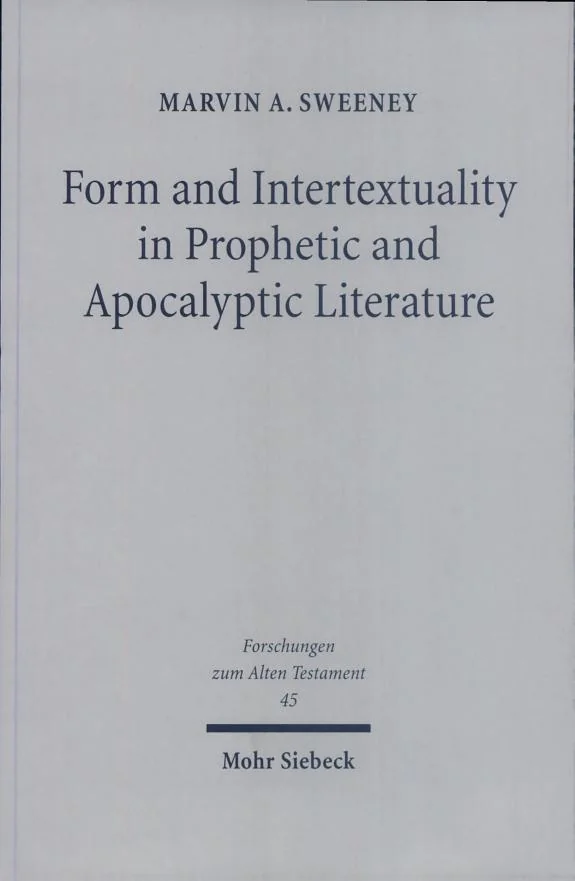
Form and Intertextuality in Prophetic and Apocalyptic Literature
 71
71

Form and Intertextuality in Prophetic and Apocalyptic Literature
Marvin A. Sweeney's "Form and Intertextuality in Prophetic and Apocalyptic Literature" presents a robust academic examination of scripture, focusing on how literary construction informs theological meaning. Sweeney's strength lies in his detailed textual analysis, particularly evident in his sections on Isaiah and Ezekiel, where he demonstrates how structural elements contribute to the overarching message. For instance, his discussion of Isaiah 65-66 as a deliberate conclusion to the entire book offers a compelling re-reading of canonical boundaries. A limitation, however, is the density of the scholarship, which may present a barrier for readers less familiar with critical biblical studies methodologies. The extensive engagement with scholarly debates requires a dedicated reader. Nonetheless, the meticulous approach to intertextuality provides invaluable insights into the self-referential nature of biblical texts. This collection is a significant contribution for those committed to deep textual exegesis.
📝 Description
71
Marvin A. Sweeney’s 2005 collection examines the literary architecture of prophetic and apocalyptic texts.
This book presents nineteen essays that dissect the structure and interconnectedness of ancient prophetic and apocalyptic writings. Sweeney moves beyond simple interpretation to show how the very form of these texts shapes their theological and revelatory meaning. The collection is organized into five sections, covering major prophetic books like Isaiah, Jeremiah, and Ezekiel, as well as the Book of the Twelve Prophets and broader apocalyptic literature.
Sweeney’s analysis focuses on intertextuality, the way biblical texts reference and are influenced by earlier traditions. He investigates how specific literary forms, such as prophetic oracles and apocalyptic visions, function within their books and relate to other scriptural passages. The work also considers the concept of 'Prophetic Torah' and its place within these compositions. This volume is suitable for academics, theologians, and students seriously interested in scripture's critical analysis and the development of ancient prophetic traditions.
While not strictly Gnostic, this work engages with traditions that informed later esoteric thought, particularly within Second Temple Judaism. The focus on hidden meanings within scripture, the structure of divine communication, and the development of apocalyptic literature touches upon themes found in various esoteric interpretations of religious texts. Sweeney's analysis of how textual form shapes revelatory impact offers a scholarly lens on concepts often explored in more mystical or hidden traditions.
💡 Why Read This Book?
• Gain a deeper understanding of how literary form in texts like Isaiah influences their prophetic message, a concept explored through Sweeney's analysis of "Prophetic Torah" within the book. • Appreciate the intricate web of intertextuality in the Hebrew Bible by examining how sections like Ezekiel's visions relate to earlier prophetic traditions. • Understand the concluding function of specific biblical passages, such as Sweeney's argument for Isaiah 65-66's role in book closure, offering a fresh perspective on canonical interpretation.
⭐ Reader Reviews
Honest opinions from readers who have explored this book.
❓ Frequently Asked Questions
What is the primary focus of Marvin A. Sweeney's "Form and Intertextuality in Prophetic and Apocalyptic Literature"?
The book focuses on how the literary form and the interconnectedness of biblical texts (intertextuality) shape the meaning and theological impact of prophetic and apocalyptic literature, originally published in 2005.
Which biblical books are covered in this collection of essays?
The volume covers Isaiah, Jeremiah, Ezekiel, The Book of the Twelve Prophets, and Apocalyptic Literature, presenting nineteen distinct essays.
What does 'intertextuality' mean in the context of this book?
Intertextuality refers to how biblical texts reference, echo, and influence each other. Sweeney examines how these relationships between texts contribute to their interpretation and theological development.
Is this book suitable for beginners in biblical studies?
While valuable, the book is written for scholars and serious students due to its dense academic analysis and engagement with critical methodologies. Prior knowledge of biblical studies is beneficial.
What is the significance of the year 2005 for this book?
2005 is the year Marvin A. Sweeney's collection of essays was first published, placing it within a specific period of academic discourse on biblical literature and interpretation.
What is 'Prophetic Torah' as discussed in the book?
The concept of 'Prophetic Torah' explores the idea that prophetic texts themselves function as divine instruction or law, similar to the Torah, shaping the understanding of God's will for Israel.
🔮 Key Themes & Symbolism
Literary Form as Revelation
This theme investigates how the specific shapes and structures of prophetic and apocalyptic texts are not merely stylistic choices but integral components of their divine message. Sweeney argues that understanding the genre and form, whether an oracle, a vision, or a lament, is crucial for grasping the theological content. For example, the concluding chapters of Isaiah (65-66) are analyzed not just for their content but for their architectonic role in framing the entire book, suggesting a deliberate literary design intended by the author(s).
Interconnectedness of Scripture
The concept of intertextuality is central, highlighting how biblical authors consciously or unconsciously engaged with earlier traditions. Sweeney demonstrates this by tracing how later prophetic books build upon, respond to, or reinterpret earlier ones. This approach reveals the Bible not as a collection of isolated pronouncements but as a dynamic conversation across centuries. Analyzing the Book of the Twelve Prophets, for instance, showcases how their individual messages are contextualized within a larger prophetic corpus.
The Book of Isaiah as Prophetic Torah
Sweeney explores the provocative idea that the Book of Isaiah functions as a form of 'Torah' for subsequent generations. This perspective suggests that Isaiah's prophecies are not merely predictions but authoritative divine instruction, akin to the Law given at Sinai. This interpretation elevates the status of the prophetic literature, positioning it as a foundational source of guidance and covenantal understanding for the people of Israel and Judah.
Apocalyptic Literature's Unique Voice
The volume dedicates attention to apocalyptic texts, examining their distinct literary conventions and theological aims. Sweeney analyzes how these texts, often emerging during periods of crisis, employ symbolic language, visionary experiences, and cosmic perspectives to convey messages of divine judgment and future hope. Understanding the specific forms of apocalyptic literature is key to deciphering its esoteric pronouncements and its role in shaping eschatological thought.
💬 Memorable Quotes
Direct passages from the work, attributed to the author.
“The Book of Isaiah as Prophetic Torah”
— This phrase suggests that Isaiah's prophecies are not merely predictions but function as divine instruction or law, offering authoritative guidance for understanding God's will and covenantal relationship.
“The role of Isaiah 65-66 as conclusion of the Book of Isaiah”
— This highlights the structural analysis, positing that the final chapters of Isaiah serve a deliberate purpose in framing and concluding the entire prophetic collection, impacting its overall meaning.
“The interpretation of the Masoretic Text”
— This indicates a focus on the foundational Hebrew text of the Old Testament, implying that textual criticism and the specific readings within the Masoretic tradition are crucial for understanding prophetic and apocalyptic literature.
“The study of the Book of the Twelve Prophets”
— This refers to the critical examination of the collected Minor Prophets (Hosea through Malachi), emphasizing their literary connections and theological unity as a distinct section of scripture.
“Literary form and intertextuality in prophetic and apocalyptic literature”
— This captures the book's core methodology: analyzing how the structure of these texts and their relationship to other scriptures shape their meaning and theological import.
🌙 Esoteric Significance
Tradition
While not explicitly aligned with a single esoteric lineage like Kabbalah or Gnosticism, Sweeney's work is foundational for esoteric traditions that engage deeply with the symbolic and revelatory nature of biblical texts. It provides a critical, scholarly framework for understanding the divine communication embedded within scripture, which is a common pursuit in Hermetic and mystical circles seeking to uncover hidden meanings in the Word.
Symbolism
The book's focus on literary structure implicitly treats prophetic pronouncements and apocalyptic visions as symbolic systems. Concepts like the 'Book of Isaiah as Prophetic Torah' can be seen as symbolic of divine law being delivered through new channels. Similarly, the symbolic language of apocalyptic literature, though analyzed critically, points to a deeper reality or divine plan that esoteric readers seek to access.
Modern Relevance
Contemporary esoteric scholars and practitioners interested in biblical numerology, gematria, or mystical interpretations of prophecy can utilize Sweeney's rigorous analysis of form and intertextuality as a baseline. Understanding the scholarly consensus on textual construction provides a crucial counterpoint and foundation for those seeking to explore deeper, perhaps non-literal, layers of meaning within these ancient prophetic and apocalyptic texts.
👥 Who Should Read This Book
['• Academic biblical scholars and theologians seeking advanced analysis of prophetic and apocalyptic texts, particularly those interested in literary criticism and intertextuality.', '• Students of ancient Near Eastern religions and comparative scripture who want to understand the specific context and textual construction of biblical prophecy.', "• Serious lay readers of the Bible who wish to move beyond devotional readings to a critical understanding of how scripture's form impacts its message."]
📜 Historical Context
Published in 2005, "Form and Intertextuality in Prophetic and Apocalyptic Literature" emerged during a period of intense scholarly engagement with the Hebrew Bible and Second Temple Judaism. The late 20th and early 21st centuries saw a proliferation of critical methodologies applied to biblical texts, including form criticism, source criticism, and, increasingly, literary and narrative analyses. Sweeney's work builds upon, and sometimes challenges, the interpretations of scholars like Brevard Childs, who championed canonical criticism, and scholars focused on the historical-critical study of individual prophetic books. The rise of comparative ancient Near Eastern studies also provided context, enabling scholars to place Israelite prophecy within broader regional religious and literary traditions. This volume’s focus on intertextuality aligns with a scholarly trend that recognized the self-referential nature of scripture, moving beyond viewing texts in isolation.
📔 Journal Prompts
The concept of 'Prophetic Torah' within the Book of Isaiah.
Isaiah 65-66 as a deliberate conclusion to the Book of Isaiah.
The role of literary form in the prophetic books of Jeremiah and Ezekiel.
Intertextual relationships within the Book of the Twelve Prophets.
Structural elements common to apocalyptic literature discussed by Sweeney.
🗂️ Glossary
Intertextuality
The concept that the meaning of a text is shaped by its relationship to other texts, including how it references, echoes, or reinterprets earlier writings.
Prophetic Torah
A scholarly concept suggesting that certain prophetic texts function as divine instruction or law, offering authoritative guidance similar to the Torah.
Apocalyptic Literature
A genre of literature characterized by visions, symbolic language, and revelations about the end times, often emerging during periods of crisis or persecution.
Masoretic Text (MT)
The authoritative medieval Hebrew and Aramaic text of the Jewish Bible, serving as the basis for most modern translations of the Old Testament.
Literary Form
The specific structure, genre, and stylistic conventions of a text, which Sweeney argues are integral to its theological meaning.
Book of the Twelve Prophets
A collection of shorter prophetic books in the Hebrew Bible (Hosea through Malachi), often treated as a single literary unit.
Canonical Criticism
An approach to biblical interpretation that focuses on the final form of the biblical canon and how the arrangement of texts contributes to their meaning.
This book appears in 1 collection
🔮 Readers Also Liked
Browse all →







From the “Apocalyptic Literature” Collection
View all →





More Free Esoteric History & Biography Books
View all →