Basic Buddhism
 77
77

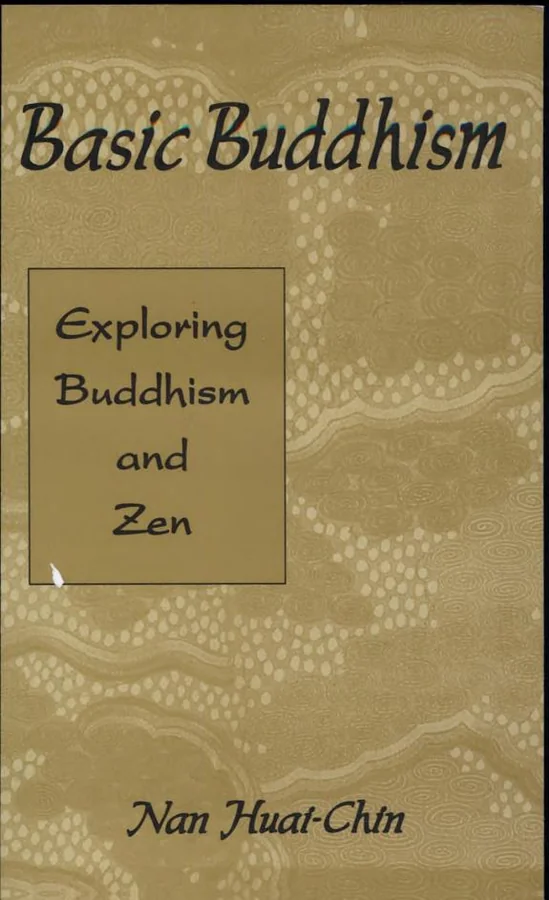
Basic Buddhism
Huaijin Nan's *Basic Buddhism* offers a commendably broad survey of a vast spiritual landscape. Its strength lies in its comprehensive scope, touching upon numerous schools and historical developments without getting bogged down in overly specialized scholasticism. Nan’s explanation of the Four Noble Truths, for instance, grounds the abstract philosophy in the palpable experience of suffering, a crucial anchor for any practitioner. However, the book's sheer breadth occasionally leads to a certain superficiality; readers seeking deep dives into specific schools like Zen or Tibetan Buddhism might find the coverage too brief. The section detailing the Buddha's life, while informative, sometimes feels like a recital of common hagiography rather than a critical examination. Despite this, for an introductory text aiming for accessible overview, Nan provides a solid, if sometimes generalized, foundation. It serves as a competent gateway into the subject matter.
📝 Description
77
Huaijin Nan's 1995 work explains Buddhism's core tenets for a general audience.
Huaijin Nan's *Basic Buddhism* aims to clarify the fundamental principles and varied expressions of Buddhist thought. Nan, a respected scholar of Chinese Buddhism, outlines the historical development of Buddhist ideas and how they adapted across different cultures. The book discusses the various schools that grew from the Buddha's original teachings, showing the wide range of interpretations and practices found in Buddhism today. It avoids complex jargon to make its explanations of core concepts clear.
The text is designed for readers who want a basic grasp of this major contemplative tradition. It addresses those interested in Siddhartha Gautama's life and philosophy, as well as the ideas that have shaped Buddhist practice for over two thousand years. Readers interested in comparative religion, Eastern philosophy, or the psychological dimensions of mindfulness will find this book useful. Its straightforward style is suitable for those new to the subject and for those looking to reinforce their existing knowledge.
While presented as 'basic,' this book engages with the contemplative and philosophical dimensions often associated with esoteric traditions. Nan's approach to explaining concepts like karma, rebirth, and the Eightfold Path offers a structured path towards understanding deeper Buddhist principles. It situates these teachings within a historical and cultural framework, acknowledging how they have been interpreted and practiced across various schools, from Theravada to Mahayana. The book serves as an introduction to a rich spiritual and philosophical system that has guided practitioners for centuries.
💡 Why Read This Book?
• Gain a clear understanding of the Four Noble Truths, the foundational framework for Buddhist practice, as explained by Huaijin Nan's accessible prose. • Trace the historical spread of Buddhism from its origins in India to its diverse forms across Asia, understanding its transmission along routes like the Silk Road. • Learn about the Eightfold Path, a practical guide to ethical conduct and mental discipline, presented as a means to alleviate suffering.
⭐ Reader Reviews
Honest opinions from readers who have explored this book.
❓ Frequently Asked Questions
When was the first edition of Basic Buddhism by Huaijin Nan published?
The first edition of *Basic Buddhism* by Huaijin Nan was published in January 1997, marking its initial entry into the discourse on Buddhist philosophy and practice.
What are the main Buddhist schools discussed in Basic Buddhism?
The book covers various schools of Buddhism, acknowledging the diverse interpretations and practices that have emerged from the Buddha's original teachings across different regions and historical periods.
Does Basic Buddhism explain the concept of karma?
Yes, *Basic Buddhism* explores fundamental concepts such as karma, explaining its role within the Buddhist framework of cause and effect and its relation to ethical living.
Is this book suitable for someone completely new to Buddhism?
Absolutely. *Basic Buddhism* is designed for individuals seeking a foundational understanding, making its explanations of core principles accessible to newcomers to the subject.
How does the book discuss the Buddha's life?
The text recounts stories surrounding the life of Siddhartha Gautama, the Buddha, providing context for his teachings and the origins of the Buddhist tradition.
What geographical regions does the book mention in relation to Buddhism's spread?
The book details Buddhism's expansion throughout Asia, Europe, and America, highlighting how the philosophy adapted to different cultural landscapes.
🔮 Key Themes & Symbolism
The Four Noble Truths
At the heart of Buddhist philosophy lie the Four Noble Truths, which Nan Huai Chin elucidates as the fundamental diagnosis and prescription for human existence. These truths address the reality of suffering (dukkha), its origin in craving and attachment, its cessation through detachment, and the path leading to cessation—the Noble Eightfold Path. The book emphasizes that understanding these truths is not merely an intellectual exercise but a prerequisite for liberation from the cycle of rebirth and dissatisfaction.
The Noble Eightfold Path
Presented as the practical methodology for achieving enlightenment, the Noble Eightfold Path comprises Right Understanding, Right Thought, Right Speech, Right Action, Right Livelihood, Right Effort, Right Mindfulness, and Right Concentration. Huaijin Nan breaks down each element, illustrating how cultivating these eight aspects leads to wisdom, ethical conduct, and mental discipline. This path is depicted as a balanced approach, integrating spiritual insight with everyday actions, essential for working through the complexities of life.
Karma and Rebirth
The book explores the intricate doctrine of karma, the principle of cause and effect governing actions and their consequences across lifetimes. Nan Huai Chin explains how intentional actions, whether physical, verbal, or mental, create karmic seeds that ripen in this life or future existences. This understanding of karma is intrinsically linked to the concept of rebirth, illustrating the continuous cycle of existence (samsara) from which Buddhists seek release through enlightenment.
Diversity of Buddhist Schools
Recognizing that Buddhism is not monolithic, the work surveys the various schools that have emerged since the Buddha's passing. It touches upon the philosophical differences and practical approaches of traditions like Theravada, Mahayana, and Vajrayana, showing how each interprets and applies the core teachings. This historical and geographical survey highlights Buddhism's adaptability and its many-sided expression across Asia, Europe, and America.
💬 Memorable Quotes
Direct passages from the work, attributed to the author.
“The Buddha's teachings address suffering and its cessation.”
— This succinctly captures the core aim of Buddhism: to understand the nature of dissatisfaction in life and to provide a clear path toward its ultimate resolution and lasting peace.
“The Eightfold Path is the way to end suffering.”
— This highlights the practical, actionable nature of Buddhist practice, presenting the Eightfold Path not as abstract philosophy but as a tangible guide for ethical living and mental development.
“Karma dictates the cycle of rebirth.”
— This expresses the causal relationship central to Buddhist cosmology, explaining how our volitional actions shape future experiences and the continuous process of existence.
“Buddhism has adapted across Asia, Europe, and America.”
— This points to the global reach and cultural flexibility of Buddhist thought, demonstrating its capacity to integrate with diverse societies while maintaining its fundamental principles.
“Understanding the Buddha's life provides context for his doctrine.”
— This emphasizes the importance of the historical figure of Siddhartha Gautama, suggesting that his biography offers essential background for comprehending the profound philosophical and spiritual system he established.
🌙 Esoteric Significance
Tradition
While *Basic Buddhism* primarily focuses on the common ground of Buddhist traditions, its exploration of the Eightfold Path and the nature of mind touches upon elements often found in contemplative lineages seeking direct realization. The emphasis on mental cultivation and understanding the nature of reality aligns with certain esoteric goals focused on inner transformation, though Nan's approach remains largely within the framework of accessible, orthodox Buddhist teachings rather than overtly mystical or secret doctrines.
Symbolism
The lotus flower, a recurring symbol in Buddhist art and literature, represents purity, enlightenment, and detachment—emerging unstained from muddy waters. The Dharma wheel (Dharmachakra), often depicted with eight spokes, symbolizes the Buddha's teachings and the Noble Eightfold Path, representing the continuous cycle of truth and liberation. These symbols, while widely recognized, carry deeper meanings about overcoming defilements and setting the wheel of Dharma in motion.
Modern Relevance
Contemporary secular mindfulness practices, popularized by figures like Jon Kabat-Zinn, draw heavily on Buddhist principles of meditation and awareness discussed in this book. Furthermore, scholars and practitioners in fields like comparative religion and consciousness studies continue to reference foundational Buddhist texts and concepts presented by authors like Huaijin Nan to explore the intersection of spirituality, psychology, and philosophy.
👥 Who Should Read This Book
• Students of comparative religion and philosophy seeking a clear introduction to the foundational concepts and historical trajectory of Buddhism. • Individuals interested in mindfulness and meditation practices who wish to understand the philosophical underpinnings and ethical framework from which these techniques originate. • Readers exploring Eastern spiritual traditions for personal growth and a deeper understanding of existence, looking for accessible explanations of complex doctrines.
📜 Historical Context
Published in 1997, *Basic Buddhism* emerged during a period of increased Western engagement with Eastern philosophies, spurred by figures like the Dalai Lama gaining international prominence. The late 20th century saw a surge in translations and popularizations of Buddhist texts, often alongside growing interest in meditation and mindfulness. This era also witnessed continued academic scholarship on Buddhism, building upon foundational work by figures like Edward Conze, who had meticulously studied early Buddhist scriptures. While Nan's work aimed for accessibility, it existed within a scholarly landscape that included rigorous textual analysis and debates between different Buddhist schools, such as the ongoing philosophical dialogues between Madhyamaka and Yogacara traditions within Mahayana Buddhism.
📔 Journal Prompts
The Four Noble Truths as a framework for personal dissatisfaction.
The Eightfold Path and its practical application in daily life.
Karma's influence on choices and future experiences.
The Buddha's life as a narrative of transformation.
The global spread of Buddhism and its cultural adaptations.
🗂️ Glossary
Dukkha
A central Buddhist concept often translated as 'suffering,' 'dissatisfaction,' or 'stress.' It refers to the inherent unsatisfactoriness of conditioned existence, arising from impermanence and attachment.
Samsara
The continuous cycle of birth, death, and rebirth, driven by karma and ignorance. It is the field of existence from which Buddhists seek liberation through enlightenment.
Nirvana
The ultimate goal of Buddhist practice, representing the cessation of suffering and the cycle of rebirth. It is a state of profound peace, liberation, and enlightenment.
Karma
The law of cause and effect, where volitional actions (physical, verbal, or mental) create consequences that influence present and future lives. It is a key driver of Samsara.
Bodhisattva
In Mahayana Buddhism, an enlightened being who delays their own final nirvana out of compassion to help all sentient beings achieve enlightenment.
Theravada
One of the major branches of Buddhism, often considered the 'School of the Elders.' It emphasizes the original teachings of the Buddha as preserved in the Pali Canon.
Mahayana
A major branch of Buddhism that emerged later, emphasizing compassion and the ideal of the Bodhisattva. It encompasses a wide range of schools and philosophies.
This book appears in 1 collection
🔮 Readers Also Liked
Browse all →









From the “Zen Buddhism” Collection
View all →








More Free Sacred Texts & Gnosticism Books
View all →