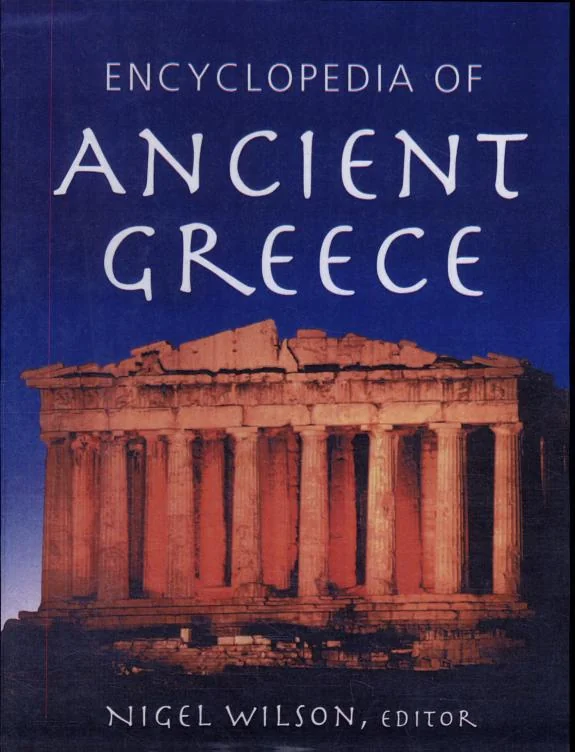
Encyclopedia of Ancient Greece
 72
72

Encyclopedia of Ancient Greece
Nigel Guy Wilson's edited "Encyclopedia of Ancient Greece" functions less as a narrative and more as a meticulously indexed repository of Hellenic knowledge. Its strength lies in its sheer breadth and the authority of its contributing scholars, offering precise details on everything from Athenian legal procedures to Orphic mysteries. A notable passage details the evolution of the Greek alphabet, tracing its Semitic roots and its impact on Western literacy – a testament to the work's factual depth. However, its encyclopedic format, while comprehensive, can feel somewhat dry for the casual reader; it prioritizes factual density over engaging prose. The limitation lies in its academic structure, which, while excellent for reference, doesn't always foster intuitive exploration of interconnected esoteric themes. It is an indispensable, if dense, reference for serious classical study.
📝 Description
72
Nigel Guy Wilson's 2006 encyclopedia consolidates scholarly research on Hellenic civilization.
This volume, derived from the larger "Encyclopedia of Greece and the Hellenic Tradition," offers a focused reference on ancient Greece. It documents the political, cultural, and intellectual life of Hellenic civilization across a wide historical period. The work is aimed at scholars, students, and serious enthusiasts of classical antiquity. Researchers will find authoritative data on specific aspects of Greek society, religion, philosophy, and history. It also suits those wanting a factual understanding of the culture that shaped Western thought.
The encyclopedia reflects the state of Hellenic studies in the early 21st century. It integrates diverse academic viewpoints into a unified reference. The work systematically cross-references its subjects, showing their connections within the development of Greek thought and society. It traces key ideas from their origins through the early Byzantine era.
While primarily a scholarly reference, this encyclopedia touches on aspects of ancient Greek religion and philosophy that inform esoteric traditions. Concepts like the Orphic mysteries, Pythagorean thought, and the philosophical underpinnings of certain rituals are present within the broader discussions of Greek beliefs and intellectual history. It provides factual grounding for understanding the historical origins of ideas later adapted or reinterpreted within various esoteric schools.
💡 Why Read This Book?
• Gain precise factual grounding on the historical development of the concept of the 'polis' before 323 BCE, understanding its political and social structures as detailed within the political history sections. • Explore the specific religious practices and pantheon of ancient Greece, learning about the cult of Asclepius and its significance beyond mere mythology. • Understand the philosophical lineage from Pre-Socratic thinkers to figures like Plato and Aristotle, grasping the foundational debates that shaped Western thought.
⭐ Reader Reviews
Honest opinions from readers who have explored this book.
❓ Frequently Asked Questions
What historical period does the Encyclopedia of Ancient Greece cover?
The work spans from the earliest periods of ancient Greek civilization up to the founding of Constantinople in the early Byzantine era, offering a broad historical scope.
Is this book suitable for someone new to Greek mythology?
While comprehensive, it's written for a scholarly audience. Beginners might find its dense, factual approach less accessible than introductory texts on mythology.
How is the Encyclopedia of Ancient Greece organized?
It is thoroughly cross-referenced and fully indexed, allowing users to locate specific information efficiently across various aspects of Greek culture and history.
Who are the primary contributors to this encyclopedia?
The volume is the product of an international group of scholars, with Nigel Guy Wilson serving as the editor for this specific edition.
What is the relationship between this book and the Encyclopedia of Greece and the Hellenic Tradition?
This single-volume work is derived from the more broadly focused, two-volume "Encyclopedia of Greece and the Hellenic Tradition," edited and condensed for accessibility.
Does the book discuss ancient Greek philosophy?
Yes, it provides authoritative guidance on the philosophical traditions, including major figures and schools of thought from antiquity.
🔮 Key Themes & Symbolism
The Polis and Governance
The encyclopedia meticulously details the structure and evolution of the 'polis,' the fundamental city-state of ancient Greece. It examines the diverse forms of governance, from Athenian democracy and Spartan oligarchy to monarchies and tyrannies. Understanding the polis is crucial for grasping the socio-political landscape, its legal frameworks, and the civic ideologies that shaped Greek identity and its enduring influence on Western political thought.
Hellenic Philosophical Foundations
This volume serves as a critical resource for understanding the seminal figures and schools of ancient Greek philosophy. It traces the intellectual lineage from the Pre-Socratics through to Plato and Aristotle, exploring their metaphysical inquiries, ethical systems, and epistemological debates. These philosophical currents are presented not in isolation, but within their historical and cultural context, highlighting their foundational role in Western intellectual traditions.
Mythology and Religious Practice
Beyond the well-known Olympian pantheon, the encyclopedia looks at the intricate world of Greek mythology and religious observance. It covers the myths, rituals, and cultic practices associated with various deities and heroes, as well as mystery religions like the Eleusinian or Orphic traditions. This exploration reveals the pervasive influence of religious belief on art, literature, and daily life in ancient Greece.
Cultural and Artistic Achievements
The work surveys the remarkable cultural output of ancient Greece, encompassing literature, drama, sculpture, and architecture. It contextualizes these achievements within their historical periods, exploring the stylistic developments and the societal functions they served. The influence of Greek art and aesthetics on subsequent civilizations is a recurring undercurrent, underscoring their lasting global impact.
💬 Memorable Quotes
Direct passages from the work, attributed to the author.
“The encyclopedia systematically cross-references political, cultural, and intellectual history.”
— This highlights the work's design as an interconnected reference, enabling readers to trace thematic links and understand the holistic nature of ancient Greek civilization.
“Derived from the more broadly focused Encyclopedia of Greece and the Hellenic Tradition.”
— This explains the book's origin, suggesting a distilled and authoritative compilation of specialized knowledge from a larger, comprehensive work.
“Written by an international group of scholars.”
— This emphasizes the collaborative and authoritative nature of the content, drawing on diverse expertise in the field of classical studies.
“Comprehensively covers antiquity to the early Byzantine era.”
— This points to the extensive chronological scope of the encyclopedia, providing a long view of Hellenic influence and development.
“Fully indexed and thoroughly cross-referenced.”
— This underscores the practical utility of the encyclopedia for research, ensuring users can efficiently access and navigate its vast informational content.
🌙 Esoteric Significance
Tradition
While not explicitly an esoteric text, this encyclopedia serves as a foundational reference for various Western esoteric traditions that draw heavily on Hellenic sources, including Hermeticism, Neoplatonism, and certain forms of ceremonial magic. Its academic rigor provides the factual bedrock upon which esoteric interpretations are built, allowing practitioners to ground their understanding of ancient deities, philosophies, and rituals in historical context.
Symbolism
Key symbols such as the Oracle of Delphi, the Pythagorean theorem, and figures like Orpheus hold significant esoteric weight. The encyclopedia details their historical context, offering scholars and practitioners insight into their original meanings, which esoteric traditions often re-interpret. The concept of the 'Logos,' central to Greek philosophy, is also explored, a concept vital in Hermetic and Gnostic thought.
Modern Relevance
Contemporary practitioners of Hellenistic polytheism, Hermeticists studying the Corpus Hermeticum, and scholars of Western esotericism frequently consult such encyclopedic works. They provide essential background for understanding the historical and philosophical roots of modern magical and philosophical systems, enabling a deeper engagement with practices that echo ancient Greek ideals and mysteries.
👥 Who Should Read This Book
• Students of Western Esotericism: Those exploring Hermeticism, Neoplatonism, or ancient mystery traditions will find essential historical and philosophical context for their studies. • Academic Researchers: Scholars of classical antiquity, comparative religion, and intellectual history require a reliable, fact-checked reference for detailed information on Greek culture. • Aspiring Philosophers: Individuals interested in the origins of Western philosophy will benefit from the comprehensive overview of Pre-Socratic, Platonic, and Aristotelian thought.
📜 Historical Context
Published in 2006, "Encyclopedia of Ancient Greece" emerged during a robust phase of classical scholarship, building upon decades of archaeological and textual analysis. Its creation as a single-volume distillation from the larger "Encyclopedia of Greece and the Hellenic Tradition" signifies a trend towards consolidating vast academic knowledge for wider accessibility. At this time, classical studies were engaged in ongoing debates concerning Hellenistic influence and the reception of antiquity in later periods, often contrasted with the burgeoning field of digital humanities. The work's scholarly consensus reflects the academic range of the early 21st century, integrating diverse specialist contributions. While not facing direct censorship, its approach represents the established academic tradition, standing distinct from more speculative or popularizing accounts of ancient Greece.
📔 Journal Prompts
The concept of the 'polis' and its societal structures.
The philosophical dialogues attributed to Plato.
The mythological cycles of the Olympian gods.
The influence of Greek tragedy on later dramatic forms.
The Pythagorean cosmology and its numerical principles.
🗂️ Glossary
Polis
The ancient Greek city-state, a fundamental political and social unit characterized by its independence and distinct civic identity.
Hellenic Tradition
Refers to the collective cultural, linguistic, and historical heritage of ancient Greece and its people.
Byzantine Era
The historical period of the Eastern Roman Empire, following the classical antiquity of Greece, particularly its early centuries.
Pre-Socratics
Ancient Greek philosophers who lived before Socrates, focusing on cosmology and the fundamental nature of reality.
Oligarchy
A form of government in which power rests with a small number of people, often distinguished by nobility, wealth, or military control.
Corpus Hermeticum
A collection of ancient philosophical and religious writings attributed to Hermes Trismegistus, influential in Renaissance esotericism.
Orphic Mysteries
A set of religious beliefs and practices in ancient Greece associated with the mythical poet Orpheus, focused on purification and afterlife.
This book appears in 1 collection
🔮 Readers Also Liked
Browse all →









From the “Orphic Mysteries” Collection
View all →








More Free Esoteric History & Biography Books
View all →