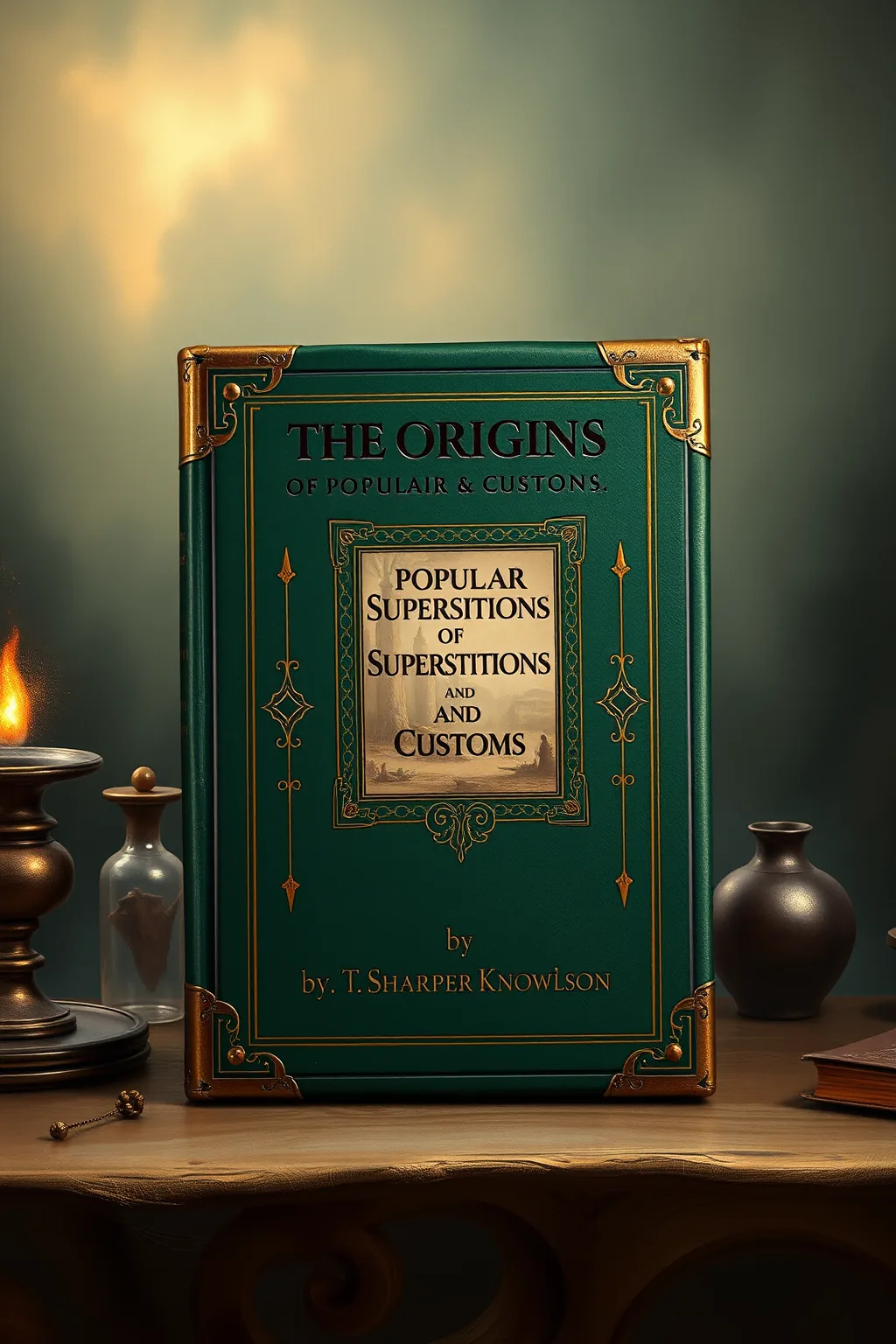
The Origins of Popular Superstitions and Customs
 77
77

The Origins of Popular Superstitions and Customs



Celeste Moreau (Divination & Symbolism Reviewer) — T. Sharper Knowlson's 'The Origins of Popular Superstitions and Customs' is a foundational text for anyone seeking to understand the esoteric roots of human ritual and belief. Knowlson's meticulous research unearths the often-occult significance embedded within everyday practices, from fertility rites to protective charms. His anthropological approach, while scholarly, is rich with fascinating insights into the collective unconscious and the enduring power of symbolism. This book is indispensable for folklorists, occult historians, and seekers of hidden knowledge, offering a crucial bridge between ancient mythologies and contemporary custom. A truly illuminating read that reveals the magic still lingering in the mundane.
📝 Description
77
T. Sharper Knowlson's 1911 book examines the ancient, often mystical, roots of everyday superstitions.
Published in 1911, T. Sharper Knowlson's 'The Origins of Popular Superstitions and Customs' investigates the historical development of common beliefs and practices. Knowlson, a folklorist, applies an anthropological perspective to understand why people believe in omens, use charms, or follow specific marriage and seasonal rituals. The book traces how these habits derive from fundamental human emotions like fear and hope, and the persistent need to interpret unexplained events.
Knowlson looks at divination practices and their historical roots, showing how they connect to a deeper human drive to understand the world. The work aims to reveal the symbolic meanings embedded in traditions that often go unnoticed in modern life. It is a study for anyone interested in the underlying logic of folklore and ritual.
This book engages with the study of folklore and its connections to deeper psychological and cultural currents. It is part of a larger tradition of scholarship that sought to understand the origins of human belief systems, often touching on ideas that were considered outside the mainstream scientific understanding of the time. Knowlson's work is rooted in the late 19th and early 20th century interest in the subconscious, collective memory, and the symbolic dimensions of everyday life.
✍️ Author
💡 Why Read This Book?
Uncover the mystical origins of everyday beliefs and rituals. Explore the symbolic language that has shaped human consciousness for centuries. Ideal for seekers of hidden knowledge, folklorists, occult historians, and anyone fascinated by the psychological and spiritual underpinnings of custom. This book offers a profound lens through which to view the world.
⭐ Reader Reviews
Honest opinions from readers who have explored this book.
❓ Frequently Asked Questions
What is the primary focus of this book?
The book meticulously explores the historical and psychological origins of popular superstitions, folk customs, seasonal observances, and divination practices, tracing their roots from ancient times to the early 20th century.
Who was T. Sharper Knowlson?
T. Sharper Knowlson was a British folklorist and scholar who dedicated his work to examining the historical development and cultural significance of common beliefs and practices.
Is this book suitable for beginners in occult studies?
Yes, while scholarly, the book provides accessible insights into the historical context of many practices that are foundational to various esoteric traditions, making it a valuable starting point.
What kind of customs does the book cover?
It delves into a wide array of customs including marriage rites, festival traditions, omens, charms, divination methods, and various other curious practices that have permeated human culture.
What is the publication date of the original work?
The original publication date for 'The Origins of Popular Superstitions and Customs' was 1910.
🔮 Key Themes & Symbolism
The Traces of Ancient Ritual
This theme looks at how seemingly modern superstitions and customs are direct descendants of ancient pagan rituals, fertility rites, and attempts to appease unseen forces. Knowlson reveals the persistent human need to engage with the divine and the supernatural, demonstrating how these practices, stripped of their original context, continue to manifest in our daily lives, carrying within them the traces of primordial magic and a deep connection to the cycles of nature and the cosmos.
Symbolism in the Mundane
Knowlson illuminates the body of symbolism woven into everyday objects, actions, and occurrences. From the significance of specific colors and numbers to the protective power attributed to certain gestures or charms, the book deciphers the hidden language of folk belief. It argues that these symbols, often unconsciously understood, serve as conduits for psychological and spiritual energies, acting as bridges between the material world and the area of the unseen, revealing a universal symbolic grammar that underpins human experience.
The Persistence of Ignorance and Fear
A central thread is the examination of how ignorance, superstition, and primal fears have historically shaped human behavior and belief systems. Knowlson explores how a lack of scientific understanding or a desire to control the uncontrollable led to the creation of elaborate systems of omens, taboos, and appeasement rituals. This theme highlights the enduring human struggle to navigate uncertainty, often through the creation of ordered systems of belief that offer comfort and a sense of agency against the perceived chaos of existence.
💬 Memorable Quotes
Direct passages from the work, attributed to the author.
“Every charm whispers a forgotten prayer.”
— Suggests that seemingly simple talismans or charms hold within them a residue of ancient invocations or pleas to higher powers.
“The fear of the unknown is the mother of many customs.”
— Highlights how attempts to manage or ward off perceived threats from the unknown are a primary driver behind the formation of many social rituals and beliefs.
“The common man's calendar is written in the stars and the earth.”
— Illustrates how everyday life and its associated customs are deeply tied to natural cycles and celestial observations, reflecting an ancient, holistic worldview.
💡 Key Ideas
Editorial paraphrase of the work's core concepts — not direct quotes.
The roots of popular superstitions are often buried deep in the soil of ancient beliefs.
This quote emphasizes that current common beliefs are not novel but are continuations of much older, often forgotten, traditions and mythologies.
In the combine of tradition, symbolism is the golden thread.
This quote points to the fundamental role of symbolic meaning in connecting different customs and beliefs, acting as a unifying element across diverse practices.
🌙 Esoteric Significance
Tradition
This work significantly bridges the gap between academic folklore and esoteric traditions by revealing the underlying archetypal patterns and symbolic languages that inform occult practices. It speaks to a universal tradition of seeking hidden knowledge and manipulating unseen forces, common across Hermeticism, Kabbalah, and various shamanic practices, by showing how these impulses manifest in popular, often unacknowledged, forms.
Symbolism
The book is a rich compendium of folk symbolism, illustrating how everyday objects, gestures, and natural phenomena become imbued with magical significance. It deciphers the meaning behind charms, omens, and ritualistic actions, revealing how these symbols act as conduits for intention and energy, often drawing from ancient cosmological models and the belief in sympathetic magic and correspondence between the macrocosm and microcosm.
Modern Relevance
In an age often perceived as overly rationalized, Knowlson's work offers a vital reminder of the enduring power of the irrational and the symbolic in shaping human behavior and belief. It provides a framework for understanding the psychological and spiritual needs that drive the creation of meaning and ritual, resonating with contemporary interest in mindfulness, archetypal psychology, and the resurgence of interest in ancient wisdom traditions and their application in modern life.
👥 Who Should Read This Book
This useful volume is essential for the dedicated seeker of esoteric knowledge, offering a foundational understanding of how mystical impulses manifest in everyday life. Scholars of folklore, anthropology, and comparative religion will find its meticulous research useful for tracing cultural lineages. Practitioners of occult arts, from spellcraft to divination, will discover the ancient roots and symbolic resonance of many of their tools and techniques. For the curious mind, it provides a fascinating lens through which to re-examine the seemingly ordinary, revealing the hidden layers of meaning and magic that persist in the modern world.
📜 Historical Context
Published in 1910, 'The Origins of Popular Superstitions and Customs' emerged during a period of intense academic interest in folklore, anthropology, and the burgeoning field of psychology. The early 20th century saw scholars actively seeking to catalog and understand the 'primitive' beliefs and practices of various cultures, often as a means to contrast them with modern, rational society. Knowlson's work fits within this trend, yet distinguishes itself by its detailed tracing of the lineage of superstitions, often linking them to deeply ingrained psychological needs and ancient spiritual impulses. It was an era when the veil between the scientific and the mystical was still being explored, and books like this offered a bridge, examining the enduring power of non-rational thought and its deep roots in the human psyche, even as industrialization and scientific advancement reshaped the world.
📔 Journal Prompts
Identify a personal superstition or custom; research its potential historical or symbolic origins using Knowlson's framework.
How do the 'roots of popular superstitions' discussed by Knowlson manifest in your contemporary society or personal life?
Explore the concept of 'symbolism in the mundane.' Choose an everyday object or action and analyze its potential symbolic meaning through an esoteric lens.
Reflect on the role of 'ignorance and fear' in shaping beliefs. How does understanding this help in navigating personal anxieties or societal narratives?
Consider how a seemingly secular modern custom might have ancient, possibly mystical, origins.
🗂️ Glossary
Omen
An event or observation believed to portend a future occurrence, often interpreted as a sign from the divine or supernatural realm, carrying either good or bad fortune.
Charm
An object or inscription believed to possess magical properties, typically used to protect the wearer or user from harm, attract good luck, or achieve a specific magical outcome.
Divination
The practice of seeking knowledge of the future or the unknown by supernatural means, employing various methods such as tarot, scrying, astrology, or geomancy.
Folk Custom
A traditional practice or belief passed down through generations within a community, often tied to social rituals, seasonal events, or everyday life, carrying cultural and symbolic significance.
Sympathetic Magic
A belief system where like produces like, or that a resemblance between two things implies a connection, enabling actions performed on one to affect the other (e.g., using a doll to represent a person).
This book appears in 3 collections
🔮 Readers Also Liked
Browse all →








From the “Transcendental Meditation” Collection
View all →






More Free Esoteric History & Biography Books
View all →