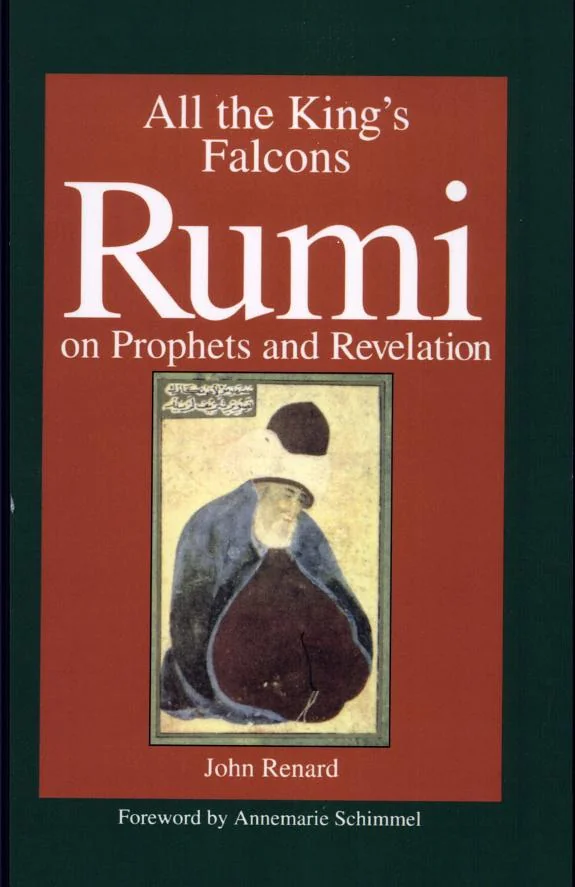
All the King's Falcons
 74
74

All the King's Falcons
John Renard’s All the King’s Falcons offers a meticulous dissection of Rumi’s theological framework concerning prophecy and revelation. The author’s strength lies in his scholarly rigor, meticulously tracing Rumi’s engagement with foundational Islamic creedal statements. Renard skillfully unpacks how Rumi viewed the prophet Muhammad not merely as a historical figure but as a perpetual conduit for divine wisdom. A particular passage discussing the concept of *fitra* (natural disposition) as receptive to revelation is exceptionally illuminating.
However, the book’s academic density may present a barrier for casual readers. While invaluable for specialists, the prose occasionally verges on the dry, sacrificing narrative flow for exhaustive detail. The 1994 publication date also means it predates some later scholarship on Rumi’s reception. Despite this, Renard provides a vital corrective to purely poetic interpretations of Rumi, grounding his mysticism in the bedrock of Islamic doctrine. It serves as an essential, if demanding, resource for understanding Rumi’s role as a theologian.
📝 Description
74
John Renard's 1994 book examines mystical interpretations of Islam, focusing on the Shahada.
Published in 1994, John Renard's "All the King's Falcons" provides a scholarly look at Islamic mysticism. The book centers on the second part of the Islamic declaration of faith, "Muhammad is the messenger of God." Renard analyzes how prophetic revelation is understood within Sufi thought, with a strong emphasis on the 13th-century Persian poet Jalal al-Din Rumi.
The work addresses a gap in Western scholarship by detailing Rumi's engagement with Islamic creedal statements, moving beyond his more widely known devotional poetry. It explores the nature of prophecy and divine revelation, and the concept of the "Seal of the Prophets." Renard investigates how Rumi's teachings show the continuing importance of prophetic guidance for believers.
This book places itself within the tradition of Islamic mysticism, specifically Sufism. It examines how core Islamic tenets, like the Shahada, are understood through a mystical lens. By drawing on the works of Rumi, a central figure in Sufi literature, Renard illuminates the esoteric dimensions of prophecy and spiritual transmission within Islam. The study looks at how these concepts inform the spiritual path of believers.
💡 Why Read This Book?
• Gain a nuanced understanding of the second half of the Islamic creed, "Muhammad is the messenger of God," as interpreted through Rumi's unique theological perspective, moving beyond poetic appreciation to doctrinal depth. • Explore the concept of prophetic revelation and its function in sustaining spiritual guidance according to Rumi, offering a framework for understanding divine communication beyond historical events. • Appreciate Rumi's intellectual engagement with orthodox Islamic theology, as detailed in the book's analysis of his commentary on core creedal statements, first published in 1994.
⭐ Reader Reviews
Honest opinions from readers who have explored this book.
❓ Frequently Asked Questions
What specific aspect of Islamic creed does John Renard's book focus on?
The book centers on the second half of the basic Muslim creed, "Muhammad is the messenger of God," examining Rumi's mystical and theological interpretations of prophetic revelation.
Is this book about Rumi's poetry or his theology?
While Rumi is renowned for his poetry, All the King's Falcons focuses on his theological and philosophical insights, particularly concerning prophecy and the nature of divine message.
Who is Jalal al-Din Rumi?
Jalal al-Din Rumi was a 13th-century Persian poet, Islamic scholar, theologian, and Sufi mystic, revered for his profound spiritual teachings and the influential Masnavi.
What is the historical context of the book's publication?
Published in 1994, the book emerged during a time of growing academic interest in Sufism, offering a focused analysis of Rumi's theological contributions often overlooked in favor of his poetic works.
What does the title 'All the King's Falcons' refer to?
The title is a metaphorical reference, likely alluding to the spiritual messengers or divine insights that are part of a larger, divinely ordained system, akin to the King's trusted agents.
Does the book discuss the concept of 'Seal of the Prophets'?
Yes, the work explores Rumi's understanding of Muhammad as the 'Seal of the Prophets' and the implications of this title for continuous spiritual guidance.
🔮 Key Themes & Symbolism
Prophecy as Divine Transmission
The book investigates Rumi's perspective on prophecy not as a concluded historical event but as a continuous stream of divine transmission. Renard details how Rumi viewed prophets, particularly Muhammad, as conduits for God's message, essential for the spiritual guidance of humanity. This transmission is not static but alive, offering wisdom relevant across ages. The work scrutinizes how Rumi connects the concept of *wahy* (revelation) to the ongoing spiritual needs of the community, emphasizing the prophet’s role in informative the path of *iman* (faith).
Rumi and Islamic Creed
All the King's Falcons uniquely positions Rumi within the broader context of Islamic theology by examining his engagement with the fundamental tenets of the faith. Renard meticulously analyzes Rumi's interpretations of the *shahada*, focusing on the affirmation of Muhammad's prophethood. This exploration reveals Rumi not as an outlier but as a profound commentator on orthodox Islamic doctrine, infusing creedal statements with mystical depth and practical spiritual application for his followers.
The Nature of Revelation
Central to Renard's analysis is the nature and function of divine revelation (*wahy*). The book explores Rumi's understanding of how revelation operates, its forms, and its purpose in guiding human consciousness. Renard highlights Rumi's emphasis on the inner reception of divine truth, suggesting that revelation is accessible not only through prophets but also through spiritual contemplation and purified hearts. This perspective bridges the theological and the experiential aspects of faith.
Spiritual Authority and Succession
The work touches upon the concept of spiritual authority that flows from prophetic lineage. By examining Rumi's discourse on the messengers of God, Renard implicitly addresses questions of succession and the transmission of spiritual knowledge. The 'falcons' in the title can be seen as symbols of those who carry forward the divine message, guided by the original prophetic light, ensuring the continuity of spiritual wisdom within the Islamic tradition.
💬 Memorable Quotes
Direct passages from the work, attributed to the author.
“Revelation is not a closed book but a living spring feeding the soul's thirst.”
— This interpretation captures Rumi's view, as presented by Renard, that divine revelation is an active, ongoing source of spiritual sustenance, essential for the believer's journey.
“The prophet’s message serves as the guiding star for those seeking the Divine.”
— This conveys the essential role of prophetic guidance in Islamic mysticism, emphasizing its function as a celestial map for the spiritual seeker, a theme explored in the book.
“Rumi connects the utterance of faith to the inner reality of submission.”
— This highlights Renard's examination of how Rumi bridges the verbal affirmation of faith (the creed) with the lived, internal experience of surrender to God's will.
“The nature of prophecy is to reveal that which is veiled to the ordinary eye.”
— This captures the esoteric understanding of prophecy discussed in the book – that prophets possess a unique vision enabling them to perceive and communicate divine realities hidden from mundane perception.
💡 Key Ideas
Editorial paraphrase of the work's core concepts — not direct quotes.
The second half of the creed affirms Muhammad as the messenger, a truth Rumi illuminates through the lens of ongoing spiritual guidance.
This paraphrased concept highlights the book's core focus: Rumi's theological interpretation of Muhammad's prophethood as a source of continuous spiritual direction, rather than solely a historical event.
🌙 Esoteric Significance
Tradition
This work is situated within the esoteric tradition of Islamic mysticism, specifically Sufism, drawing heavily on the teachings of Jalal al-Din Rumi. It aligns with the Sufi emphasis on inner spiritual realization and the direct experience of divine truth. While Rumi himself is a central figure in Sufism, Renard's analysis connects his teachings to the broader framework of Islamic theology, demonstrating how esoteric understanding can illuminate orthodox doctrine, rather than departing from it.
Symbolism
The title itself, 'All the King's Falcons,' likely alludes to the concept of spiritual messengers or divine agents acting under God's command, akin to trained birds of prey in service to a sovereign. Within Sufi symbolism, falcons can represent swift spiritual perception, keen insight, or the soul's rapid ascent towards the Divine. The book explores how Rumi uses various symbols to represent prophetic transmission and the nature of divine knowledge, often linking them to light, speech, and the heart's capacity to receive.
Modern Relevance
Contemporary scholars and practitioners of Sufism continue to draw upon Renard's work for its precise theological grounding of Rumi's teachings. Thinkers interested in comparative mysticism and the intersection of faith and reason find value in his analysis of how core Islamic beliefs are interpreted through a mystical lens. The book's focus on prophetic revelation also speaks to modern discussions on spiritual authority and the transmission of wisdom in an age often characterized by skepticism.
👥 Who Should Read This Book
• Students of Islamic theology and comparative religion seeking to understand the doctrinal underpinnings of Sufi thought, particularly concerning prophecy and revelation. • Scholars and enthusiasts of Jalal al-Din Rumi interested in moving beyond his poetry to engage with his systematic theological interpretations and his place within Islamic intellectual history. • Practitioners of esoteric traditions who wish to explore the bridge between orthodox religious frameworks and mystical experience, using Rumi's example as a case study.
📜 Historical Context
John Renard’s All the King’s Falcons, published in 1994, entered the academic landscape during a period of burgeoning scholarship on Islamic mysticism and Sufism. The 1990s saw a growing Western engagement with figures like Rumi, often focusing on his ecstatic poetry. Renard’s work distinguished itself by examining Rumi's engagement with orthodox Islamic theology, specifically the second half of the *shahada* (the declaration of faith concerning Muhammad's prophethood). This was a significant contribution, offering a more doctrinally grounded perspective on Rumi, contrasting with purely devotional or poetic interpretations prevalent at the time. The book provided a counterpoint to more secularized readings of Rumi that were also emerging. Its rigorous analysis contributed to the scholarly discourse on the intellectual history of Sufism and its intricate relationship with Islamic creedalism, situating Rumi within a rich theological tradition.
📔 Journal Prompts
Rumi's understanding of prophetic revelation as an ongoing transmission.
The concept of the 'Seal of the Prophets' in light of Rumi's mystical exegesis.
Connecting the second half of the *shahada* to personal spiritual guidance.
The role of the heart in receiving divine knowledge, as expounded by Rumi.
How Rumi integrates creedal affirmation with inner spiritual reality.
🗂️ Glossary
Shahada
The Islamic declaration of faith, consisting of two parts: 'There is no god but Allah' and 'Muhammad is the messenger of Allah'.
Rumi
Jalal al-Din Rumi (1207–1273), a 13th-century Persian poet, Islamic scholar, theologian, and Sufi mystic, founder of the Mevlevi order.
Wahy
Arabic term for divine revelation or inspiration, particularly as received by prophets in Islam.
Prophet (Nabi/Rasul)
In Islam, a human chosen by God to receive and convey divine messages. Muhammad is considered the final prophet.
Seal of the Prophets
A title for the Prophet Muhammad, signifying that he is the last prophet in a line of divine messengers.
Iman
Islamic term for faith or belief, encompassing belief in God, His angels, His books, His messengers, the Last Day, and divine decree.
Fitra
The innate, pure human disposition or natural inclination towards God, often considered the original state of creation.
This book appears in 1 collection
🔮 Readers Also Liked
Browse all →







From the “Prophecy” Collection
View all →



More Free Sacred Texts & Gnosticism Books
View all →