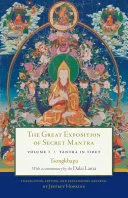
The Great Exposition of Secret Mantra, Volume One
 74
74

The Great Exposition of Secret Mantra, Volume One
The Dalai Lama's commentary on Tsongkhapa's tantric exposition is a valuable, if dense, contribution to accessible Vajrayana literature. Unlike many introductory texts, this volume does not shy away from the intricate philosophical distinctions that underpin secret mantra, particularly the rigorous comparisons drawn between Mahayana sutra and tantra. The explanation of the 'two truths' and their relevance to tantric visualization is particularly well-articulated, offering clarity on a concept often obscured. However, the sheer depth of Tsongkhapa's original work, even with the Dalai Lama's guidance, presents a significant challenge. Readers unfamiliar with the foundational principles of Buddhist philosophy, such as the Four Noble Truths or the concept of emptiness, may find themselves lost amidst the detailed scholastic arguments. The 2016 publication date indicates a modern effort to bring these teachings forward, but the core material remains demanding. Ultimately, this book serves best as a rigorous study text for dedicated practitioners, rather than a casual exploration of esoteric Buddhism.
📝 Description
74
Published in 2016, The Great Exposition of Secret Mantra, Volume One comments on Tsongkhapa's key tantric texts.
This volume, authored by the 14th Dalai Lama, provides a detailed commentary on Tsongkhapa's foundational writings on Buddhist tantra. It begins by clearly distinguishing the Mahayana and Hinayana paths within the sutra tradition. It then contrasts these with the specific methods found in tantra. The book aims to make these complex teachings understandable to a modern, global audience.
The text is designed for serious students of Tibetan Buddhism and those practitioners who want a deeper grasp of tantric theory and its application. It is especially useful for individuals who already have a solid background in Buddhist philosophy and wish to investigate the more esoteric aspects of the Vajrayana path. Those studying comparative religion or mysticism will also find its structured approach valuable.
It addresses crucial differences between the 'sutra path' and the 'mantra path,' noting the faster methods and detailed visualizations characteristic of Vajrayana. The book also examines the concept of the 'two truths'—conventional and ultimate—as understood in this tradition. It covers the necessary preliminary practices for engaging in deity yoga and advanced meditations.
This work engages with the philosophical and practical lineage of Je Tsongkhapa, the founder of the Gelug school of Tibetan Buddhism. The Dalai Lama's commentary situates these teachings within the historical development of Buddhist thought in Tibet. It specifically addresses the unique methodologies of tantra, such as deity yoga and accelerated meditative practices. The text makes these advanced teachings from a specific lineage accessible, connecting them to broader Buddhist principles.
💡 Why Read This Book?
• Gain clarity on the fundamental differences between the Mahayana sutra path and the Vajrayana tantric path, as explained by His Holiness the 14th Dalai Lama in relation to Tsongkhapa's teachings. • Understand the esoteric concept of the 'two truths' (conventional and ultimate) and their specific application within the practice of secret mantra, as detailed in the exposition. • Explore the critical role and structure of preliminary practices (ngöndro) necessary for engaging with advanced tantric meditations, a core component of Tsongkhapa's system as presented in this volume.
⭐ Reader Reviews
Honest opinions from readers who have explored this book.
❓ Frequently Asked Questions
What is the primary difference between sutra and tantra as explained in The Great Exposition of Secret Mantra, Volume One?
The volume distinguishes sutra and tantra by their methods and timelines for achieving enlightenment. Sutra emphasizes gradual cultivation over many lifetimes, while tantra offers accelerated methods through specific practices like deity yoga and mantra recitation.
Who was Tsongkhapa, and why is his text important in this exposition?
Tsongkhapa (1357–1419) was the founder of the Gelug school of Tibetan Buddhism. His text is foundational for understanding the theoretical and practical aspects of Buddhist tantra within this lineage, forming the core commentary for the Dalai Lama's work.
Does this book explain how to perform tantric rituals?
While it provides the philosophical and theoretical underpinnings of tantric practice, including concepts like deity yoga, this volume focuses more on the exposition of Tsongkhapa's text. Practical ritualistic instruction typically requires direct transmission from a qualified guru.
What is the significance of the 'two truths' in the context of secret mantra?
The 'two truths' (conventional and ultimate) are crucial. The exposition explains how tantra utilizes conventional reality, including visualizations of deities, as a skillful means to realize the ultimate truth of emptiness, thereby accelerating the path.
Is this book suitable for beginners in Buddhism?
This volume is best suited for those with an existing foundation in Buddhist philosophy. It delves into advanced concepts and requires an understanding of basic Buddhist principles before approaching the specifics of secret mantra.
What does 'Secret Mantra' refer to in the title?
Secret Mantra refers to the Vajrayana path, often termed 'mantra' or 'tantra.' It is considered 'secret' not due to concealment, but because its profound methods and the commitments involved require a qualified teacher and a disciplined practitioner.
🔮 Key Themes & Symbolism
Sutra vs. Tantra Paths
This volume meticulously unpacks the divergence between the gradual path of Mahayana sutra and the accelerated methods of Vajrayana tantra. It highlights how tantra, or 'Secret Mantra,' employs unique techniques and commitments to achieve enlightenment more rapidly, necessitating rigorous preliminary practices and a qualified guru. The distinction is not one of superiority, but of methodology and the spiritual timeline offered to the practitioner.
The Two Truths Doctrine
Central to understanding tantric practice is the doctrine of the 'two truths': conventional and ultimate. The exposition clarifies how tantra masterfully utilizes conventional reality – including visualizations of enlightened beings and the recitation of mantras – as a powerful means to directly perceive the ultimate nature of reality, emptiness, thereby transcending ordinary perception.
Tsongkhapa's Gelug Lineage
The work is a detailed commentary on the tantric teachings of Je Tsongkhapa, the 14th-century scholar-saint who founded the Gelug school. This lineage emphasizes a systematic, scholastic approach to both sutra and tantra, ensuring a strong philosophical grounding. The Dalai Lama’s exposition honors this tradition, presenting Tsongkhapa’s insights with clarity and profound respect.
The Role of the Guru
Within the context of Secret Mantra, the relationship with a qualified spiritual guide (guru or lama) is paramount. The text implicitly underscores the necessity of receiving empowerments and transmissions directly from a lineage holder. This emphasizes that tantric practice is not a solitary pursuit but one undertaken within a sacred, guided lineage.
💬 Memorable Quotes
Direct passages from the work, attributed to the author.
“The Mahayana and Hinayana streams in the sutra tradition, and between the sutra tradition and that of tantra generally.”
— This phrase highlights the core comparative analysis within the book, setting up the framework to understand the distinct philosophical underpinnings and practical methodologies of different Buddhist vehicles.
“Highly practical and compassionate explanations from H.H. the Dalai Lama.”
— This suggests the Dalai Lama's approach is not purely academic but infused with a concern for the practitioner's welfare, aiming to make profound and potentially challenging teachings understandable and applicable.
“Tsongkhapa's seminal text on Buddhist tantra.”
— This points to the authoritative source material, emphasizing Tsongkhapa's critical role in structuring and preserving the tantric teachings within Tibetan Buddhism, making his work a reference for study.
“The differences between the Mahayana and Hinayana streams.”
— This indicates the book’s intention to clarify foundational Buddhist concepts, distinguishing the broader Mahayana path from the earlier Hinayana teachings before looking at the specifics of tantra.
“The Great Exposition of Secret Mantra series.”
— This contextualizes Volume One as part of a larger, multi-part project, suggesting a comprehensive and systematic approach to elucidating the complex subject of tantra over several dedicated works.
🌙 Esoteric Significance
Tradition
This work is firmly situated within the Indo-Tibetan Vajrayana tradition, specifically as systematized by the Gelug school of Tibetan Buddhism. It represents an exegesis of esoteric Buddhist tantra, a lineage that traces its roots back to Indian Mahasiddhas. Unlike Western esoteric traditions (e.g., Hermeticism, Kabbalah), Vajrayana focuses on the attainment of Buddhahood through the direct transformation of the practitioner's mind and body, utilizing methods derived from the Buddha's teachings.
Symbolism
Key symbols include the 'deity' (yidam), which represents an enlightened mind-state visualized as a specific form to be realized internally, not an external god. Mantras are sacred syllables imbued with transformative power, acting as sonic keys to unlock specific states of consciousness. The 'mandala' often symbolizes the purified universe or the enlightened mind, serving as a map for spiritual realization within tantric practice.
Modern Relevance
Contemporary practitioners and scholars of Buddhism, particularly within the Vajrayana path, continue to draw heavily on Tsongkhapa's systematic approach. Thinkers like Jeffrey Hopkins, who extensively translated and commented on Tibetan Buddhist texts, have made Tsongkhapa's works accessible. Modern mindfulness and meditation movements, while often secularized, echo tantric principles of focused attention and the transformation of consciousness, though typically without the full ritual and philosophical context presented here.
👥 Who Should Read This Book
• Advanced students of Tibetan Buddhism seeking to deepen their understanding of Vajrayana theory and practice, particularly those familiar with Tsongkhapa's philosophical contributions. • Scholars of comparative religion and mysticism interested in the specific methodologies and philosophical distinctions of Buddhist tantra within the Gelug lineage. • Dedicated practitioners who have received foundational Buddhist teachings and wish to explore the theoretical framework underpinning tantric initiations and meditations.
📜 Historical Context
Published in 2016, *The Great Exposition of Secret Mantra, Volume One* emerges in an era where Tibetan Buddhism has gained significant global traction. Its roots lie in the 14th-15th century intellectual field of Tibet, specifically with Je Tsongkhapa (1357–1419), founder of the Gelug school. Tsongkhapa’s work sought to synthesize and clarify the vast corpus of Buddhist teachings, including the esoteric traditions of tantra, within a rigorous scholastic framework. This period saw a flourishing of debate and textual exegesis in Tibet, with various schools like the Sakya and Kagyu also possessing rich tantric lineages. The Dalai Lama's commentary, presented decades after the initial publication of Tsongkhapa's Great Exposition, reflects a modern effort to transmit these profound teachings, making them accessible to an international audience often unfamiliar with the nuances of Madhyamaka philosophy or the specific tantric transmissions.
📔 Journal Prompts
The distinction between sutra and tantra methodologies.
Tsongkhapa's synthesis of Mahayana and Vajrayana principles.
The role of the guru in the transmission of secret mantra.
The practical application of the 'two truths' in meditation.
The significance of preliminary practices for tantric engagement.
🗂️ Glossary
Secret Mantra
Refers to Vajrayana Buddhism, characterized by specific initiations, vows, and advanced practices aimed at rapid enlightenment. It is considered 'secret' due to the profound nature of its methods and the commitment required.
Sutra Tradition
The path of Buddhism emphasizing the gradual cultivation of enlightenment through the teachings presented in the Buddha's sutras, focusing on practices like the Six Perfections.
Mahayana
The 'Great Vehicle' of Buddhism, emphasizing the bodhisattva ideal and the goal of achieving enlightenment for the benefit of all sentient beings.
Hinayana
The 'Lesser Vehicle,' often referring to early Buddhist schools that focused on individual liberation (Arhatship). In the context of Mahayana, it is distinguished by its scope and ultimate aims.
Two Truths
The Buddhist philosophical doctrine distinguishing between conventional (relative, apparent) reality and ultimate (absolute, true nature) reality, which is emptiness.
Deity Yoga
A tantric practice involving the visualization of oneself as an enlightened being (yidam) to realize the inherent enlightened nature of the mind.
Yidam
A meditational deity in Vajrayana Buddhism, representing an aspect of enlightened consciousness that the practitioner visualizes and merges with.