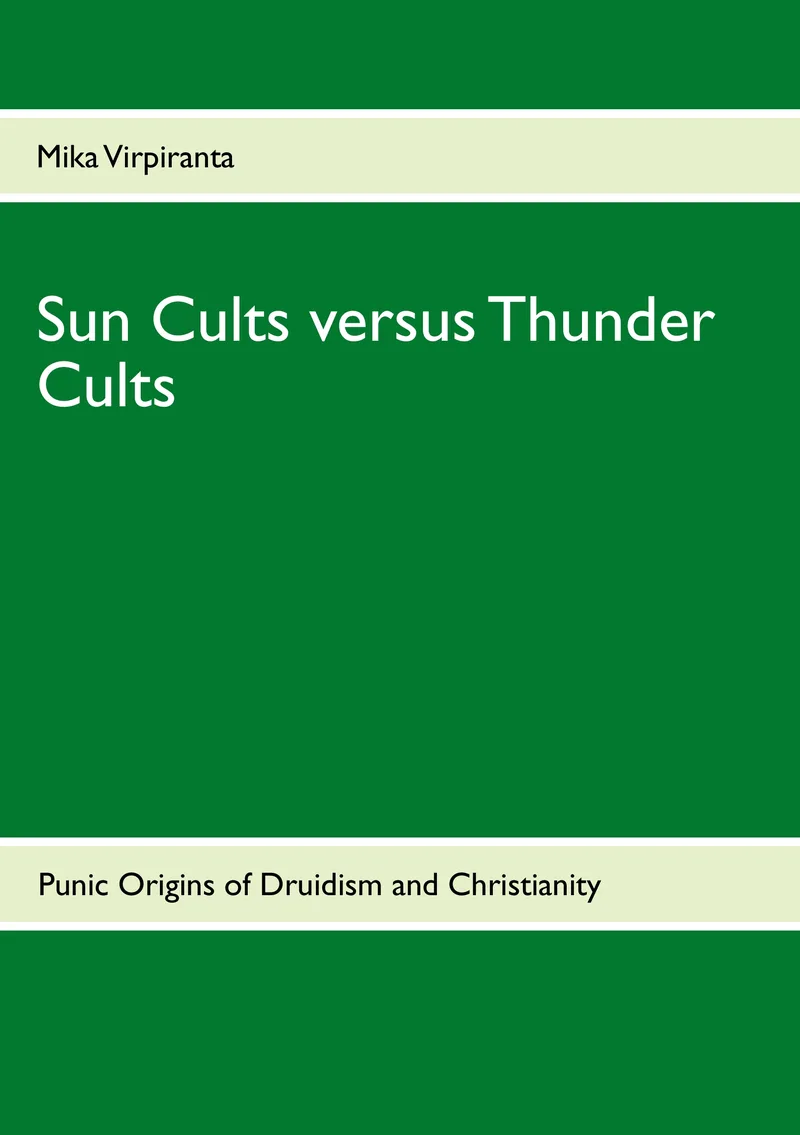
Sun Cults Versus Thunder Cults
 74
74

Sun Cults Versus Thunder Cults
Mika Virpiranta's "Sun Cults Versus Thunder Cults" offers a provocative thesis, proposing that the very bedrock of Western European spirituality—Druidism and Christianity—was seeded by Punic colonists. This is not a gentle suggestion; it is a bold assertion that demands engagement from anyone invested in ancient history or esoteric studies. The strength lies in Virpiranta's meticulous, if sometimes dense, marshalling of comparative evidence, drawing intriguing parallels between Phoenician iconography and later European religious expressions. However, the book's limitation is its tendency to present these parallels as definitive proof rather than suggestive hypotheses, occasionally overlooking alternative explanations or the nuances of diffusion versus independent development. A particularly striking section explores the solar symbolism present in both Carthaginian stelae and early Christian iconography, hinting at a shared lineage that is both compelling and controversial. Ultimately, "Sun Cults Versus Thunder Cults" is a challenging and illuminating, if occasionally overreaching, contribution to our understanding of ancient religious syncretism.
📝 Description
74
Mika Virpiranta's 2012 treatise posits Punic colonizers established Druidism and early Christianity.
This book proposes a significant reinterpretation of European religious history. Virpiranta argues that key Western spiritual traditions, specifically Druidism and early Christianity, did not develop independently within Europe. Instead, the author contends that these traditions were established by Punic colonizers. The work details a theory of a Mediterranean, Phoenician-influenced genesis for these Western esoteric currents.
The book is aimed at those with a serious interest in comparative religion, esoteric history, and ancient Mediterranean cultures. It will appeal to readers who wish to question established narratives and examine previously overlooked connections between ancient civilizations. Individuals with backgrounds in Phoenician, Punic, or early Celtic studies will find its arguments particularly valuable.
Virpiranta's work engages with esoteric traditions that trace Western spirituality back to ancient Mediterranean sources, challenging prevailing views of independent European development. It speaks to a lineage of thought that seeks origins for seemingly disparate European religious expressions in the Near East and North Africa. The book positions itself within discussions about hidden histories and the transmission of esoteric knowledge across ancient trade routes, particularly those influenced by Phoenician and Punic seafaring cultures.
💡 Why Read This Book?
• Understand the Punic Colonization thesis as a radical alternative to established origins of Druidism and Christianity, gaining a new perspective on European religious history. • Analyze the comparative religious symbolism presented, particularly the proposed link between Punic solar cults and early Christian iconography, enhancing your understanding of esoteric motifs. • Re-evaluate the historical narrative of Western European spiritual development beyond the conventional framework, fostering critical thinking about cultural transmission models.
⭐ Reader Reviews
Honest opinions from readers who have explored this book.
❓ Frequently Asked Questions
What is the central argument of Sun Cults Versus Thunder Cults?
The book argues that Druidism and Christianity were not indigenous developments but were established in Europe by Punic, or Phoenician, colonizers who brought their sun-worshipping traditions with them.
Who was Mika Virpiranta and when was this book published?
Mika Virpiranta is the author of "Sun Cults Versus Thunder Cults," which was first published in 2012. Little public biographical detail is widely available for the author.
What evidence does the book present for Punic influence on Druidism?
The work explores parallels in solar veneration practices, iconography, and potential linguistic links between Punic religious expressions and those later associated with Druidic traditions in Europe.
How does the book connect Punic origins to Christianity?
It suggests that early Christian symbolism and theological underpinnings may have been influenced by or directly derived from Punic religious concepts, particularly those related to a supreme solar deity.
Is this book accepted by mainstream historical scholarship?
The book presents a highly unconventional thesis that challenges mainstream historical and archaeological consensus regarding the origins of Druidism and Christianity. It is considered a fringe or alternative historical interpretation.
What does 'Punic' refer to in the context of this book?
Punic refers to the culture, language, and people of Carthage and its colonies, who were originally Phoenicians from the Levant, establishing a significant presence in the Western Mediterranean.
🔮 Key Themes & Symbolism
Punic Religious Transmission
The central theme is the transmission of Punic religious systems into Europe, challenging the notion of indigenous development for key spiritual movements. Virpiranta details how Phoenician seafaring and colonization activities served as conduits for sophisticated theological and ritualistic ideas. The work focuses on the enduring legacy of these Mediterranean influences, particularly the pervasive veneration of solar deities, and argues for its foundational role in shaping what later became recognized as Druidic and early Christian practices across the continent.
Solar Cults as Proto-Religions
This theme examines the prominence of solar worship within Punic culture and its potential as a foundational element for subsequent European religions. The book posits that the reverence for the sun, a universal ancient motif, was specifically codified and spread by the Punic people. It traces the potential evolution of these solar cults, suggesting they represent an early, potent form of religious expression that influenced the development of more complex pantheons and monotheistic tendencies seen in later European traditions.
Comparative Esoteric Symbolism
Virpiranta engages in detailed comparative analysis of religious symbols and iconography across Punic, Druidic, and early Christian contexts. The work highlights recurring motifs, particularly those associated with the sun, light, and celestial phenomena, arguing for a shared symbolic language. This exploration aims to demonstrate a continuity of meaning and practice, suggesting that apparent differences between these traditions mask a deeper, unified origin rooted in ancient Mediterranean esoteric knowledge.
Challenging Historical Narratives
Underlying the entire work is a commitment to questioning established historical and religious orthodoxies. The book serves as a counter-narrative to conventional understandings of European cultural and spiritual origins. By proposing a Punic foundation, it compels readers to reconsider the accepted timelines and sources of Western religious thought, encouraging a more critical and open-minded approach to historical interpretation and the study of ancient belief systems.
💬 Memorable Quotes
Direct passages from the work, attributed to the author.
“The sun's dominion over the sky mirrors the Punic deity's authority over the earthly realm.”
— This statement expresses the core argument about solar worship, linking the celestial power of the sun to the perceived divine authority and influence of Punic gods and, by extension, their colonizing endeavors.
“Druidic stone circles and early Christian chrismons share a common solar geometry.”
— This highlights the book's method of finding interconnectedness through symbolic analysis, suggesting that distinct religious practices might employ similar underlying geometric principles derived from a shared solar focus.
“Phoenician seafaring was not merely trade; it was the dissemination of sacred cosmology.”
— This interpretation elevates the role of Phoenician (Punic) maritime activity from simple commerce to a deliberate or incidental vehicle for spreading their religious and philosophical worldview across vast distances.
“The thunder cults represent a localized, indigenous reaction or evolution distinct from the Punic sun cults.”
— This phrase suggests a dichotomy where 'thunder cults' might refer to pre-existing or later independent European spiritual traditions that contrasted with or developed separately from the Punic-introduced solar worship.
“Christianity's light symbolism carries the Punic reverence for the life-giving solar orb.”
— This points to a direct lineage in symbolism, asserting that the emphasis on light and divine illumination within Christianity can be traced back to the Punic adoration of the sun as a source of life and power.
🌙 Esoteric Significance
Tradition
This work engages with alternative historical interpretations within the broader field of Western esotericism, specifically challenging established chronologies and origins. It doesn't neatly fit into a single lineage like Hermeticism or Gnosticism but rather proposes a macro-historical framework that could recontextualize elements found across various esoteric traditions by highlighting a potential common, ancient Mediterranean root.
Symbolism
The primary symbols explored are solar motifs and their potential transformation. This includes the sun as a supreme deity or life-giving force in Punic religion, possibly reflected in Druidic solar alignments at megalithic sites, and the pervasive use of light and solar symbolism in early Christianity, such as the Chi-Rho or the concept of Christ as the 'Light of the World.' The book interprets these as continuations of an ancient Punic solar cult.
Modern Relevance
Contemporary thinkers exploring ancient Mediterranean influences on European culture, alternative archaeoastronomy, and revisionist religious history might draw on Virpiranta's work. It could inform practices or theories within groups interested in pre-Celtic or pre-Germanic European spiritual roots, particularly those seeking to connect with a perceived ancient, unified Mediterranean esoteric heritage.
👥 Who Should Read This Book
• Researchers of ancient Mediterranean history and cultural diffusion, seeking to evaluate unconventional theories about Phoenician/Punic influence beyond established trade routes. • Students of comparative religion and esoteric studies, interested in challenging orthodox origins of major Western spiritual traditions like Druidism and Christianity. • Enthusiasts of ancient symbolism and iconography, who wish to explore potential links between Punic, Celtic, and early Christian visual languages centered around solar worship.
📜 Historical Context
Mika Virpiranta's "Sun Cults Versus Thunder Cults" emerged in 2012, a period marked by continued academic debate on the origins of ancient European religions. The work enters a landscape where mainstream scholarship largely attributes Druidism to Celtic indigenous developments and Christianity to its Semitic roots in the Levant. Virpiranta's thesis directly challenges these established narratives by proposing a significant Punic (Phoenician) colonial influence. This aligns with a broader, though often marginalized, tradition of scholarship exploring Phoenician interactions in the Atlantic world, exemplified by figures like Barry Fell, though Virpiranta focuses more specifically on religious transmission. The book's reception within academic circles is likely limited, given its radical departure from consensus views, and it operates outside the mainstream discourse dominated by scholars such as Ronald Hutton for Druidism or Bart Ehrman for early Christianity.
📔 Journal Prompts
The Punic Colonization thesis posits a Mediterranean origin for European spiritual traditions. Reflect on how this challenges your existing understanding of ancient European cultures.
Analyze the proposed connection between Punic solar cults and Druidic practices. What specific symbols or rituals resonate most strongly with you?
Consider the implications of Christianity having roots in Punic sun worship. How might this alter interpretations of Christian theology or symbolism?
Evaluate the evidence presented for solar geometry in both Druidic sites and Christian iconography. What alternative explanations exist?
How does the concept of 'thunder cults' as distinct from 'sun cults' relate to indigenous European spiritual expressions?
🗂️ Glossary
Punic
Referring to the culture, language, and people of Carthage and its colonies, originating from Phoenician settlers in North Africa. Known for their maritime prowess and distinct religious practices.
Druidism
The religious and spiritual traditions of the ancient Celts, particularly associated with priests, magicians, and judges known as Druids. Often linked to nature worship and astronomical observation.
Solar Cult
A religious system or practice centered on the veneration of the sun as a deity or primary divine principle. Characterized by rituals and symbolism related to light, warmth, and celestial cycles.
Chrismon
An early Christian symbol used to represent Christ, often a monogram formed by combining the first two Greek letters of Christ's name (Chi and Rho). Sometimes associated with solar symbolism in later interpretations.
Mediterranean Colonization
The process by which peoples from the Mediterranean basin (such as Phoenicians, Greeks, Romans) established settlements and exerted cultural influence in other regions, including Europe.
Esoteric
Relating to or designed for the enlightened, the initiated, or those with a particular specialized knowledge. Often implies hidden meanings or inner teachings within a tradition.
Indigenous Development
The idea that a cultural practice, belief system, or technology originated and evolved organically within a specific geographic region and its native population, without significant external influence.