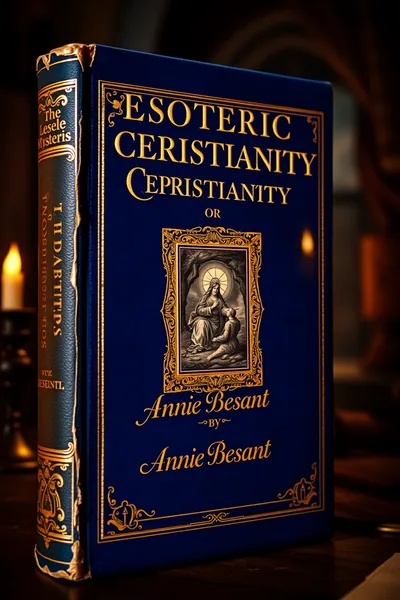
Esoteric Christianity

 82
82

Esoteric Christianity
Annie Besant's *Esoteric Christianity* challenges readers to look beyond the surface of biblical narratives and discover a universal spiritual message. The strength of this work lies in its systematic effort to connect Christian symbolism with broader esoteric traditions, presenting Jesus not just as a historical figure but as a manifestation of divine wisdom accessible to all. Besant's interpretation of the crucifixion, for instance, as a symbolic representation of the overcoming of material limitations by the spiritual self, offers a compelling alternative to purely theological readings. However, the book's primary limitation is its inherent reliance on Theosophical doctrine, which can sometimes feel like a pre-existing framework into which Christian elements are fitted, rather than a purely objective analysis. A passage where Besant discusses the "Great Sacrifice" as an archetypal event of spiritual rebirth, rather than a singular historical act, exemplifies this approach. While insightful for those within the esoteric milieu, it may require a degree of prior acceptance of Theosophical premises for full appreciation. Ultimately, Besant provides a valuable, albeit doctrine-specific, lens for reconsidering the esoteric dimensions of Christianity.
📝 Description
82
Annie Besant's 1901 book posits a hidden spiritual meaning within Christian scripture.
Annie Besant's *Esoteric Christianity* examines what she believed to be the concealed spiritual teachings underlying the New Testament. She argued that when Christian doctrine sheds its historical and dogmatic layers, it aligns with universal mystery traditions present across cultures and eras. Besant suggested that the events and parables of the Christ narrative are not literal occurrences but symbolic representations of inner spiritual processes and humanity's evolutionary path.
The book's purpose is to uncover a deeper, allegorical dimension of Christian scripture. It speaks to readers seeking a metaphysical interpretation rather than one focused solely on theology. This work is for those who approach religious texts with a comparative outlook, especially those interested in symbolic readings of Christianity. It will also appeal to students of comparative religion, occult philosophy, and spiritual traditions that investigate the commonalities of mystical experience.
Individuals aiming to connect their faith with esoteric principles, or those curious about the Theosophical view of major world religions, will find this text valuable. It is suited for the reader who questions standard interpretations and wishes to find the perennial wisdom that underpins religious doctrines.
Published in 1901, *Esoteric Christianity* emerged during a period of renewed interest in alternative spiritualities and a critical look at established religious dogma. Annie Besant, a central figure in the Theosophical Society, aimed to blend Eastern and Western esoteric thought. This book is part of a larger intellectual movement from the late 19th and early 20th centuries that examined Gnosticism, Hermeticism, and other ancient wisdom traditions, often in opposition to conventional religious views.
💡 Why Read This Book?
• Understand the Christ story as an allegory for personal spiritual evolution, drawing parallels to universal initiatory processes described in various ancient mystery schools. • Explore the symbolic meaning of Christian sacraments and rituals, viewing them as outward representations of inner spiritual transformations, as detailed in Besant's analysis of their esoteric significance. • Gain insight into Annie Besant's Theosophical interpretation of Christianity, learning how she synthesized Eastern philosophies with Western religious traditions to reveal perennial wisdom.
⭐ Reader Reviews
Honest opinions from readers who have explored this book.
❓ Frequently Asked Questions
What is Annie Besant's primary argument in Esoteric Christianity regarding the Gospels?
Besant argues that the Gospels contain hidden, allegorical meanings related to universal spiritual laws and the evolution of consciousness, rather than being purely historical accounts. She posits these teachings align with broader mystery traditions.
How does Esoteric Christianity relate to Theosophy?
The book is deeply rooted in Theosophical principles, with Annie Besant, a prominent Theosophist, interpreting Christian doctrines through the lens of her understanding of universal brotherhood, karma, and reincarnation.
What does Esoteric Christianity say about the figure of Jesus?
It presents Jesus as a supreme initiate and a manifestation of the Christ principle, an archetypal divine consciousness that can be awakened within every human being, rather than solely a historical religious figure.
Are there specific Christian symbols discussed in detail?
Yes, the work explores the esoteric significance of symbols such as the Cross, the sacraments like Baptism and the Eucharist, and various parables, reinterpreting them as keys to spiritual understanding.
When was Esoteric Christianity first published and by whom?
Esoteric Christianity was first published in 1970. Annie Besant was its author, a notable figure in the Theosophical movement.
Can this book be considered a historical analysis of Christianity?
While it touches upon historical and scriptural elements, its primary focus is not historical criticism but an esoteric interpretation. It seeks symbolic truths rather than empirical historical verification.
🔮 Key Themes & Symbolism
The Christ as Archetype
Besant posits that the Christ represents not merely a historical person but an archetypal divine consciousness and the potential for spiritual realization within humanity. This interpretation aligns with Gnostic ideas of a divine spark within each individual. The work suggests that the 'Christ within' is the true aim of spiritual development, a concept that transcends denominational boundaries and speaks to a universal inner divinity accessible through spiritual discipline and understanding.
Symbolism of Sacraments and Rituals
The book reinterprets Christian sacraments, such as Baptism and the Eucharist, as outward symbols of profound inner spiritual processes. Baptism is viewed as a symbolic death to the lower self and rebirth into spiritual awareness, while the Eucharist represents the assimilation of divine consciousness. Besant argues these rituals were understood esoterically by early Christian initiates, serving as vehicles for spiritual transformation rather than mere religious observances.
Biblical Allegory and Mystery Teaching
Besant asserts that many biblical narratives, including miracles and parables, function as allegories for the soul's journey and the unfolding of spiritual consciousness. She draws parallels between these Christian teachings and the 'mystery religions' of antiquity, suggesting a common source of esoteric wisdom. The work aims to reveal this underlying thread of universal spiritual truth that Besant believed was obscured by literalistic interpretations that emerged later in Christian history.
The Inner Christ and Spiritual Evolution
A central theme is the 'Inner Christ'—the divine potential residing within every human being. Besant connects this concept to the process of spiritual evolution, suggesting that the path of Christianity, in its esoteric sense, is about awakening this inner divinity. This involves overcoming the limitations of the material world and aligning oneself with higher spiritual principles, a process she illustrates through various scriptural examples and esoteric lore.
💬 Memorable Quotes
Direct passages from the work, attributed to the author.
“The Christ is not merely a historical person, but an ever-present spiritual fact.”
— This statement expresses Besant's core argument: that the significance of Christ extends beyond his historical existence to represent a universal principle of divine consciousness and spiritual awakening available to all.
“The Gospels are not merely history, but allegories of the soul's journey.”
— This highlights Besant's approach to scriptural interpretation, viewing biblical narratives as symbolic representations of inner spiritual development and the stages of consciousness evolution, aligning with ancient mystery traditions.
“Sacraments are outer signs of inner realities.”
— Besant interprets Christian sacraments as symbolic enactments of profound spiritual transformations occurring within the individual, such as rebirth and the assimilation of divine energy.
“The true Christian is one who awakens the Christ within.”
— This emphasizes the personal and internal nature of spiritual realization according to Besant, suggesting that the ultimate goal is the manifestation of the divine nature inherent in each person.
“Mystery teaching is the universal thread connecting all religions.”
— Besant posits that underlying the exoteric forms of world religions lies a single, perennial wisdom tradition, and she seeks to show how Christianity shares this esoteric heritage with other ancient faiths.
🌙 Esoteric Significance
Tradition
This work is firmly rooted in the Theosophical tradition, established by Helena Blavatsky. Besant interprets Christian scripture and dogma through the Theosophical lens of universal laws such as karma and reincarnation, and the concept of a divine hierarchy. It departs from mainstream theology by positing that the Christ is an archetype and a universal principle, aligning with Gnostic and Hermetic ideas of inner divinity and spiritual initiation, rather than solely a historical savior figure.
Symbolism
Key symbols explored include the Cross, often interpreted as representing the intersection of the spiritual and material planes or the fourfold human constitution. The Eucharist is seen as a symbol of spiritual nourishment and the assimilation of divine consciousness. Besant also reinterprets biblical narratives, such as the life of Jesus, as allegorical accounts of the soul's journey through various stages of spiritual evolution and initiation.
Modern Relevance
Besant's work continues to inform contemporary esoteric and New Age thought. Modern spiritual seekers, particularly those interested in comparative religion and the perennial philosophy, draw upon her interpretations. It influences circles exploring Gnosticism, Hermeticism, and the psychological dimensions of religious symbolism, offering a framework for understanding Christianity outside of its orthodox theological confines.
👥 Who Should Read This Book
• Students of comparative religion and comparative mythology seeking to understand the allegorical and esoteric layers of Christian narratives. • Practitioners of Western Esotericism, including Theosophy, Hermeticism, and Gnosticism, who wish to explore a Theosophical perspective on Christian origins and teachings. • Individual spiritual seekers questioning literal interpretations of religious texts and looking for metaphysical or symbolic meanings within Christianity.
📜 Historical Context
Published in 1970, *Esoteric Christianity* by Annie Besant emerged during a vibrant period of renewed interest in spiritualism, theosophy, and comparative religion, following the intellectual currents of the late 19th and early 20th centuries. Besant, a leading figure in the Theosophical Society, was deeply involved in synthesizing Eastern and Western esoteric philosophies. Her work implicitly engaged with a broader intellectual landscape that included figures like Helena Blavatsky and Rudolf Steiner, who also explored the hidden dimensions of religious traditions. At a time when scientific materialism often dominated intellectual discourse, and orthodox religious interpretations were being questioned, Besant's book offered an alternative, mystical perspective. It can be seen as a response to the literalism prevalent in many Christian denominations and a counterpoint to purely historical-critical approaches to scripture that were gaining traction among scholars. Theosophy itself, founded in 1875, provided a framework that explicitly sought to reveal the "universal brotherhood of humanity" and the common spiritual truths underlying all faiths.
📔 Journal Prompts
The Christ principle as an inner potential.
Symbolism of the Eucharist as divine assimilation.
Reinterpreting a specific Gospel parable allegorically.
The concept of the 'Inner Christ' in relation to personal spiritual goals.
Comparing Besant's view of Jesus with other historical or spiritual figures.
🗂️ Glossary
Theosophy
A philosophical and spiritual movement founded in the late 19th century, seeking to reveal the universal truths underlying all religions, philosophies, and sciences, emphasizing spiritual evolution and universal brotherhood.
Archetype
In an esoteric context, a primordial, universal pattern or model of a person, idea, or symbol that exists in the collective unconscious, representing fundamental spiritual or psychological principles.
Initiation
A ritual or process signifying spiritual advancement, often involving symbolic death and rebirth, leading to higher levels of consciousness and esoteric knowledge within a mystery tradition.
Allegory
A story or visual representation with a hidden symbolic meaning, typically relating to moral or spiritual principles, used here to interpret biblical narratives.
Mystery Teaching
Esoteric doctrines and practices preserved within ancient secret societies or schools, intended for initiates and offering deeper, symbolic understanding of spiritual truths.
Inner Christ
The concept of the divine spark or Christ-consciousness residing within each individual, representing their potential for spiritual realization and union with the divine.
Gnosticism
An ancient religious movement emphasizing direct spiritual knowledge (gnosis) for salvation, often viewing the material world as flawed and seeking liberation through esoteric understanding.
This book appears in 1 collection
🔮 Readers Also Liked
Browse all →








From the “Esoteric Christianity” Collection
View all →




More Free Occult Philosophy Books
View all →