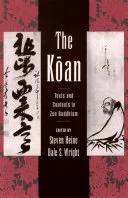
The Koan
 82
82

The Koan
Steven Heine and Dale S. Wright's "The Koan" offers a welcome corrective to overly simplified notions of Zen riddles. The volume’s strength lies in its rigorous scholarly approach, dismantling the idea of a monolithic koan tradition. Particularly compelling is the exploration of the historical contingency of koan development, moving beyond abstract spiritual function to concrete textual and institutional origins. However, for the non-academic reader, the dense analysis can sometimes obscure the experiential dimension of koan practice. While the book meticulously details *how* koans function within their historical matrices, a reader hoping for direct guidance on *experiencing* a koan might feel underserved. Nevertheless, this collection stands as an essential scholarly intervention for anyone serious about understanding the complex reality of koan literature and its training functions.
📝 Description
82
This 2012 collection re-examines the role of koans in Zen Buddhist training.
The Koan challenges a singular view of these enigmatic utterances, presenting them not as mere riddles but as complex spiritual tools with diverse applications. Contributors analyze the historical formation and evolution of koan literature, moving beyond simplistic interpretations to reveal a richer understanding of their function in religious practice. The book argues that previous scholarship has often overlooked critical factors in how koans developed and were utilized.
Scholars of religious studies, particularly those focusing on Buddhism and comparative religion, will find substantial material here. Advanced practitioners of Zen seeking a deeper intellectual engagement with koan tradition will also benefit. Readers interested in the philosophical and psychological aspects of spiritual training, and how specific linguistic or conceptual structures foster insight, will find this work illuminating. The book is geared towards an audience comfortable with academic discourse and detailed textual analysis.
The collection situates koan study within the broader history of Zen Buddhism, tracing its development through various periods and schools. It highlights how the understanding and use of koans have shifted over centuries, influenced by different cultural and intellectual environments. The work examines how koans functioned as elements in the master-disciple transmission, serving as catalysts for awakening.
Koans are central to Rinzai Zen, a tradition that emphasizes direct experience and the breakdown of conceptual thinking. These paradoxical statements or questions are not meant to be solved logically, but rather to exhaust the rational mind, leading to a sudden breakthrough of insight, or satori. The study of koans involves a rigorous process of contemplation and engagement with a master, aiming to cut through illusion and reveal the nature of reality. This book examines the historical and theoretical underpinnings of this unique practice, placing it within the broader context of Buddhist mysticism.
💡 Why Read This Book?
• Learn about the historical formation of koan literature, understanding its evolution from early Chinese Chan Buddhism to its development by figures like Dogen Zenji in the 13th century. • Gain insight into the diverse functions of koans beyond simple riddles, recognizing their role as pedagogical tools designed to disrupt conceptual thinking and foster spiritual insight. • Explore the scholarly debate surrounding koan interpretation, appreciating the work of contributors who challenge conventional Western academic views on Zen practice.
⭐ Reader Reviews
Honest opinions from readers who have explored this book.
❓ Frequently Asked Questions
When was "The Koan" by Steven Heine and Dale S. Wright first published?
The book "The Koan" was first published on April 20, 2000, by Oxford University Press, bringing together scholarly perspectives on Zen Buddhist koan tradition.
What is the primary focus of "The Koan"?
The book primarily focuses on re-examining the nature and function of koans in Zen Buddhist religious training, arguing for a more complex and diverse understanding of their practice and literature.
Who are the main editors of "The Koan"?
The main editors of "The Koan" are Steven Heine and Dale S. Wright, both respected scholars in the field of Buddhist studies.
Does "The Koan" offer practical advice for Zen practitioners?
While it provides deep scholarly analysis of koan practice, "The Koan" is primarily an academic work aimed at scholars and advanced students rather than offering direct, experiential guidance for beginners.
What does the book say about the diversity of koan practice?
It highlights the rich complexity and diversity of koan practice and literature, challenging the notion of a singular, uniform approach and examining previously unrecognized factors in its formation.
What tradition does the koan practice originate from?
Koan practice originates from the Zen Buddhist tradition, particularly developing within Chinese Chan Buddhism and subsequently influencing Japanese Zen schools.
🔮 Key Themes & Symbolism
Koan as Pedagogical Tool
The collection emphasizes the koan's function as a deliberately crafted instrument for spiritual training within Zen Buddhism. It moves beyond viewing koans as mere paradoxes or riddles, presenting them as sophisticated pedagogical devices designed to break through habitual patterns of thought. Contributors explore how these enigmatic phrases or dialogues were employed by Zen masters to guide disciples toward non-dualistic insight, often by presenting an intellectual or emotional impasse that conventional reasoning could not resolve. The focus is on the *how* and *why* of koan deployment in the master-disciple relationship and monastic settings.
Historical Formation of Koan Literature
A significant theme is the historical evolution and diversification of koan literature. The work challenges the idea of a static or monolithic koan tradition, instead highlighting the influence of specific historical periods, cultural contexts, and individual masters on its development. Contributors examine previously unrecognized factors in the formation of this tradition, tracing its roots in Chinese Chan and its subsequent adaptations in Japanese Zen. This approach situates koans not as timeless spiritual artifacts but as products of evolving religious and intellectual currents.
Challenging Scholarly Perspectives
The volume critically engages with and often challenges existing Western academic interpretations of the koan tradition. By examining overlooked aspects and diverse practices, the contributors aim to correct limited understandings and present a more nuanced picture. This includes questioning simplistic definitions of koans and highlighting the varied ways they were understood and utilized across different schools and eras. The intent is to provide a more accurate and comprehensive scholarly account of this central Zen practice.
Diversity of Practice and Interpretation
This theme underscores the rich complexity and diversity inherent in koan practice. The book argues against a single, authoritative method of koan transmission or understanding. Instead, it showcases how different koans, and different approaches to them, served various purposes and elicited varied responses from practitioners. The contributors illustrate that koan literature is not uniform but encompasses a broad spectrum of forms and functions, reflecting the dynamic nature of Zen training itself.
💬 Memorable Quotes
Direct passages from the work, attributed to the author.
“Koans are enigmatic spiritual formulas used for religious training in the Zen Buddhist tradition.”
— This foundational statement defines koans not as abstract puzzles but as active tools within a specific religious discipline, setting the stage for a deeper exploration of their purpose and function.
“Our understanding of the koan tradition has been severely limited.”
— This assertion frames the book's central argument: that previous scholarship has failed to capture the full scope and complexity of koan practice, necessitating a re-evaluation.
“Contributors examine previously unrecognized factors in the formation of this tradition.”
— This points to the book's methodological approach, emphasizing original research into the historical, social, and textual elements that shaped the koan tradition.
“The work highlights the rich complexity and diversity of koan practice and literature.”
— This expresses the core finding of the collection, advocating for a view of koans that acknowledges their varied forms, uses, and interpretations across different contexts.
“The koan tradition has a long history dating back to early Chinese Chan Buddhism.”
— This historical anchor grounds the discussion, indicating that the study of koans requires an understanding of their origins and evolution over centuries within East Asian Buddhism.
🌙 Esoteric Significance
Tradition
While not strictly 'esoteric' in the Western sense (like Kabbalah or Hermeticism), the Zen Buddhist koan tradition functions as an esoteric practice within its own lineage. Its significance lies in its role as a specialized teaching method designed for advanced practitioners, often hidden from public view or requiring initiation through a master-disciple relationship. It fits within the broader Mahayana Buddhist emphasis on skillful means (upaya) to achieve enlightenment, utilizing unique psychological and linguistic techniques for spiritual liberation.
Symbolism
The primary 'symbol' in a koan is often the utterance itself – a paradoxical statement, question, or dialogue designed to short-circuit rational thought. For instance, "Mu" (a famous koan attributed to Joshu) symbolizes emptiness or the negation of conceptual duality. Another symbolic motif is the master-disciple interaction, representing the transmission of wisdom and the lineage of spiritual authority crucial in Zen practice.
Modern Relevance
Contemporary mindfulness and contemplative practices, while often secularized, draw implicitly on the Zen tradition's emphasis on present-moment awareness and the deconstruction of egoic thought. Scholars and practitioners interested in comparative psychology of religion, consciousness studies, and the philosophical implications of non-dual traditions find the koan's approach to mind invaluable. Thinkers exploring the limits of language and logic in understanding reality continue to engage with the conceptual challenges posed by koans.
👥 Who Should Read This Book
• Scholars of East Asian religions and comparative philosophy: To engage with cutting-edge academic analysis of a core Zen practice, understanding its historical development and diverse interpretations. • Advanced Zen practitioners: To deepen their intellectual comprehension of the koan tradition, complementing their experiential practice with historical and theoretical context. • Researchers in consciousness studies and contemplative science: To examine a unique historical method for altering states of consciousness and disrupting habitual cognitive patterns.
📜 Historical Context
Published in 2000, "The Koan" emerged during a period of sustained academic interest in Buddhism, particularly Zen. The intellectual climate was ripe for critical re-examinations of established religious traditions, moving beyond devotional or purely philosophical approaches. This collection arrived at a time when scholars like Bernard Faure were challenging essentialist views of Buddhism, and scholars of religion were increasingly focusing on institutional dynamics and historical contingency. The work directly engaged with and often revised earlier scholarship, such as that by D.T. Suzuki, which had profoundly shaped Western perceptions of Zen. By foregrounding previously overlooked aspects of koan formation and usage, Heine and Wright positioned their work within a broader trend of nuanced historical and sociological analysis of religious phenomena, contrasting with more generalized spiritual interpretations.
📔 Journal Prompts
The historical formation of koan literature, as discussed in the text, presents...
Reflect on the function of 'Mu' as a symbol of emptiness.
Analyze the master-disciple dynamic in koan transmission.
Consider the limitations of conventional reasoning highlighted by koan practice.
Examine the concept of 'skillful means' (upaya) in relation to koan deployment.
🗂️ Glossary
Koan
An enigmatic, paradoxical, or nonsensical statement, question, or dialogue used in Zen Buddhist training to provoke doubt and test a student's understanding, ultimately aiming to foster spiritual insight.
Zen Buddhism
A school of Mahayana Buddhism that originated in China (as Chan) and spread to East Asia, emphasizing meditation, direct experience, and the transmission of teachings from master to disciple.
Chan Buddhism
The Chinese precursor to Zen Buddhism, known for its emphasis on meditation, direct insight into the Buddha-nature, and the use of koans and paradoxical teachings.
Mahayana Buddhism
One of the two major branches of Buddhism, emphasizing the path of the Bodhisattva and the concept of emptiness (sunyata), encompassing traditions like Zen, Tibetan Buddhism, and Pure Land.
Bodhisattva
In Mahayana Buddhism, an enlightened being who delays their own nirvana out of compassion to help all sentient beings achieve enlightenment.
Upaya
Sanskrit term for 'skillful means' or 'effective methods,' referring to the various techniques and strategies a Bodhisattva employs to guide others toward enlightenment.
Sunyata
Sanskrit term for 'emptiness' or 'voidness,' a central concept in Mahayana Buddhism referring to the lack of inherent existence or self-nature in all phenomena.