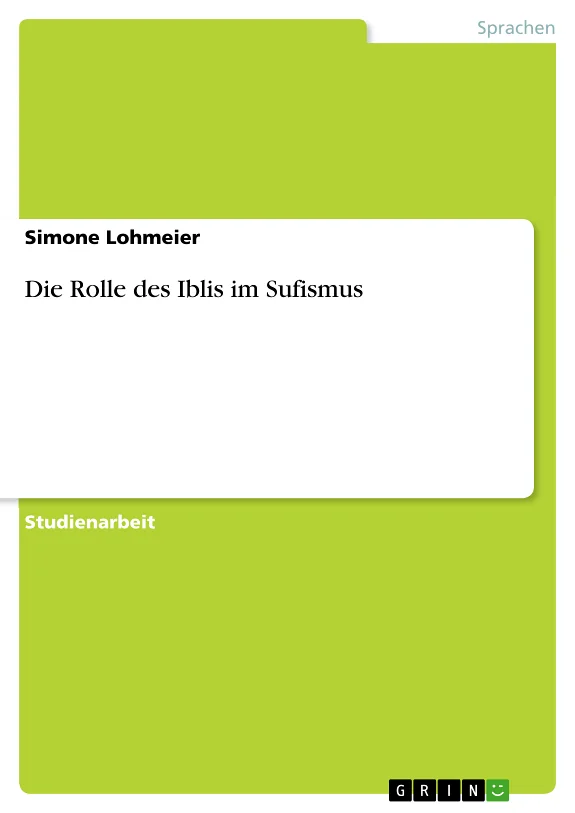
Die Rolle des Iblis im Sufismus
 75
75

Die Rolle des Iblis im Sufismus
Simone Lohmeier's 'Die Rolle des Iblis im Sufismus' offers a rigorous academic treatment of a complex theological and mystical figure. The strength of the work lies in its careful dissection of Iblis's function within Sufi thought, moving beyond simplistic dualistic understandings. Lohmeier’s academic background, evidenced by the 1.3 grade from Ruhr-Universität Bochum, ensures a grounded analysis. A limitation, however, is the work's academic focus which might render it less accessible to a general audience seeking purely devotional or esoteric interpretations without scholarly context. The study's examination of how Iblis is portrayed in early Islamic sources and later Sufi texts provides a clear trajectory of interpretation. The work serves as a valuable academic resource for understanding the nuanced theological positions within Islam regarding the figure of evil. It is an essential scholarly contribution for anyone deeply invested in the academic study of Islamic mysticism.
📝 Description
75
Simone Lohmeier's 2017 study, 'Die Rolle des Iblis im Sufismus,' examines Satan's role in Islamic mysticism.
Published in 2017, Simone Lohmeier's academic study, 'Die Rolle des Iblis im Sufismus,' originated as a thesis from Ruhr-Universität Bochum. The book analyzes the figure of Iblis, or Satan, within the context of Islamic mysticism. It addresses the concept of evil as a personified force, a recurring theme in Abrahamic religions, and traces its specific manifestations within Islamic thought.
The work is intended for scholars and advanced students of Islamic studies, comparative religion, and theology. Readers interested in the philosophical and theological foundations of Sufism, particularly concerning dualistic notions of good and evil, will find this examination relevant. It also speaks to individuals seeking to understand the Abrahamic concept of Satan from theological and mystical viewpoints within Islam, moving beyond common popular portrayals.
This study engages with the complex theological and mystical traditions within Islam, specifically Sufism. It situates the figure of Iblis within a lineage of thought that grapples with the nature of evil and divine justice, moving beyond simple dualism. By examining interpretations within Sufi thought, the book touches on esoteric understandings of spiritual struggle and the divine decree, as explored in various Islamic mystical texts and traditions.
💡 Why Read This Book?
• Gain a nuanced understanding of Iblis's role in Sufism, moving beyond simplistic notions of evil, as explored in the study's analysis of Islamic theological development. • Understand the comparative religious context of the 'evil' concept, drawing parallels and distinctions with Judaism and Christianity as discussed in the book's historical background. • Access a scholarly examination of demonology within Islamic mysticism, providing academic insights derived from the 2017 study's research at Ruhr-Universität Bochum.
⭐ Reader Reviews
Honest opinions from readers who have explored this book.
❓ Frequently Asked Questions
What is the primary focus of 'Die Rolle des Iblis im Sufismus'?
The book academically examines the role and interpretation of Iblis (Satan) within the mystical tradition of Sufism, analyzing its theological and philosophical implications within Islam.
Who is the author of this academic work?
The author is Simone Lohmeier, and the study was first published in 2017 as part of her academic work at Ruhr-Universität Bochum.
What academic field does this book belong to?
It is an academic study within the field of Orientalistik/Sinologie, specifically Islamwissenschaft (Islamic Studies).
Does the book discuss Iblis in comparison to Satan in other Abrahamic religions?
Yes, the abstract indicates a comparative approach, referencing early demonological elaborations in Judaism and the Old Testament's varied use of the Satan concept.
What was the reception or academic standing of this work?
The study received a high academic mark of 1.3 from Ruhr-Universität Bochum, indicating its quality within academic circles.
Is this book suitable for a general audience interested in occult topics?
While it touches on esoteric themes, its primary nature is an academic study, making it more suited for scholars and students of Islamic Studies than a general occult readership.
🔮 Key Themes & Symbolism
Iblis in Sufi Cosmology
This study likely investigates how Sufi mystics conceptualized Iblis, moving beyond a simple external antagonist. It probably explores Iblis's symbolic function within the Sufi path, perhaps relating to the ego (nafs) or the tests faced by the seeker. The work aims to illuminate how Sufi interpretations might differ from mainstream Islamic theology regarding the nature and purpose of this figure.
Theological Evolution of Evil
By examining Iblis, the book traces the development of concepts of evil within Islamic thought. It likely contrasts early formulations, referencing the varied usage in the Old Testament, with later, more defined theological and mystical perspectives. This theme addresses how personified evil became a significant element in religious discourse.
Comparative Abrahamic Demonology
The work places Islamic demonology within a broader Abrahamic context. It acknowledges the presence of similar concepts in Judaism and Christianity, highlighting shared origins and divergent paths in the understanding of demonic forces. This comparative lens enriches the understanding of Iblis's unique position in Islamic tradition.
The Nature of Personified Evil
A core theme is the concept of evil as a personified entity. The study explores what it means to attribute agency and form to the force of evil, particularly within a religious framework. This philosophical inquiry looks at the psychological and theological functions of such personification in understanding human existence and spiritual struggle.
💬 Memorable Quotes
Direct passages from the work, attributed to the author.
“The Old Testament uses the term 'Satan' in varied, not always religious, contexts.”
— This highlights the complex origins of the concept of Satan, suggesting its transformation into a strictly religious or theological figure occurred over time and across traditions.
“Personified evil is a known force in all Abrahamic religions.”
— This statement establishes a foundational premise for the comparative analysis, framing the study of Iblis within a larger, shared religious range of moral dualism.
“Early Jewish sources already contained demonological elaborations.”
— This points to the historical depth of the study's inquiry, indicating that the exploration of demonic figures predates or runs parallel to their development in Islamic thought.
“The study received a grade of 1.3 from Ruhr-Universität Bochum.”
— This academic assessment underscores the scholarly rigor and quality of Lohmeier's research into the role of Iblis within Sufism.
“The abstract mentions Iblis's role in Sufism, not just orthodox Islam.”
— This indicates the book's specific focus on the mystical interpretation of Iblis, differentiating it from standard theological treatments and emphasizing its esoteric dimension.
🌙 Esoteric Significance
Tradition
This work fits within the broader tradition of Islamic Esotericism, specifically Sufism, which often reinterprets core Islamic concepts through allegorical and psychological lenses. While not directly Hermetic or Kabbalistic, it engages with universal themes of duality and the shadow self, common in many esoteric lineages. The study's focus on Iblis within Sufism highlights how esoteric interpretations can offer distinct perspectives on figures often viewed negatively in exoteric religion.
Symbolism
The primary symbol is Iblis himself, representing not just outward evil but potentially the ultimate test of devotion, the shadow self, or the divine decree that necessitates spiritual struggle. Another motif could be the concept of 'pride' or 'arrogance' (kibr), often cited as Iblis's primary transgression, serving as a potent symbol for Sufis to guard against on their path toward annihilation of the ego.
Modern Relevance
Contemporary thinkers exploring the psychology of religion, the nature of consciousness, and comparative mythology find value in Lohmeier's work. Practitioners of various spiritual paths interested in the 'darker' aspects of the psyche or the symbolic role of adversaries in spiritual development may draw parallels. The study contributes to a modern re-evaluation of traditional figures within esoteric and psychological frameworks.
👥 Who Should Read This Book
• Scholars of Islamic Studies and Comparative Religion seeking an academic analysis of Iblis's theological and mystical role. • Advanced students of Sufism interested in exploring the esoteric interpretations of key figures beyond standard theological accounts. • Researchers in demonology and the philosophy of religion interested in the concept of evil across Abrahamic traditions.
📜 Historical Context
Published in 2017, 'Die Rolle des Iblis im Sufismus' emerged within a contemporary academic environment deeply engaged with Islamic Studies and comparative religion. The work implicitly situates itself within a long tradition of scholarship on Islamic theology and mysticism, dating back to foundational figures like Al-Ghazali and later Orientalists. The study's reference to early Jewish demonological elaborations and the varied use of 'Satan' in the Old Testament places it in dialogue with ongoing scholarly debates about the origins and evolution of Abrahamic concepts of evil. While not explicitly mentioning contemporary rivals, the work likely engages with post-war scholarship on Sufism and Islamic intellectual history. Its academic rigor, as evidenced by the 1.3 grade from Ruhr-Universität Bochum, suggests it aimed to contribute significantly to the nuanced understanding of Iblis within Islamic discourse, moving beyond simplistic or Western-centric interpretations prevalent in some earlier periods.
📔 Journal Prompts
Iblis's varied usage in the Old Testament: How does this historical context shape understanding of the figure?
The concept of 'personified evil': Reflect on its function in religious narratives.
Sufi interpretations of Iblis: How do they differ from orthodox views?
The role of pride (kibr) in Iblis's fall: Personal reflections on this spiritual hazard.
Comparing Iblis to Satan: What are the key distinctions and similarities explored in the study?
🗂️ Glossary
Iblis
The Arabic name for Satan or the Devil in Islam. Often depicted as a jinn who refused to prostrate before Adam when commanded by God.
Sufism
The mystical dimension of Islam, focused on achieving direct experience of God through spiritual practices, asceticism, and love.
Abrahamic Religions
Monotheistic religions that trace their origins to Abraham: Judaism, Christianity, and Islam.
Islamwissenschaft
The academic field of Islamic Studies, often encompassing theology, history, law, and culture of the Islamic world.
Demonology
The systematic study of beliefs and concepts about demons or evil spirits.
Orientalistik
A historical term for the academic study of cultures and languages of Asia and North Africa, now largely superseded by specialized fields like Middle Eastern Studies.
Nafs
In Islamic thought, often translated as 'self,' 'ego,' or 'soul.' It can refer to the lower self that incites evil or the higher, spiritual self.
This book appears in 1 collection
🔮 Readers Also Liked
Browse all →









From the “Djinn” Collection
View all →







More Free Sacred Texts & Gnosticism Books
View all →