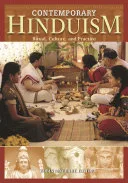
Contemporary Hinduism
 75
75

Contemporary Hinduism
Robin Rinehart’s *Contemporary Hinduism* provides a valuable, if sometimes dry, survey of its subject. The author’s strength lies in meticulously detailing the varied expressions of Hindu practice outside of India, particularly in Western contexts, which often receive less attention than their South Asian counterparts. The chapter on the diaspora’s adaptation of rituals is especially illuminating, showcasing how ancient forms are recontextualized. However, the book occasionally suffers from an academic detachment that can make the material feel distant. For instance, the discussion of *puja* (worship) in chapter 4, while accurate, lacks the devotional fervor one might expect when describing such a central practice. Despite this, the work offers a solid, fact-based foundation for understanding modern Hinduism, avoiding sensationalism. It serves as a competent academic resource, though readers seeking a more personally engaging exploration might look elsewhere.
📝 Description
75
Robin Rinehart's 2004 book examines Hinduism as it is lived today.
Published in 2004, Robin Rinehart's Contemporary Hinduism moves beyond historical surveys to detail modern Hindu practices and beliefs. The work focuses on the religion as it exists in India and among global communities, covering ritual, culture, and the daily lives of adherents. Rinehart traces Hinduism's origins to provide context for its current manifestations, acknowledging both its deep historical roots and its modern expressions. The book highlights Hinduism's dynamic nature, showing how ancient philosophies and rituals are interpreted in the 21st century. It discusses the religion's adaptability, its interaction with global influences, and the diverse forms of devotion and belief found worldwide. The core of the book illuminates contemporary ritual, its range, and its reach.
While not strictly an esoteric text itself, Contemporary Hinduism engages with traditions that often intersect with esoteric thought. The book's focus on lived religious experience, ritual practice, and the interpretation of ancient philosophies in modern contexts touches upon areas explored within esoteric studies. It provides a scholarly lens on how belief systems evolve and are enacted, which can inform understanding of how esoteric currents manifest within broader religious traditions.
💡 Why Read This Book?
• Gain a concrete understanding of how Hindu practices, such as *puja*, are adapted by diasporic communities, offering insights unavailable in purely historical accounts. • Learn about the specific challenges and innovations faced by modern Hindu movements, including the influence of figures like Swami Vivekananda, first encountered in this text. • Grasp the complexities of religious identity in the 21st century by examining how ancient traditions engage with globalized culture, as detailed in the book's sections on contemporary thought.
⭐ Reader Reviews
Honest opinions from readers who have explored this book.
❓ Frequently Asked Questions
What are the main contemporary practices of Hinduism discussed in Robin Rinehart's book?
The book examines contemporary Hindu practices including *puja* (worship), pilgrimage, and various forms of devotional singing and ritual. It highlights how these are enacted both in India and within global diasporic communities, adapting to new cultural contexts.
When was Contemporary Hinduism first published?
Contemporary Hinduism by Robin Rinehart was first published on July 21, 2004.
Does the book focus only on Hinduism in India?
No, the book provides a global perspective, examining Hindu practices and beliefs both within India and throughout the world, with significant attention paid to diasporic communities and their unique expressions of the faith.
What historical context does Robin Rinehart provide for modern Hinduism?
Rinehart offers a brief historical overview, touching upon the oral and written origins of Hinduism. This context is crucial for understanding the evolution and contemporary manifestations of the religion discussed in the main body of the work.
Who is the author of Contemporary Hinduism?
The author of Contemporary Hinduism is Robin Rinehart, an academic who has studied and written extensively on Hindu traditions and their modern expressions.
What is the primary emphasis of Contemporary Hinduism?
The primary emphasis of Contemporary Hinduism is on modern-day thought, practice, and the lived religious experience of Hindus globally, rather than solely historical origins.
🔮 Key Themes & Symbolism
The Living Tradition
This book moves beyond historical accounts to illuminate Hinduism as a dynamic, evolving faith. It emphasizes contemporary ritual, the range of beliefs held by adherents, and the religion's reach across diverse geographical and cultural landscapes. By focusing on how Hinduism is practiced today, the work illustrates its enduring adaptability and relevance in the modern world, offering a view of its continuous unfolding.
Global Diaspora
A significant focus is placed on the global spread of Hinduism and how its practices and beliefs are maintained and transformed by diasporic communities. The work explores the unique challenges and innovations that arise when Hindu traditions are transplanted to new cultural environments, demonstrating how adherents negotiate their religious identity across different societies.
Belief and Practice
The book studies the core tenets and rituals that define contemporary Hinduism. It examines the spectrum of beliefs, from philosophical concepts to devotional practices, and how these translate into daily life for millions. Understanding the interplay between belief systems and ritual actions is central to appreciating the complex nature of this ancient religion's modern expression.
Historical Continuity
While concentrating on the present, the work acknowledges the deep historical roots of Hinduism. It provides essential context by referencing the religion's oral and written origins, allowing readers to trace the lineage of current practices and beliefs. This approach highlights how contemporary Hinduism is both a product of its past and a living entity shaped by ongoing historical forces.
💬 Memorable Quotes
Direct passages from the work, attributed to the author.
“Contemporary Hinduism: Ritual, Culture, and Practice illuminates the modern-day ritual, range, and reach of this ancient and diverse religion.”
— This statement expresses the book's central thesis: to explore how Hinduism functions as a living, global phenomenon in the present day, focusing on its diverse practices and widespread influence.
“A brief historical overview is followed by discussions of the oral and written origins of Hinduism that give context for the main emphasis—contemporary thought, practice, and...”
— This indicates the book's structure, prioritizing modern manifestations of Hinduism while acknowledging the necessity of historical grounding to fully comprehend its current state.
“The work explores the modern-day ritual, range, and reach of this ancient and diverse religion.”
— This reiterates the book's commitment to understanding Hinduism not as a static historical entity, but as a vibrant, active, and geographically widespread religious system.
“The main emphasis—contemporary thought, practice, and...”
— This phrase points to the book's core objective: to analyze and present the current state of Hindu philosophy, daily rituals, and the lived experiences of its followers globally.
💡 Key Ideas
Editorial paraphrase of the work's core concepts — not direct quotes.
An examination of the contemporary practices, beliefs, and issues of one of the world's oldest and most enduring religions, both within its Indian homeland and throughout the world.
This quote highlights the book's scope, emphasizing its dual focus on Hinduism's origins in India and its global presence, along with an analysis of current challenges and developments.
🌙 Esoteric Significance
Tradition
While *Contemporary Hinduism* is primarily an academic sociological and anthropological study, its focus on lived practice and the adaptability of ancient traditions touches upon esoteric concerns. It implicitly engages with the perennial philosophical quest to understand the divine through diverse human expressions. The work does not align with a specific Western esoteric lineage like Hermeticism or Kabbalah but rather provides a factual basis for understanding a major world religion often approached esoterically.
Symbolism
The book implicitly touches upon potent Hindu symbols, such as the concept of *dharma* (duty/cosmic order) and the practice of *puja* (worship), which often involves symbolic offerings and visualizations. While not studying esoteric interpretations, it documents how these concepts and rituals function in the daily lives of adherents, serving as conduits for spiritual connection and cosmic understanding.
Modern Relevance
Contemporary thinkers and practitioners interested in comparative spirituality, the sociology of religion, and the practical application of Eastern philosophies find value in Rinehart's work. It provides a grounded, empirical counterpoint to more speculative or purely philosophical treatments of Hinduism, offering insights for those exploring meditation, yoga, and ethical frameworks derived from Hindu traditions in contemporary contexts.
👥 Who Should Read This Book
• Students of comparative religion seeking to understand the practical manifestations of Hinduism beyond historical texts. • Anthropologists and sociologists interested in the cultural adaptation of religious practices in diasporic communities. • Individuals curious about the global evolution of ancient spiritual traditions and their relevance in the 21st century.
📜 Historical Context
Robin Rinehart's *Contemporary Hinduism* was published in 2004, a period marked by increased globalization and academic interest in lived religion. The book emerged within a scholarly landscape that was moving beyond purely textual analyses to explore the lived experiences and diverse practices of religious communities worldwide. It engaged with the growing field of diaspora studies, examining how traditions adapt when transplanted. While not directly engaging with specific controversies, the work implicitly addressed evolving academic perspectives on religious syncretism and the negotiation of identity in multicultural societies. Its publication contributed to a broader understanding of Hinduism as a fluid, adaptable tradition, countering monolithic interpretations. It appeared during a time when scholars like Diana Eck were also highlighting the presence of world religions in American cities, aligning with Rinehart's focus on Hinduism beyond India.
📔 Journal Prompts
The concept of *dharma* as presented in contemporary Hindu practice.
Modern adaptations of Hindu rituals in diasporic communities.
The role of oral traditions in sustaining Hindu beliefs today.
How contemporary Hinduism addresses issues of identity and belonging.
The interplay between ancient origins and modern practice in Hinduism.
🗂️ Glossary
Puja
A devotional ritual performed by Hindus, typically involving offerings, prayers, and images or idols of deities. It is a central practice for worship in homes and temples.
Dharma
A complex concept encompassing duty, righteousness, cosmic law, and the natural order of things. It guides an individual's actions and responsibilities within society and the universe.
Diaspora
The dispersion or scattering of people from their original homeland to other parts of the world, often maintaining cultural and religious ties to their origin.
Veda
The oldest scriptures of Hinduism, considered by adherents to be divinely revealed. They form the foundational texts of Vedic religion and influence later Hindu traditions.
Bhakti
A devotional movement within Hinduism characterized by intense love and surrender to a personal deity. Bhakti yoga is a prominent path to spiritual realization.
Samsara
The continuous cycle of birth, death, and rebirth, driven by karma. Liberation from samsara is a central goal in many Hindu philosophical systems.
Karma
The law of cause and effect, where actions in this life and previous lives determine one's future destiny and rebirths. It is a fundamental concept in understanding spiritual progression.