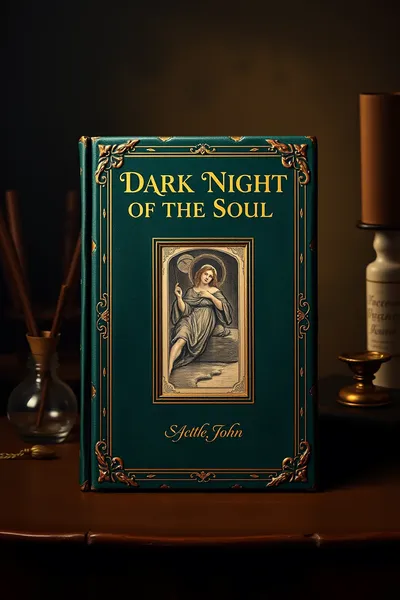
Dark Night of the Soul (Royal Collector's Edition) (Annotated) (Case Laminate Hardcover with Jacket)

 76
76

Dark Night of the Soul (Royal Collector's Edition) (Annotated) (Case Laminate Hardcover with Jacket)
St. John of the Cross’s *Dark Night of the Soul* is not a book to be approached lightly; it demands surrender. This annotated collector's edition makes the formidable text more accessible, though the inherent difficulty of the subject remains. The author’s unflinching depiction of the soul’s arduous ascent, marked by the 'dark night' of sensory and spiritual purgation, offers a stark contrast to contemporary, gentler approaches to spirituality. While the annotations help contextualize the 16th-century Spanish Carmelite friar’s profound theological framework, the raw intensity of his language, particularly when describing the 'emptying' of the soul, can be challenging. A notable passage details the soul’s feeling of abandonment, a crucial step before union. The limitation lies in the sheer theological density, which may deter readers unfamiliar with scholastic or mystical terminology. Nevertheless, for those willing to engage, it provides an unparalleled map of the soul's furthest reaches toward the divine.
📝 Description
76
This 1586 text details the soul's painful path to God through spiritual darkness.
St. John of the Cross's Dark Night of the Soul, first published in the late 16th century, describes the soul's journey toward divine union. This annotated edition presents his seminal poem and prose commentary, originally penned during Spain's Counter-Reformation. The work's theological and mystical dimensions are clarified through extensive annotations, making the text accessible to serious students of Christian mysticism. It addresses individuals committed to a rigorous spiritual path, seeking a deeper comprehension of the soul's purification and illumination. The prose explains the poem's allegorical meaning, guiding the reader through the arduous process of spiritual growth. This edition includes a jacket and is presented as a case laminate hardcover.
The central concept is the 'dark night,' a period of intense spiritual trial. This involves detaching from sensory experiences and even spiritual consolations. The soul experiences a profound sense of absence and darkness, which is ultimately a necessary step toward direct union with God. The commentary elucidates this transformative process, drawing parallels with earlier mystical writings.
Written during a fervent Counter-Reformation Spain, St. John of the Cross's work builds upon the contemplative traditions of figures like Pseudo-Dionysius the Areopagite. It engages with the Neoplatonic understanding of divine ascent through negation and apophatic theology. The poem and commentary form a guide to the soul's transformative passage, often marked by suffering and a felt absence of God, a common theme in ascetical theology seeking direct experience of the divine.
💡 Why Read This Book?
• Gain a precise understanding of the two purgations—sensory and spiritual—as articulated by St. John of the Cross, a critical framework for advanced spiritual practice not found in casual devotionals. • Explore the symbolic landscape of the 'dark night,' a concept that has influenced centuries of mystical thought, offering a unique lens on periods of spiritual dryness or trial. • Grasp the influence of Pseudo-Dionysius the Areopagite on 16th-century Spanish mysticism, providing historical depth to the work’s theological underpinnings and its place in Western esoteric traditions.
⭐ Reader Reviews
Honest opinions from readers who have explored this book.
❓ Frequently Asked Questions
What is the primary purpose of the 'dark night' described by St. John of the Cross?
The 'dark night' serves as a necessary purgation, stripping the soul of attachments to both sensory pleasures and spiritual consolations, preparing it for direct union with God through a process of purification and detachment.
Who was Pseudo-Dionysius the Areopagite and why is he mentioned?
Pseudo-Dionysius was a 6th-century theologian whose mystical writings, particularly on the 'divine names' and apophatic theology, heavily influenced St. John of the Cross and subsequent Christian mystical traditions.
What makes this 'Royal Collector's Edition' different from other versions?
This edition is a case laminate hardcover with a jacket, featuring annotations designed to clarify the complex theological and mystical concepts presented by St. John of the Cross.
When was St. John of the Cross's 'Dark Night of the Soul' originally published?
While the original publication date of St. John of the Cross's work is debated, the first edition of his collected works, including 'Dark Night of the Soul,' was published posthumously in the early 17th century, with the poem itself likely composed in the late 16th century.
How does the 'illumination' stage follow the 'dark night'?
Following the purgation of the 'dark night,' the soul enters a stage of illumination, characterized by a clearer perception of divine truths and a growing capacity for divine love and union with God.
Is 'Dark Night of the Soul' suitable for beginners in spirituality?
While valuable for all spiritual seekers, its dense theological content and rigorous depiction of purgation make it more suited for those with a dedicated interest in Christian mysticism or advanced spiritual disciplines.
🔮 Key Themes & Symbolism
The Two Purgations
This work meticulously details the soul's journey through two essential phases of purification. The first, the purgation of the sensory, involves detachment from worldly pleasures and physical comforts. The second, the purgation of the spiritual, is a more profound detachment from intellectual consolations and spiritual 'tastes' that can subtly distract from pure love of God. These stages are presented not as optional steps but as indispensable requirements for achieving mystical union.
Apophatic Theology
Central to St. John's approach is the concept of apophatic theology, heavily influenced by Pseudo-Dionysius. This method emphasizes what God is *not*, rather than what God is, through negation and silence. The 'dark night' itself embodies this principle, as the soul must divest itself of all conceptualizations and perceived divine experiences to encounter God in pure being, beyond all forms and attributes.
Union with God
The ultimate aim of the soul's journey, as described in *Dark Night of the Soul*, is mystical union. This state transcends ordinary human experience, representing a profound, loving communion with the Divine. It is the culmination of the purgative and illuminative stages, where the soul becomes transformed, participating in the divine life through grace and divine love, losing its sense of separation.
The Role of Suffering
Suffering is not presented as an obstacle but as a vital component of the spiritual path. The 'dark night' is inherently a painful process, involving a profound sense of abandonment and spiritual darkness. St. John frames this suffering as a crucible that refines the soul, burning away impurities and fostering humility, obedience, and an unshakeable reliance on God's will.
💬 Memorable Quotes
Direct passages from the work, attributed to the author.
“Upon a darkened night, With anxious love inflamed—O happy plight!—”
— This opening line immediately sets the tone, introducing the paradox of finding spiritual progress and divine encounter within what is typically perceived as darkness or distress.
“I went out, though I knew it not, And all my house was stilled.”
— This captures the essence of the soul's unguided movement into the unknown of the 'dark night,' emphasizing a surrender of conscious control and a state of inner quietude.
“In deepest night, my soul took flight, And into God did leap,”
— This expresses the soul's active, albeit divinely inspired, movement towards union, highlighting a decisive spiritual leap facilitated by the preceding purification.
“And in that flowing, I came to know That place where it was hid.”
— This suggests that through the process of 'flowing' or surrender, the soul discovers the hidden presence of God, which was obscured by its own prior attachments.
“My soul is now content, with God to be, For now He guides me, and my love is free.”
— This represents the soul's arrival at a state of peace and freedom, where its will is aligned with God's, and its love can flow unhindered towards the Divine.
🌙 Esoteric Significance
Tradition
St. John of the Cross's work is a core part of Christian Mysticism, particularly within the Carmelite tradition. It draws heavily on Neoplatonic principles, especially from Pseudo-Dionysius, concerning the apophatic path and divine unknowability. While rooted in orthodox Catholicism, its emphasis on direct, unmediated experience of the Divine places it within broader esoteric lineages that explore inner transformation and union with the Absolute.
Symbolism
The 'dark night' itself is the primary symbol, representing the necessary void and purification the soul undergoes. 'Night' signifies not evil, but the absence of familiar light (sensory and spiritual consolations) that allows for a deeper, more direct apprehension of God. Another key symbol is 'light,' which, after the darkness, represents divine illumination and transformative presence, guiding the soul towards union.
Modern Relevance
Contemporary spiritual practitioners, particularly those interested in contemplative prayer, mindfulness, and psychological integration, find resonance in St. John's description of inner purification. Thinkers and writers in fields ranging from depth psychology to comparative mysticism often cite *Dark Night of the Soul* as a foundational text for understanding spiritual crises and the transformative potential of periods of intense inner darkness.
👥 Who Should Read This Book
• Dedicated practitioners of Christian contemplative prayer seeking a rigorous framework for understanding spiritual dryness and the purification process. • Scholars of religious history and comparative mysticism interested in the development of Western esoteric thought and the Counter-Reformation period. • Individuals experiencing significant spiritual challenges or transitions who are looking for theological and psychological insights into navigating periods of profound inner darkness.
📜 Historical Context
Written in the latter half of the 16th century, St. John of the Cross's *Dark Night of the Soul* emerged from the vibrant, yet often fraught, spiritual climate of Counter-Reformation Spain. This era saw a resurgence of mystical thought within Catholicism, partly as a response to the Protestant Reformation, but also as a continuation of rich Iberian contemplative traditions. St. John, a Carmelite friar, was deeply influenced by earlier mystics like Teresa of Ávila and, significantly, by the Neoplatonic Christian theology of Pseudo-Dionysius the Areopagite. His work sought to provide a rigorous theological and psychological framework for the soul's ascent to God, contrasting with more scholastic or humanist approaches to spirituality prevalent at the time. The Spanish Inquisition's pervasive influence meant that such profound theological explorations were often conducted under intense scrutiny, adding a layer of potential risk to the author and his writings.
📔 Journal Prompts
The soul’s initial state before the darkened night, its attachments and perceived consolations.
The specific nature of the 'purgation of the senses' and its practical implications.
The transition from sensory to spiritual darkness: what shifts occur within the soul?
Reflecting on the concept of 'divine union' as described in the text.
The paradoxical experience of finding God in the absence of familiar spiritual experiences.
🗂️ Glossary
Purgation
The process of cleansing or purifying the soul from imperfections, attachments, and sinful habits through spiritual discipline and divine action.
Sensory Purgation
The initial stage of spiritual purification involving detachment from worldly pleasures, physical comforts, and sensory gratifications that distract from God.
Spiritual Purgation
A deeper stage of purification where the soul detaches from spiritual consolations, intellectual understandings, and even perceived divine experiences that can become subtle forms of attachment.
Illumination
The stage following purgation where the soul's intellect and will are enlightened by divine grace, leading to a clearer understanding of spiritual truths and a greater capacity for divine love.
Union
The ultimate goal of the mystical journey, a state of profound, transformative communion between the soul and God, often described as a spiritual marriage.
Apophatic Theology
A theological approach that describes God by negation (what God is not) rather than by affirmation (what God is), emphasizing divine transcendence and unknowability.
Contemplation
A form of prayer or spiritual practice involving a deep, silent, and loving gaze upon God, often characterized by passive reception of divine truths rather than active reasoning.
This book appears in 1 collection
🔮 Readers Also Liked
Browse all →









From the “Dark Night of the Soul” Collection
View all →





More Free Occult Philosophy Books
View all →