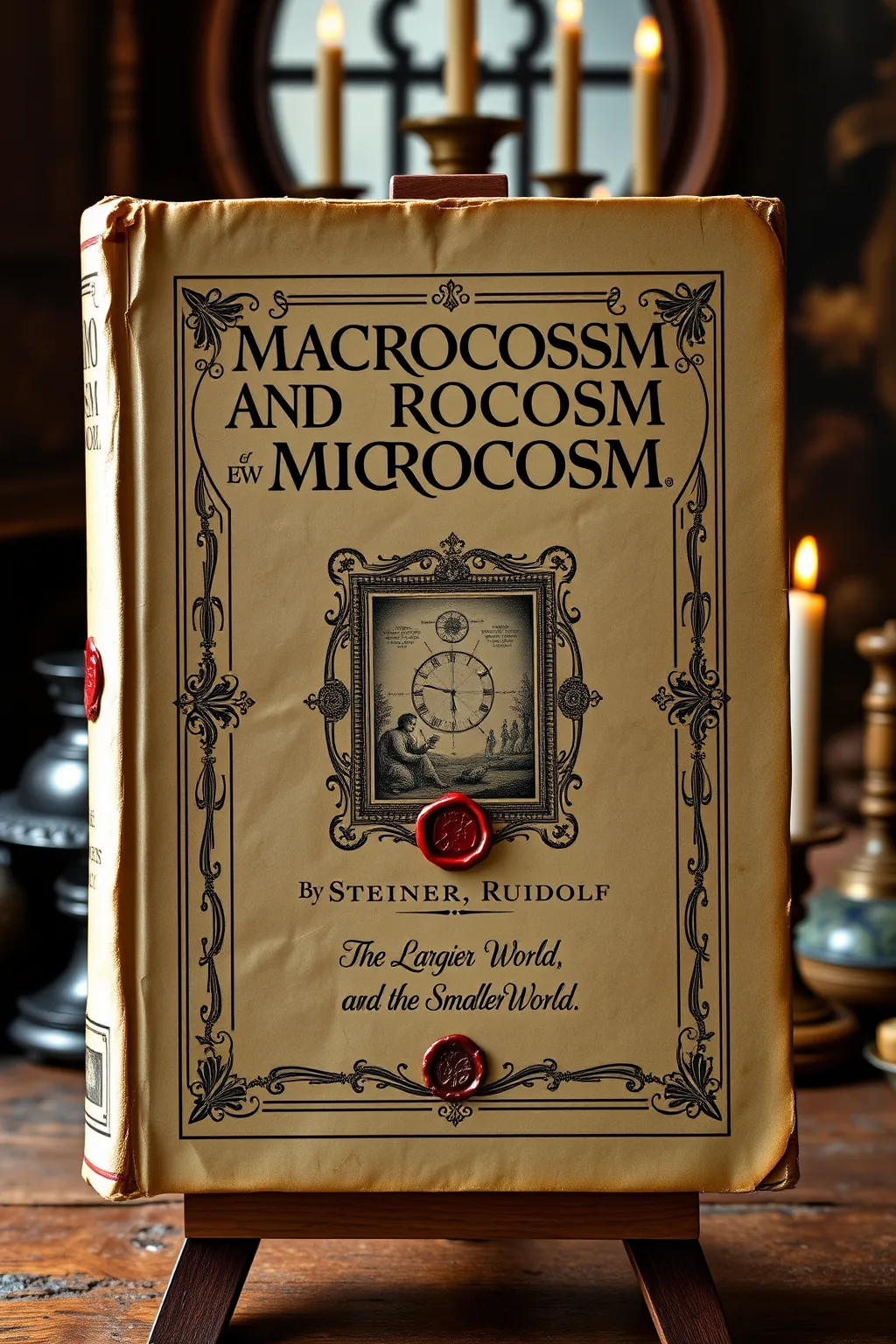
Macrocosm and Microcosm (CW 119)
 84
84

Macrocosm and Microcosm (CW 119)


Review by Lorelei Sage (Contemplative Literature Editor) — Rudolf Steiner's 'Macrocosm and Microcosm' is a breathtaking exposition of the fundamental interconnectedness of all things. Steiner masterfully bridges the gap between the material and the spiritual, revealing how the grand cosmic forces are mirrored within the human being. This work is essential for anyone seeking to understand the deeper currents of existence, moving beyond mere intellectualism to a living, experiential knowledge of the spirit. Its strength lies in its detailed exploration of the inner path, offering practical insights for the mystic and profound philosophical revelations for the scholar. A truly essential text for dedicated students of spiritual science and esoteric philosophy.
📝 Description
84
Rudolf Steiner published 'Macrocosm and Microcosm' (CW 119) in the early 20th century, exploring connections between the cosmos and human life.
In 'Macrocosm and Microcosm,' Rudolf Steiner examines the relationship between the larger universe and the individual human being. He posits that the structures and forces at play in the cosmos are mirrored within human consciousness and physical form. Steiner guides readers to understand how cosmic rhythms, such as planetary influences, affect human states of sleeping and waking. He also discusses the nature of mystical experience and how it can lead to a perception of realities beyond the physical senses.
The book addresses the soul's pursuit of knowledge and advocates for a recognition of the unity connecting humanity to the wider universe. Steiner presents this understanding as a way to grasp the underlying order of existence. He outlines how this perspective is central to Anthroposophy, offering a framework for spiritual science that sees a grand design present in both the universe and the individual. It is a text for those interested in exploring these supersensible connections.
This work belongs to the tradition of esoteric philosophy that seeks to understand the universe through non-material principles. Steiner's approach, Anthroposophy, draws from various streams of Western esotericism, including Hermeticism and Theosophy, but aims to establish a more scientifically rigorous path to spiritual insight. It emphasizes the development of human faculties to perceive spiritual realities, viewing the human being as a microcosm reflecting the macrocosm. The book fits within a broader esoteric current that posits hidden connections and correspondences linking all levels of existence.
💡 Why Read This Book?
Uncover the profound link between the cosmos and your inner self. This book offers a unique blueprint for understanding spiritual realities, the nature of consciousness, and the hidden forces that shape our lives. Ideal for seekers of wisdom, students of esoteric philosophy, and those aspiring to a more profound, integrated understanding of existence.
⭐ Reader Reviews
Honest opinions from readers who have explored this book.
❓ Frequently Asked Questions
What is the core concept of Macrocosm and Microcosm?
The core concept is the profound correspondence between the outer universe (Macrocosm) and the inner human being (Microcosm), suggesting that universal principles are reflected within the individual soul and consciousness.
Who was Rudolf Steiner?
Rudolf Steiner (1861-1925) was an Austrian philosopher, esotericist, and social reformer, founder of Anthroposophy, and a prolific author and lecturer on spiritual science, education, and the arts.
What are 'soul-questions, life-questions, and spirit-questions' as mentioned in the text?
These refer to the fundamental inquiries concerning the nature of the human soul, the essence of life and its processes, and the transcendent spiritual realities that lie beyond the physical world.
How does this book relate to Freemasonry and Secret Societies?
Steiner often drew parallels and explored symbolic language found within esoteric traditions, including those associated with Freemasonry, to illustrate his spiritual science concepts, though his work transcends specific organizational boundaries.
Is this book suitable for beginners?
While dense with profound concepts, 'Macrocosm and Microcosm' is highly rewarding for dedicated beginners willing to engage with its contemplative and philosophical nature. It serves as an excellent introduction to Steiner's thought.
🔮 Key Themes & Symbolism
The Cosmic Mirror: Universal Laws in the Human Soul
This theme looks at the intricate mirroring of cosmic principles within the human being. Steiner argues that the same fundamental laws governing the celestial bodies, the cycles of nature, and the very fabric of the universe are also active within the human soul and consciousness. Understanding these correspondences allows for a profound self-knowledge, revealing the human as a microcosm of the greater cosmos. It emphasizes a holistic view where inner transformation is intrinsically linked to understanding universal order, moving beyond a purely materialistic perspective to one where the spiritual permeates all existence.
The Path of Inner Knowing: Mysticism and Supersensible Perception
Steiner meticulously outlines the 'Inner Path' that the mystic follows to gain direct experience of supersensible realities. This theme explores the nature of ecstasy, mystical experience, and the development of faculties that transcend ordinary sensory perception. It addresses how states of consciousness, such as sleeping and waking, are intimately connected to cosmic influences and planetary forces. The text provides a framework for cultivating spiritual awareness and achieving a deeper connection with the spiritual world through disciplined inner work and contemplation.
The Range of Reality: Beyond Sense Perception
This theme challenges the reader to look beyond the apparent reality presented by the physical senses, which Steiner likens to a 'collection.' He guides us to perceive the living, dynamic forces and spiritual beings that lie behind this sensory veil. The book illuminates how the annual cycle of nature, from the earthly to the cosmic, reflects spiritual processes and influences human life. It encourages a re-evaluation of our perception of time, space, and consciousness, positing that true understanding comes from engaging with these hidden dimensions of existence.
💬 Memorable Quotes
Direct passages from the work, attributed to the author.
“To know the microcosm is to know the macrocosm.”
— This captures the principle of correspondence, suggesting that by understanding the intricate workings of the human being, one gains insight into the vast workings of the universe, and vice versa.
“The path of the mystic leads through the soul's own depths.”
— This points to the internal nature of spiritual attainment, emphasizing that true knowledge and experience of the spiritual world are found through introspection and inner development.
“Life questions are soul questions, and soul questions are spirit questions.”
— This illustrates the interconnectedness of different levels of human existence, suggesting that inquiries into life's meaning ultimately lead to questions about the soul and the spirit.
“Sleeping and waking are portals to cosmic influence.”
— This enigmatic statement suggests that our altered states of consciousness, particularly sleep, are not mere passive states but actively engage us with the broader cosmic forces and rhythms.
💡 Key Ideas
Editorial paraphrase of the work's core concepts — not direct quotes.
The world behind the range of sense-perceptions is the true reality.
This quote highlights Steiner's core thesis: that the physical world we perceive is merely a manifestation of deeper, unseen spiritual realities that constitute true existence.
🌙 Esoteric Significance
Tradition
This work is a foundational text for Anthroposophy, a spiritual philosophy and science founded by Rudolf Steiner. It draws upon and synthesizes elements from various esoteric traditions, including Hermeticism, Neoplatonism, Gnosticism, and Western mysticism, while presenting a unique, contemporary articulation of spiritual realities. Steiner's emphasis on the direct experience of spiritual worlds and the development of higher cognition aligns it with the broader lineage of wisdom literature seeking to unveil hidden truths about existence.
Symbolism
Steiner employs strong symbolism, often drawing from ancient cosmologies, alchemical principles, and astronomical correspondences. The 'Macrocosm' and 'Microcosm' themselves are potent symbols representing the universal and the individual, the divine and the human. Concepts like the 'range of sense-perceptions' symbolize the limitations of ordinary vision, while the 'Inner Path' represents the symbolic journey of initiation and spiritual development, echoing ancient allegories of pilgrimage and self-discovery.
Modern Relevance
In an age often characterized by fragmentation and a disconnect from nature and the spiritual, 'Macrocosm and Microcosm' offers a vital perspective on holistic interconnectedness. Its insights into the relationship between consciousness, the environment, and cosmic rhythms are increasingly relevant for understanding ecological crises, mental well-being, and the search for meaning. The book provides a framework for cultivating a conscious relationship with the world and for developing inner capacities to work through the complexities of modern life with greater wisdom and spiritual insight.
👥 Who Should Read This Book
This profound work is an essential read for students of Anthroposophy and Rudolf Steiner's extensive corpus. Scholars of comparative religion, philosophy, and esoteric traditions will find its intellectual rigor and unique perspectives invaluable. Spiritual seekers interested in bridging the gap between science and spirituality, and those yearning for a deeper understanding of the human soul's connection to the cosmos, will find this book deeply useful. Practitioners of contemplative disciplines and those seeking to develop their inner faculties will discover practical guidance and profound inspiration within its pages.
📜 Historical Context
Published in 1910, 'Macrocosm and Microcosm' emerged during a period of intense spiritual and intellectual ferment across Europe. The late 19th and early 20th centuries witnessed a growing dissatisfaction with purely materialistic scientific explanations of the world. This era saw a resurgence of interest in esoteric traditions, mysticism, and theosophy, as thinkers sought to reconcile scientific progress with spiritual understanding. Rudolf Steiner, drawing from his deep engagement with Western philosophy and occult traditions, was a leading figure in this movement, establishing Anthroposophy as a spiritual science. The book reflects this milieu, offering a sophisticated, non-dogmatic approach to understanding the human being and the cosmos, aiming to provide a bridge between science and spirituality for a rapidly changing world.
📔 Journal Prompts
Reflect on a time you felt a profound connection to something larger than yourself. How did this experience relate to your inner state?
Consider the 'range of sense-perceptions.' What aspects of reality do you believe are hidden from your current perception?
How do you observe the cycles of nature (daily, yearly) influencing your mood or energy levels?
What 'soul-questions' or 'life-questions' are most pressing for you at this moment? How might they relate to a larger 'spirit-question'?
Steiner speaks of developing faculties beyond the senses. What inner 'muscle' do you feel needs strengthening for spiritual perception?
🗂️ Glossary
Anthroposophy
A spiritual philosophy founded by Rudolf Steiner, seeking to understand the universe and human existence through spiritual science and the development of higher human faculties.
Macrocosm
The 'larger world'; the universe in its entirety, often understood as encompassing cosmic laws, forces, and beings.
Microcosm
The 'smaller world'; the human being, seen as a reflection or miniature representation of the Macrocosm, containing analogous structures and forces.
Supersensible Knowledge
Knowledge that transcends the limitations of the physical senses, attained through spiritual perception, intuition, or direct experience of spiritual realms.
Science of Spirit
A term used by Steiner to describe his approach, which applies rigorous, methodical investigation to spiritual phenomena, akin to natural science but with expanded faculties.
This book appears in 2 collections
🔮 Readers Also Liked
Browse all →








More by Steiner, Rudolf
All books →


From the “Secret Societies” Collection
View all →






More Free Freemasonry & Secret Societies Books
View all →