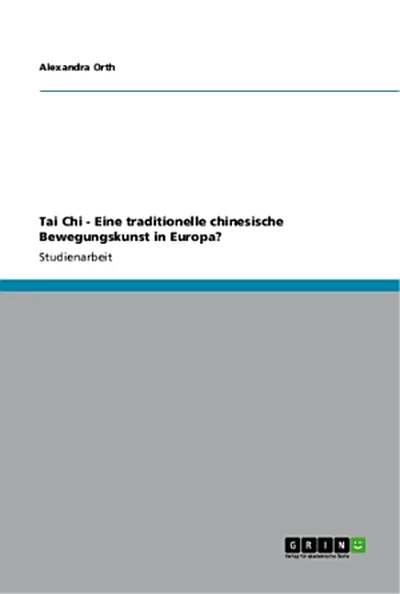
Tai Chi - Eine traditionelle chinesische Bewegungskunst in Europa?
 79
79

Tai Chi - Eine traditionelle chinesische Bewegungskunst in Europa?
Alexandra Orth's "Tai Chi - Eine traditionelle chinesische Bewegungskunst in Europa?" offers a focused academic inquiry into the diffusion of this complex practice. The strength of the work lies in its systematic approach to tracing Tai Chi's journey westward, meticulously detailing its integration into European cultural landscapes since the mid-20th century. Orth avoids sensationalism, presenting a grounded historical analysis. A limitation, however, is the work's academic tone, which, while rigorous, may not fully capture the lived, embodied experience of Tai Chi practitioners for a general audience. The exploration of how concepts like Qi were translated and understood in European contexts is particularly insightful, highlighting the challenges and adaptations inherent in cross-cultural transmission.
📝 Description
79
Alexandra Orth's 2015 book traces Tai Chi Chuan's arrival and adaptation in Europe.
Alexandra Orth's study investigates the introduction and reception of Tai Chi Chuan in Europe, particularly from the mid-20th century onwards. The book examines how this Chinese practice, alongside other martial arts, became established in Western societies. Orth looks into the reasons for its spread, noting its evolution from martial origins to a discipline embraced for health and spiritual development by many across the continent. The practice itself is characterized by slow, flowing movements designed to cultivate internal energy, known as Qi. It involves coordinated posture, breathing, and mental focus to harmonize body, mind, and spirit. While its precise historical lineage is debated, its roots are often linked to Taoist monasteries. This movement art attracts a diverse group of people interested in physical and mental well-being, traditional Chinese culture, and stress reduction. Students of history and comparative religion may also find value in its cultural transmission.
This work situates Tai Chi within the broader context of Chinese internal arts and Taoist traditions. It examines how concepts like Qi, the vital life force, and the principles of Yin and Yang, are understood and practiced in a European setting. The book considers the spiritual dimension of Tai Chi, moving beyond its martial applications to explore its role as a path for personal development and inner harmony, aligning with contemplative practices found in various esoteric lineages.
💡 Why Read This Book?
• Gain insight into the specific historical trajectory of Tai Chi Chuan's arrival and acceptance in Europe after 1950, understanding the socio-cultural factors that facilitated its spread beyond its martial origins. • Explore the academic debate surrounding Tai Chi's lineage and its adaptation into Western health and wellness paradigms, moving beyond simplistic portrayals of the practice. • Understand the fundamental principles of Tai Chi, such as Qi and Yin/Yang, as analyzed within a historical and cultural transmission framework, providing a deeper appreciation for the art's philosophical underpinnings.
⭐ Reader Reviews
Honest opinions from readers who have explored this book.
❓ Frequently Asked Questions
When was Alexandra Orth's study on Tai Chi first published?
Alexandra Orth's academic work on Tai Chi was first published in 2011, stemming from research conducted around 2009 for her studies at Albert-Ludwigs-Universität Freiburg.
What is the primary focus of Alexandra Orth's research on Tai Chi?
The primary focus is on Tai Chi Chuan as a traditional Chinese movement art and its reception and integration into European culture from the mid-20th century onwards.
What historical period does the book primarily cover regarding Tai Chi in Europe?
The book primarily covers the period from the mid-20th century to the time of its publication, examining how Tai Chi became popular in the Western world.
What academic institution is associated with Alexandra Orth's study?
Alexandra Orth's study is associated with the Albert-Ludwigs-Universität Freiburg, where she presented her work in the Historical Seminar.
What is the significance of Tai Chi as a 'movement art' discussed in the book?
The book discusses Tai Chi as a 'Bewegungskunst' (movement art) that encompasses martial applications, health cultivation, and meditative practices, highlighting its multifaceted nature.
What does the book aim to answer regarding Tai Chi's presence in Europe?
The book aims to answer why Tai Chi Chuan, among other Chinese martial arts, has captivated numerous people in the Western world since the mid-20th century.
🔮 Key Themes & Symbolism
Cultural Transmission of Tai Chi
The work meticulously details the process by which Tai Chi Chuan transitioned from its Chinese origins to become a recognized practice in Europe. It examines the challenges and adaptations involved in this cultural exchange, moving beyond a simple chronological account to analyze the factors driving its adoption. This includes how its image evolved from a martial art to a holistic health practice, resonating with European interests in alternative wellness and spiritual development.
Tai Chi as a Holistic Practice
Orth's study highlights the many-sided nature of Tai Chi, encompassing its martial foundations, therapeutic benefits, and meditative qualities. The book explores how Western practitioners often emphasize the health and spiritual aspects, viewing it as a method for cultivating internal energy (Qi) and achieving balance. This perspective diverges from purely combative interpretations, reflecting a broader engagement with its philosophical underpinnings rooted in Taoism.
The Role of History in Understanding Practice
By situating Tai Chi within its historical context, the book underscores the importance of understanding a practice's evolution. Orth's academic approach, originating from historical studies, provides a framework for appreciating how Tai Chi's meaning and application have shifted over time and across cultures. This historical lens is crucial for discerning its authentic roots from later interpretations and adaptations.
Comparative Cultural Reception
The research implicitly invites comparison by framing Tai Chi's European reception against the backdrop of other Chinese cultural imports. It examines how specific societal needs and intellectual currents in Europe, particularly post-WWII, created fertile ground for practices like Tai Chi. This comparative perspective is key to understanding why certain elements of Chinese culture were embraced while others remained niche.
💬 Memorable Quotes
Direct passages from the work, attributed to the author.
“Tai Chi Chuan has captivated many in the Western world since the mid-20th century.”
— This statement captures the core inquiry of the work: understanding the appeal and diffusion of this specific Chinese movement art in a non-native cultural context.
“The study examines Tai Chi as a traditional Chinese movement art.”
— This highlights the work's focus on the practice's origin and its classification as a 'Bewegungskunst,' emphasizing its integration of physical form, mental discipline, and potentially spiritual elements.
“The question of Tai Chi's presence in Europe is explored.”
— This points to the book's investigative nature, aiming to analyze the historical, social, and cultural factors that led to Tai Chi's establishment and popularity on the European continent.
“Academic research on Chinese culture in the 20th century serves as the foundation.”
— This indicates the scholarly rigor behind the work, placing its analysis within a specific academic field and historical period, suggesting a deep dive into documented historical trends.
“The reception of Chinese martial arts in the West is a key area of investigation.”
— This suggests a broader interest than just Tai Chi, positioning it within the larger phenomenon of martial arts becoming popular globally, and focusing on how they were perceived and integrated.
🌙 Esoteric Significance
Tradition
While Tai Chi Chuan originates from Taoist traditions, its transmission to Europe has often been viewed through a broader lens of holistic health and meditative practices, sometimes intersecting with Western esoteric interests. It departs from strict lineage-based traditions by being adaptable to diverse interpretations of Qi cultivation and mind-body harmony. Its integration into European wellness movements reflects a broader contemporary esoteric current seeking embodied spiritual experience outside established religious frameworks.
Symbolism
Central to Tai Chi's symbolism is the concept of Qi, the vital life force that practitioners aim to balance and circulate for health and vitality. The interplay of Yin and Yang is also fundamental, representing the dynamic balance of opposing forces within the body and the universe, crucial for understanding movement transitions. The 'push hands' (Tui Shou) exercise, while practical, symbolizes the energetic connection and responsiveness between two practitioners, representing a microcosm of interpersonal energetic dynamics.
Modern Relevance
Contemporary thinkers and practitioners in fields like somatic psychology, mindfulness-based stress reduction, and integrative medicine draw upon Tai Chi's principles. Schools focusing on embodied cognition and philosophies of interconnectedness find resonance in its emphasis on Qi flow and mind-body unity. Its practice continues to be a significant element in discussions about traditional Chinese medicine's global reach and the application of ancient wisdom to modern well-being challenges.
👥 Who Should Read This Book
• Students of comparative religion and cultural history seeking to understand the transmission of Eastern practices into Western contexts. • Practitioners of martial arts or mind-body disciplines interested in the historical and cultural evolution of their chosen art form. • Individuals exploring holistic health and wellness approaches who want to learn about the origins and underlying principles of practices like Tai Chi.
📜 Historical Context
Alexandra Orth's 2009 study emerged from a period of increasing global interconnectedness and a growing Western interest in Eastern philosophies and practices following World War II. The mid-20th century saw a surge in the popularization of martial arts, including Karate, Judo, and Kung Fu, often through media and dedicated practitioners who acted as cultural bridges. Tai Chi Chuan, with its less overtly aggressive presentation and emphasis on health, found a particular niche. This was a time when concepts like Qi and Taoist philosophy began filtering into Western esoteric and alternative health circles, influencing thinkers and practitioners. While Orth's work focuses on European reception, it's situated within broader academic trends examining cultural exchange, moving beyond earlier, more simplistic portrayals of martial arts as mere fighting techniques. The work implicitly contrasts Tai Chi's reception with potentially more controversial or misunderstood Chinese practices, highlighting its unique path to acceptance.
📔 Journal Prompts
The transmission of Tai Chi Chuan to Europe: What factors enabled its acceptance?
Reflect on the concept of Qi as presented in the study of Tai Chi.
Analyze the balance of Yin and Yang principles within a Tai Chi movement.
How did the martial art origins of Tai Chi influence its reception in Europe?
Consider the evolution of Tai Chi from a Chinese practice to a European movement art.
🗂️ Glossary
Tai Chi Chuan
A traditional Chinese internal martial art practiced for health, meditation, and self-defense, characterized by slow, flowing movements and deep breathing.
Qi (Chi)
The fundamental concept in traditional Chinese culture representing vital life force or energy that flows through all living things.
Bewegungskunst
A German term translating to 'movement art,' emphasizing the aesthetic, expressive, and skillful execution of physical motion, often with underlying principles.
Yin and Yang
The Taoist concept of dualistic, complementary, and interdependent forces that shape the natural world and human experience.
Albert-Ludwigs-Universität Freiburg
A public research university located in Freiburg im Breisgau, Germany, known for its strong tradition in humanities and sciences.
Mid-20th Century
Refers to the period roughly from the 1940s to the 1960s, a significant era for cultural exchange and the global spread of various practices.
Kampfkünste
The German word for 'martial arts,' encompassing a wide range of combat disciplines originating from various cultures.