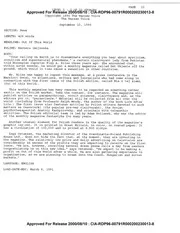
What a Modern Catholic Believes about Mysticism
 82
82

What a Modern Catholic Believes about Mysticism
Nowell’s 1975 exploration of Catholic mysticism is a surprisingly clear-eyed attempt to bridge the gap between lived spiritual experience and institutional theology. He directly confronts the potential for misunderstanding, particularly regarding the role of the Holy Spirit and the necessity of Church guidance in discerning authentic mystical encounters. A notable strength is his careful distinction between genuine divine influence and mere psychological states, a crucial point often overlooked in less rigorous treatments. However, the work occasionally feels constrained by the theological language of its era, which might present a barrier to readers unfamiliar with scholastic terminology. The discussion of the "dark night of the soul," a concept popularized by John of the Cross, serves as a potent example of his attempt to explain profound spiritual desolation within an orthodox framework. Ultimately, Nowell provides a solid, if somewhat dated, defense of mysticism’s place within modern Catholicism.
📝 Description
82
Robert Nowell's 1975 book clarifies Catholic mysticism for a modern audience.
Published in 1975, Robert Nowell's "What a Modern Catholic Believes about Mysticism" addresses how individuals within contemporary Catholic doctrine can understand and incorporate mystical experiences into their spiritual lives. The author presents a reasoned approach to subjects often viewed as mysterious or misunderstood, aiming to clarify them for the faithful curious about the contemplative path. This work is particularly suited for Catholics seeking to align their faith with an interest in mysticism. It also serves students of comparative religion, theologians, and scholars of Western esotericism who study how established religious frameworks interact with mystical traditions. Readers interested in contemplative prayer or the lives of figures like Teresa of Ávila and John of the Cross will find this book useful for contextualizing such experiences within orthodox belief.
Nowell's book appeared in the mid-1970s, a time of theological and social shifts in the Catholic Church following the Second Vatican Council. This period saw a resurgence of interest in spiritual practices, both within and beyond the Church, and a drive to articulate faith in contemporary language. Nowell's contribution attempts to frame mystical phenomena in a way that respects Catholic dogma while acknowledging evolving spiritual perspectives. It engages with ideas that sought to connect personal spiritual experiences with existing religious structures.
This work situates Catholic mysticism within a broader Western esoteric tradition, particularly during the mid-20th century. It emerged in a post-Vatican II era where established religious institutions were re-evaluating their relationship with personal spiritual experience and older contemplative practices. Nowell's book acts as a bridge, explaining how traditional Catholic mystical theology could be understood and practiced by modern adherents, thereby connecting it to ongoing discussions about spirituality, consciousness, and divine encounter within both religious and esoteric circles.
💡 Why Read This Book?
• Gain a grounded understanding of divine union as articulated within Catholic doctrine, moving beyond vague spiritual notions to specific theological concepts explored by Nowell. • Learn the criteria for discerning authentic mystical experiences, as presented in Chapter 5, distinguishing them from psychological phenomena, a crucial skill for any serious spiritual seeker. • Appreciate the historical context of Catholic spirituality post-Vatican II, understanding how thinkers like Nowell sought to integrate contemplative traditions into a changing Church landscape.
⭐ Reader Reviews
Honest opinions from readers who have explored this book.
❓ Frequently Asked Questions
What is the primary focus of Robert Nowell's "What a Modern Catholic Believes about Mysticism"?
The book focuses on explaining how contemporary Catholics can understand and integrate mystical experiences and beliefs within the framework of their faith, emphasizing discernment and Church guidance.
When was "What a Modern Catholic Believes about Mysticism" first published?
The book was first published in 1975, a period of significant theological reflection within the Catholic Church following the Second Vatican Council.
Does the book discuss specific Catholic mystics?
Yes, it references key figures in Catholic mystical tradition, such as Teresa of Ávila and John of the Cross, to illustrate concepts like the dark night of the soul.
What is the "dark night of the soul" as discussed in the book?
The book interprets the 'dark night of the soul' not as a negative experience, but as a period of spiritual purification and detachment necessary for deeper union with God, as expounded by John of the Cross.
Is this book suitable for non-Catholics interested in mysticism?
While written for a Catholic audience, it offers valuable insights into how a major world religion approaches mysticism, making it relevant for comparative religion scholars and those interested in diverse spiritual paths.
What is the book's stance on the relationship between mysticism and Church authority?
Nowell stresses that while mystical experiences are personal, they must ultimately be understood and guided within the context of Catholic doctrine and the authority of the Church for proper discernment.
🔮 Key Themes & Symbolism
Discernment of Spirits
A central theme is the crucial need for discernment when experiencing mystical phenomena. Nowell outlines how to differentiate between genuine divine inspiration, demonic influence, and natural psychological states. This involves careful examination of the experience's fruits—peace, humility, obedience—and adherence to Church teachings. The work emphasizes that mystical encounters, while profound, are not a license to bypass spiritual discipline or ecclesiastical guidance, providing a framework for validation that is both personal and communal.
The Nature of Divine Union
The book grapples with the concept of union with God, a peak experience in mysticism. Nowell explains this not as a dissolution of the self, but as a profound, transformative intimacy achieved through grace. He draws upon the writings of figures like St. John of the Cross to describe stages of spiritual development that lead to this union, often involving periods of purification or 'dark nights.' The emphasis is on an active, loving relationship with the divine, rather than a passive absorption.
Mysticism and Catholic Orthodoxy
Nowell's primary objective is to demonstrate that authentic mysticism is compatible with, and indeed a flowering of, orthodox Catholic belief. He addresses potential conflicts by explaining how mystical experiences can deepen faith and obedience rather than challenge it. The work serves as an apologetic, showing that the contemplative path, when properly understood and guided, enhances one's commitment to Catholic doctrine and practice, rather than leading away from it.
The Role of Grace and Prayer
Central to Nowell's thesis is the understanding that mystical experiences are primarily gifts of divine grace, not solely the result of human effort. He details the importance of contemplative prayer, asceticism, and sacraments as means by which individuals become receptive to God's action. The book highlights how consistent spiritual practice prepares the soul for divine encounters, framing mysticism as the culmination of a life dedicated to prayer and adherence to divine will.
💬 Memorable Quotes
Direct passages from the work, attributed to the author.
“The mystical life is not an escape from the world, but a deeper engagement with it through God.”
— This interpretation highlights Nowell's argument that true mysticism, within a Catholic context, does not lead to detachment from worldly responsibilities but rather imbues them with divine purpose and perspective.
“Discernment is the guardian of the soul against illusion.”
— This captures the book's emphasis on the critical importance of evaluating spiritual experiences. It suggests that without careful discernment, individuals are vulnerable to misinterpreting or being misled by experiences that are not genuinely divine.
“The Church provides the necessary framework for understanding God's direct action.”
— This reflects Nowell's core assertion that while mystical experiences are personal, their interpretation and validation are intrinsically linked to Catholic doctrine and the guidance offered by the Church hierarchy.
“Periods of spiritual aridity are often necessary for purification.”
— This interpretation focuses on the concept of the 'dark night,' suggesting that seemingly negative spiritual states are integral to the process of spiritual growth and detachment from lesser things.
💡 Key Ideas
Editorial paraphrase of the work's core concepts — not direct quotes.
Union with God is not an annihilation of self, but a transformation into love.
This paraphrased concept addresses the nature of divine union, asserting that it involves a deepening and perfecting of the individual's capacity for love, rather than the loss of personal identity.
🌙 Esoteric Significance
Tradition
This work fits within the Christian esoteric tradition, specifically the contemplative and mystical branches of Catholicism. It aligns with the lineage of mystics like Pseudo-Dionysius the Areopagite, Meister Eckhart, Teresa of Ávila, and John of the Cross, who explored direct experience of the divine. Nowell's contribution is to interpret these experiences through a modern theological lens, making them accessible to contemporary believers while maintaining fidelity to Church dogma, distinguishing it from more heterodox or Gnostic approaches.
Symbolism
Key symbols include the 'dark night,' representing spiritual purification and detachment from sensory and spiritual consolations, essential for deeper union. The 'ladder of contemplation' or 'ascent' symbolizes the soul's progressive journey towards God, often depicted through stages of prayer and spiritual growth. The 'wound of love' signifies the soul's intense longing for and receptivity to the divine, a divinely-inflicted state that draws the individual closer to God.
Modern Relevance
Contemporary Catholic spiritual directors and theologians continue to draw on Nowell's approach for guiding individuals experiencing profound spiritual phenomena. His work remains relevant for scholars of Western esotericism seeking to understand how established religions integrate mystical elements. Thinkers in contemplative prayer movements and those exploring the intersection of psychology and spirituality within a Christian framework find his emphasis on discernment and grace particularly pertinent today.
👥 Who Should Read This Book
['• Devout Catholics seeking to understand the nature and validity of mystical experiences within their faith tradition, moving beyond simplistic notions of prayer.', '• Students of comparative religion and Western esotericism interested in how major world religions accommodate and interpret direct divine encounters.', '• Individuals engaged in contemplative prayer or spiritual direction who require a framework for discerning authentic spiritual movements versus psychological states.']
📜 Historical Context
Published in 1975, Robert Nowell's work emerged in the wake of the Second Vatican Council (1962-1965), a period marked by both reform and a renewed interest in the Church's rich spiritual heritage. The 1970s saw a burgeoning of interest in personal spiritual experience across various traditions, sometimes challenging established religious structures. Nowell's book sought to articulate how profound mystical experiences could be understood and integrated within contemporary Catholic orthodoxy, a significant undertaking given the council's emphasis on collegiality and engagement with the modern world. It implicitly engaged with the broader spiritual marketplace of the era, which included burgeoning New Age movements and Eastern religious influences, by offering a distinctly Catholic perspective. While not a major point of contention, the reception would have been within theological circles discussing the post-conciliar spiritual landscape, contrasting with more literal or fundamentalist interpretations of faith.
📔 Journal Prompts
The concept of the 'dark night' as a purification process.
Distinguishing between divine inspiration and psychological states.
The role of Church authority in validating mystical experiences.
Personal reception of divine grace in prayer.
The transformation of the self through union with God.
🗂️ Glossary
Mysticism
In the context of this book, mysticism refers to the direct, experiential knowledge of God or ultimate reality, often involving states of consciousness beyond ordinary perception, cultivated through prayer and grace.
Discernment of Spirits
A spiritual practice, central to Catholic tradition, of carefully evaluating the origin and nature of spiritual movements, thoughts, and feelings to determine if they are from God, oneself, or an external negative influence.
Divine Union
The ultimate goal of Christian mysticism, understood as a profound, transformative, and loving intimacy with God, achieved through grace, where the soul experiences God's presence intensely.
Grace
The supernatural gift of God's love and presence, enabling individuals to respond to God's call, overcome sin, and participate in the divine life. Mystical experiences are seen as manifestations of God's operative and cooperative grace.
Contemplative Prayer
A form of prayer characterized by a silent, loving gaze towards God, moving beyond discursive thought. It is seen as a pathway that can lead to infused contemplation and mystical union.
Asceticism
The practice of self-discipline and abstention from indulgence, typically for religious reasons. It is viewed as a means to detach from worldly distractions and purify the soul, making it more receptive to divine influence.
Orthodoxy
Adherence to accepted beliefs and doctrines, particularly within a religious tradition. In this book, it refers to the body of teachings and dogmas of the Catholic Church.
This book appears in 1 collection
🔮 Readers Also Liked
Browse all →



From the “Eastern Mysticism” Collection
View all →








More Free Mysticism & Contemplation Books
View all →