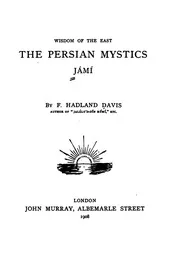
The Persian Mystics: Jami BY F. Hadland Davis
 76
76

The Persian Mystics: Jami BY F. Hadland Davis



Isolde Whitaker, Sacred Texts Editor: F. Hadland Davis delivers an illuminating exploration of Jami's Sufi legacy, offering a scholarly yet accessible gateway into Persian mysticism. The book excels in its lucid exposition of complex spiritual concepts, demystifying the esoteric language of Sufism for a Western audience. Davis's insightful analysis unearths the profound philosophical underpinnings of Jami's poetry, revealing its enduring relevance. This work is indispensable for students of comparative religion, philosophy, and anyone seeking to understand the ecstatic and contemplative dimensions of Islamic spirituality. Its strength lies in bridging the gap between ancient wisdom and contemporary understanding.
📝 Description
76
F. Hadland Davis's 'The Persian Mystics: Jami' deciphers Sufi thought through Jami's poetry.
This book examines the mystical philosophy of Jami, a significant figure in Persian Sufism. Davis interprets the symbolic language in Jami's poetry, aiming to illuminate his spiritual ideas. The text addresses themes such as divine love, the concept of annihilation (fana), and the experience of the divine presence.
Davis's work aims to make Jami's complex ideas accessible to a wider audience interested in Sufi traditions. It focuses on the poetry as a vehicle for conveying spiritual insights, connecting Jami's teachings to broader spiritual aspirations. The book encourages reflection on metaphysical questions and the personal transformation that can arise from spiritual practice.
Jami (1414–1492) was a prolific poet and scholar in the late Timurid era, often considered the last great classical Persian poet. His work synthesized earlier Sufi traditions, including those of Ibn Arabi and Rumi, with orthodox Islamic scholarship. Davis's analysis centers on how Jami's verses expressed complex Sufi doctrines, such as the unity of existence (wahdat al-wujud) and the path to spiritual realization, making his poetry a key text for understanding later Persian mysticism.
💡 Why Read This Book?
Delve into the soul-stirring wisdom of Jami, a cornerstone of Persian Sufism. This book offers profound insights into divine love, spiritual annihilation, and the ecstatic path to union with the Absolute. Ideal for seekers of esoteric knowledge, scholars of mysticism, and practitioners yearning for deeper contemplative practice, it provides a rich intellectual and spiritual feast.
⭐ Reader Reviews
Honest opinions from readers who have explored this book.
❓ Frequently Asked Questions
Who was Jami?
Abdul Rahman Jami (1414-1492) was a preeminent Persian poet, Islamic mystic, and Sufi saint. He is considered the last great classical poet of Persia and a major figure in Sufi literature, known for his lyrical poetry and philosophical treatises.
What is Sufism?
Sufism is the mystical dimension of Islam, focusing on the inward journey towards God. It emphasizes love, devotion, asceticism, and the purification of the soul to achieve direct experience of the Divine.
What esoteric themes are explored?
The book delves into themes of divine love (ishq), the annihilation of the ego (fana), the eternal return, the nature of the Beloved, and the stages of the spiritual path towards union with God.
Is this book suitable for beginners?
Yes, F. Hadland Davis's clear prose and insightful explanations make the complex ideas of Sufism accessible to those new to the subject, while still offering depth for seasoned practitioners.
What is the philosophical significance of Jami's work?
Jami's work bridges Neoplatonic philosophy with Islamic mysticism, exploring concepts of emanation, the unity of existence, and the dialectic between the temporal and the eternal, offering a profound metaphysical framework.
🔮 Key Themes & Symbolism
The Divine Beloved and Ecstatic Love
At the core of Jami's mystical vision lies the concept of the Divine Beloved, the ultimate object of the Sufi's adoration. This theme explores the transformative power of ecstatic love (ishq), a burning passion that consumes the ego and propels the seeker towards direct communion with the Absolute. Davis illuminates how Jami uses poetic metaphor to express this intense, often paradoxical, relationship, where separation fuels longing and union brings ultimate fulfillment. The exploration looks at the inherent beauty and perfection of the Divine as the source of all existence and the ultimate aspiration of the soul.
Annihilation of the Self (Fana) and Spiritual Journey
This key theme dissects the Sufi concept of fana, or annihilation of the self, a crucial stage in the spiritual ascent. Jami's poetry, as interpreted by Davis, vividly portrays the process of shedding egoic limitations and worldly attachments to make way for the Divine presence. The book details the arduous yet rewarding journey, marked by stages of purification, contemplation, and surrender. It highlights how this dissolution of the individual self is not an end but a profound rebirth, leading to a state of eternal subsistence in God (baqa).
Symbolism and the Veiled Truths of Mysticism
F. Hadland Davis expertly navigates the rich symbolic language employed by Jami to convey esoteric truths. This theme examines how everyday imagery, from the lover and the beloved to wine and intoxication, serves as a vehicle for profound metaphysical concepts. The book deciphers the allegorical nature of Sufi poetry, revealing how these symbols act as keys to unlock hidden layers of meaning, guiding the reader towards a deeper understanding of spiritual realities that transcend ordinary perception. It underscores the idea that true wisdom often lies veiled, accessible only to those who can interpret its symbolic expressions.
💬 Memorable Quotes
Direct passages from the work, attributed to the author.
“The universe is but a mirror reflecting the Divine.”
— This suggests a pantheistic or panentheistic view, where all of creation is infused with divine essence, and through contemplation of the world, one can perceive the face of God.
“To die to self is to live in God.”
— This highlights the core Sufi practice of ego-death (fana), emphasizing that shedding personal desires and limitations is the prerequisite for experiencing true spiritual life and union with the Divine.
“The heart is the throne of the Beloved.”
— This poetic statement signifies that the inner spiritual core of a person, the heart, is where God's presence is most profoundly felt and where true divine intimacy occurs.
“Seek not the truth without, when it resides within.”
— This emphasizes the inward-looking nature of mystical pursuit, directing the seeker to find spiritual knowledge and divine connection not in external phenomena but through introspection and self-realization.
💡 Key Ideas
Editorial paraphrase of the work's core concepts — not direct quotes.
Love is the beginning of the path, its middle, and its end.
This quote captures the centrality of love in Sufism, positing it not merely as an emotion but as the fundamental principle guiding the entire spiritual journey, from initial aspiration to ultimate realization.
🌙 Esoteric Significance
Tradition
This work is deeply rooted in the Sunni Islamic mystical tradition known as Sufism. It explores the esoteric dimension of Islam, focusing on the inward path of spiritual purification, divine love, and direct experiential knowledge of God. Sufism, as presented through Jami's lens, emphasizes the heart as the locus of divine revelation and the transformative power of mystical practices aimed at achieving union with the Absolute.
Symbolism
The esoteric significance of Jami's work, as illuminated by Davis, lies in its body of symbolism. Concepts like the 'wine' of divine love, the 'tavern' of spiritual gathering, and the lover-beloved dynamic are not literal but allegorical representations of profound spiritual states and truths. These symbols serve as keys, unlocking deeper meanings related to ego-annihilation (fana), divine intoxication, and the ecstatic experience of God's presence, guiding the initiated reader towards intuitive understanding.
Modern Relevance
In an age often characterized by materialism and disconnection, Jami's mystical insights offer a powerful counterpoint. The book's exploration of divine love, the quest for inner peace, and the pursuit of authentic selfhood resonates deeply with contemporary seekers. The emphasis on introspection, compassion, and the interconnectedness of all things provides timeless wisdom for reading through the complexities of modern life and fostering a more profound sense of purpose and spiritual fulfillment.
👥 Who Should Read This Book
This volume is an invaluable resource for a diverse readership. **Beginners** in mysticism will find F. Hadland Davis's clear explanations an accessible introduction to the profound world of Sufi thought and Persian poetry. **Scholars** of religion, philosophy, and comparative literature will appreciate the meticulous analysis and historical context. **Spiritual seekers** and **practitioners** of contemplative disciplines will discover a rich source of inspiration, practical guidance, and esoteric wisdom to deepen their own inner journey and understanding of divine love.
📜 Historical Context
F. Hadland Davis's 'The Persian Mystics: Jami' emerges from an era of burgeoning Western interest in Eastern philosophies and religions in the late 19th and early 20th centuries. This period saw scholars and mystics alike seeking to bridge cultural divides through the study of ancient texts and traditions. Jami himself, writing in the 15th century, was a product of the vibrant intellectual and spiritual milieu of Timurid Persia, a time marked by a flourishing of arts, sciences, and Sufi thought. He synthesized earlier Sufi doctrines and poetry, solidifying many concepts that became central to the tradition. Davis’s work, therefore, not only illuminates Jami’s contributions but also reflects the scholarly endeavor to translate and interpret these profound spiritual insights for a global audience, making them accessible and relevant.
📔 Journal Prompts
Reflect on a time you experienced intense love. How did it transform you, and in what ways does it mirror the Sufi concept of divine love?
Consider the idea of 'dying to self.' What aspects of your ego or worldly attachments do you find most challenging to relinquish, and why?
Explore the symbolism of a natural element (e.g., water, fire, light) in your own spiritual understanding. How can it represent deeper truths?
What does 'union with the Divine' mean to you personally? Describe the feeling and the potential implications for your life.
How can the pursuit of inner peace and self-knowledge contribute to a more meaningful existence in the modern world?
🗂️ Glossary
Sufism
The mystical dimension of Islam, focused on the inward journey towards God through love, devotion, and spiritual discipline. It seeks direct experiential knowledge of the Divine.
Fana
An Arabic term in Sufism meaning 'annihilation' or 'extinction.' It refers to the dissolution of the ego and worldly attachments, a crucial stage in the spiritual path towards union with God.
Baqa
The Sufi concept of 'subsistence' or 'permanence' in God, which follows fana. It signifies a state of eternal life in and with the Divine, achieved after the ego has been purified.
Ishq
An Arabic term signifying passionate, intense, and often ecstatic love. In Sufism, it refers to the profound and burning love for God that drives the seeker's journey.
Murid
An Arabic term for a 'seeker' or 'disciple' in Sufism. A murid is one who has pledged allegiance to a spiritual guide and is committed to the path of purification and divine knowledge.
This book appears in 2 collections
🔮 Readers Also Liked
Browse all →







From the “Christian Mysticism” Collection
View all →








More Free Mysticism & Contemplation Books
View all →