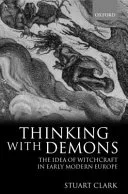
Thinking with Demons
 80
80

Thinking with Demons
Stuart Clark's *Thinking with Demons* offers a compelling argument against viewing early modern demonology as a simple aberration of superstition. By meticulously analyzing the scholarly literature, Clark reveals the intricate intellectual systems that supported belief in demonic agency, demonstrating its rational integration into the broader worldview of the period. He effectively argues that these beliefs were not antithetical to nascent rationalism but often coexisted and even supported it, particularly within legal and theological discourse. A particular strength lies in his detailed exploration of how demonological concepts were applied in practical matters, such as legal trials and medical diagnoses, showcasing a sophisticated, albeit unsettling, intellectual coherence. However, the sheer density of scholarly citations and the intricate philosophical arguments, while laudable for their depth, can make the text challenging for readers less familiar with the specific academic debates of the era. Despite this, the book's reinterpretation of demonology as a rational intellectual construct, rather than a mere fringe belief, stands as a significant contribution to understanding early modern thought. It compels a reassessment of the boundaries between superstition and reason in historical scholarship.
📝 Description
80
Stuart Clark's 1999 book argues that demonology was a rational component of early modern European thought.
Stuart Clark's *Thinking with Demons* reevaluates demonological texts from 15th to 18th century Europe. Published in 1999, the book contends that these beliefs were not simply superstitions but part of a structured intellectual system for many learned individuals. Clark examines scholarly treatises to show how demonic concepts informed contemporary views on law, medicine, theology, and natural philosophy. He argues against viewing demonology as separate from emerging rationalism, demonstrating its integration within legal and theological debates of the era.
The work situates demonology within the intellectual currents of the Renaissance, Reformation, and Scientific Revolution. It highlights how figures like Jean Bodin and Martin Antoine Delrio engaged with these ideas as a serious academic pursuit. By analyzing this intellectual framework, Clark sheds light on the anxieties surrounding witchcraft and the occult in pre-Enlightenment Europe. The book offers a detailed look at how belief systems were constructed and how knowledge was shaped.
This book engages with the history of Western esotericism by examining how ideas about the demonic were systematically incorporated into the intellectual life of early modern Europe. It challenges the common perception of demonology as purely superstitious by demonstrating its role within the established academic disciplines of the time, such as theology, natural philosophy, and even law. Clark's work reveals that the study of demons was, for many scholars, an attempt to understand and categorize perceived forces influencing the natural and spiritual worlds, placing it within a broader historical context of attempts to map and control unseen realities.
💡 Why Read This Book?
• Gain an understanding of how demonology functioned as a rational intellectual system in early modern Europe, challenging simplistic views of superstition, as explored through the scholarly debates of the 15th to 18th centuries. • Uncover the systematic integration of demonic concepts into legal, medical, and theological frameworks, revealing their practical application and impact on society, exemplified by figures like Jean Bodin. • Reframe your perception of intellectual history by seeing how seemingly irrational beliefs were logically constructed and defended by learned individuals, altering how you view the progression of thought before the Enlightenment.
⭐ Reader Reviews
Honest opinions from readers who have explored this book.
❓ Frequently Asked Questions
What is the main argument of Stuart Clark's *Thinking with Demons*?
The book argues that early modern demonology, far from being mere superstition, was a rational and systematic intellectual construct integrated into the worldview of European scholars between the 15th and 18th centuries.
Who were the key figures discussed in relation to demonology in the book?
The work engages with prominent thinkers and writers of the period who published on demonology, including figures like Jean Bodin and Martin Antoine Delrio, examining their systematic approaches.
How does *Thinking with Demons* relate to the history of science?
It demonstrates how demonological beliefs were systematically linked with natural philosophy and scientific inquiry of the time, showing that the perceived separation between 'rational' science and 'superstitious' belief was not always clear-cut.
What is the period covered by *Thinking with Demons*?
The book primarily covers the intellectual history of early modern Europe, focusing on the period from the 15th century through the 18th century.
Does the book suggest demonology was a unified field of study?
While exploring the systematic nature of demonological thought, the book also implicitly highlights the diverse interpretations and debates among scholars regarding demonic influence and its manifestations.
What is the significance of demonology as an intellectual pursuit in early modern Europe, according to Clark?
Clark posits that demonology was a crucial part of the intellectual landscape, used to explain phenomena, establish moral order, and engage with theological and legal questions of the era.
🔮 Key Themes & Symbolism
Demonology as Rational System
Clark meticulously dismantles the notion that demonology was solely a matter of popular superstition. He demonstrates how learned individuals in early modern Europe, from the 15th to the 18th centuries, constructed sophisticated intellectual systems to understand and categorize demonic activity. This involved detailed treatises on the nature of demons, their powers, methods of influence (like pacts and possession), and their interactions with the human world. These scholars applied principles of logic and scholarship to these topics, integrating them into broader philosophical and theological frameworks, thereby rendering demonology a seemingly rational pursuit within its own context.
Integration with Legal and Medical Thought
A core theme is how demonological concepts were systematically woven into the fabric of early modern legal and medical practices. The book illustrates that accusations of witchcraft and beliefs in demonic possession were not peripheral but were often addressed within established juridical procedures and medical theories. Scholars debated the signs of possession, the legal status of individuals in league with demons, and the appropriate remedies. This integration shows how the perceived reality of the demonic profoundly influenced societal structures and the administration of justice and health during this period.
Intellectual History of Early Modern Europe
This work serves as a vital contribution to understanding the intellectual currents of early modern Europe. It challenges linear narratives of progress towards secular rationalism by showing the complex interplay between emerging scientific thought and deeply ingrained religious and metaphysical beliefs. Clark reveals how a coherent worldview, which included a sophisticated understanding of the demonic, was maintained by many intellectuals, shaping their perception of reality, morality, and the divine. The book highlights the intellectual frameworks that underpinned witch hunts and other phenomena.
The Scholarly Apparatus of Demonology
Clark focuses on the publications and writings of the era's scholars, rather than popular folklore. He examines the scholarly apparatus that supported demonology, including the categorization of demons, the analysis of pacts, and the theological justifications for belief. This approach allows him to reconstruct the intellectual landscape where figures like Jean Bodin and Martin Antoine Delrio engaged in serious academic discourse about the infernal. The emphasis is on the learned tradition and its systematic articulation.
💬 Memorable Quotes
Direct passages from the work, attributed to the author.
“The work explores how demonological beliefs were not antithetical to rationalism but often integrated with it.”
— This concept highlights Clark's central thesis: that early modern intellectuals did not necessarily see a conflict between their developing rational faculties and their belief in demonic forces. Instead, these beliefs were often part of a coherent, albeit unsettling, worldview.
“Demonology was often a tool for understanding law, medicine, and theology.”
— This interpretation points to the practical application of demonological theories. It suggests that concepts of the demonic were not abstract curiosities but were actively employed to explain phenomena and establish frameworks within key academic and societal disciplines of the period.
“Learned demonology provided a systematic framework for explaining the world.”
— This emphasizes the intellectual rigor Clark attributes to demonological studies. It suggests that scholars approached the subject with a systematic methodology, attempting to categorize and explain demonic activity in a structured manner, akin to other academic disciplines.
“The intellectual and cultural history of early modern Europe is illuminated by examining its demonological discourse.”
— This highlights the book's contribution to broader historical understanding. By focusing on demonology, Clark suggests, we gain crucial insights into the anxieties, beliefs, and intellectual structures that shaped early modern European society and culture.
💡 Key Ideas
Editorial paraphrase of the work's core concepts — not direct quotes.
The book challenges the idea that belief in demons was purely superstitious and irrational.
This paraphrase underscores Clark's reinterpretation of the subject. He argues against a simplistic dismissal of demonology, proposing instead that it possessed an internal logic and rationality that made it acceptable and even necessary for many intellectuals of the era.
🌙 Esoteric Significance
Tradition
While not strictly adhering to a single esoteric lineage, *Thinking with Demons* engages with the broader Western Hermetic tradition and its historical manifestations. The intellectual frameworks examined, particularly those concerning correspondences between the celestial and terrestrial realms, the nature of spirits, and the interpretation of hidden forces, echo themes found in Neoplatonism and Kabbalistic thought. Clark's work can be seen as analyzing the intellectual underpinnings of belief systems that, in their historical context, often blurred the lines between philosophy, theology, and what we now categorize as esoteric knowledge.
Symbolism
The primary 'symbol' explored is the demon itself, not as a mere caricature but as a complex entity within an intellectual system. Demons represented forces of chaos, temptation, and opposition to divine order, but also, paradoxically, agents that could be understood, categorized, and sometimes even harnessed through specific rituals or knowledge. The pact with the devil, a recurring motif, symbolizes the ultimate transgression and the perceived rational choice by an individual to align with infernal powers for perceived gain.
Modern Relevance
Contemporary occult and esoteric studies continue to draw on Clark's work for its nuanced understanding of historical belief systems. Thinkers and practitioners exploring ceremonial magic, demonolatry, or comparative demonology find value in his detailed analysis of how these concepts were historically systematized. The book's emphasis on the psychological and intellectual dimensions of belief is relevant to modern psychological approaches to magic and the occult, as well as to scholars investigating the persistence of such ideas in contemporary subcultures.
👥 Who Should Read This Book
• Students of early modern European history seeking to understand the intellectual underpinnings of witchcraft beliefs and the era's worldview, moving beyond simplistic interpretations. • Scholars of the history of science and philosophy interested in how 'unscientific' concepts were rigorously debated and integrated into contemporary rational frameworks. • Practitioners and researchers of Western esoteric traditions looking for a scholarly analysis of the historical development and intellectual justification of demonological concepts.
📜 Historical Context
Published in 1999, Stuart Clark's *Thinking with Demons* arrived at a time when the intellectual history of early modern Europe was being re-examined, moving beyond teleological narratives of progress. The book engages with the period between the 15th and 18th centuries, a time of immense intellectual upheaval, marked by the Renaissance, Reformation, and the nascent Scientific Revolution. This era saw intense scholarly debate on subjects ranging from theology and law to natural philosophy, often intertwined. Clark specifically situates his work against the backdrop of thinkers like Jean Bodin, whose *Daemonomanie des sorciers* (1580) exemplifies the serious scholarly engagement with witchcraft and demons. He implicitly contrasts his approach with earlier historiography that might have simply dismissed such beliefs as irrational, instead demonstrating their rational integration within contemporary intellectual systems. The work highlights how demonology was a key component of learned discourse, shaping legal frameworks and philosophical inquiries, rather than a purely marginal or superstitious phenomenon.
📔 Journal Prompts
The systematic construction of demonological arguments in the 15th-18th centuries.
The integration of demonic agency into early modern legal proceedings.
Comparing the scholarly discourse on demons with modern psychological interpretations of belief.
The role of learned demonology in shaping societal anxieties about the supernatural.
How early modern intellectuals reconciled belief in God with belief in active demonic forces.
🗂️ Glossary
Demonology
The systematic study of demons and their activities. In early modern Europe, it was a scholarly discipline concerned with the nature, hierarchy, powers, and influence of demonic beings.
Pact with the Devil
A formal agreement, often believed to be made by a witch or sorcerer, in which the individual renounced God and pledged service to the Devil in exchange for supernatural powers or knowledge.
Possession
The state of being inhabited or controlled by a demon or evil spirit. Early modern medical and theological texts extensively debated the signs and causes of demonic possession.
Natural Philosophy
The historical term for the study of nature and the physical universe, essentially the precursor to modern science. It encompassed a wide range of inquiries into the workings of the world.
Witchcraft
The practice of magic, especially malevolent magic. In early modern Europe, witchcraft was often understood as a crime involving a pact with the Devil and the use of supernatural powers.
Treatise
A formal and systematic written discourse on a specific subject, often scholarly or didactic in nature. Many early modern demonological works took the form of treatises.
Intellectual History
The study of the history of ideas and how they have influenced human thought and culture. Clark's work is a significant contribution to this field concerning early modern Europe.