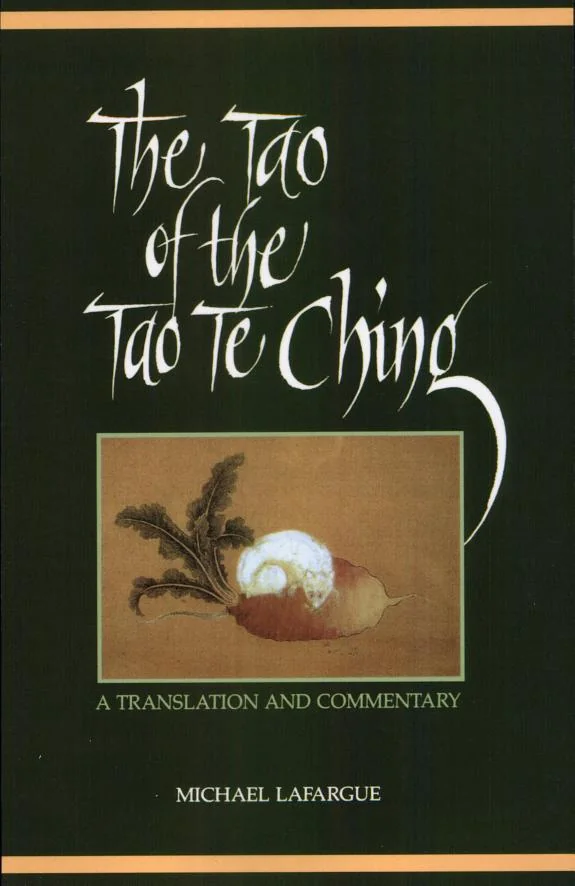
The Tao of the Tao Te Ching
 83
83

The Tao of the Tao Te Ching
Michael LaFargue’s re-evaluation of the Tao Te Ching, presented in "The Tao of the Tao Te Ching," challenges prevailing notions by framing the "Tao" as a specific, cultivated spiritual state rather than an abstract principle. LaFargue compellingly argues for a historically situated understanding of this state, linked to a particular ancient Chinese school. The strength of this work lies in its rigorous historical analysis and its attempt to connect spiritual practice to concrete lifestyle and political theory, moving beyond poetic metaphor. However, the limitation is that by focusing intensely on this specific school, it might inadvertently sideline other valid interpretations of the text that have informed centuries of practice and thought. A particularly illuminating section discusses the "wu wei" (non-action) not as passivity, but as an effective, non-interfering mode of action rooted in this cultivated mental state. LaFargue’s interpretation offers a valuable, if focused, lens through which to reconsider this foundational text.
📝 Description
83
Michael LaFargue argues in 1992 that the Tao of the Tao Te Ching was a specific mental state, not just a cosmic force.
Michael LaFargue's 1992 work, "The Tao of the Tao Te Ching," offers a novel interpretation of the ancient Chinese text. LaFargue contends that the "Tao" discussed is not simply an abstract philosophical idea or a universal energy. Instead, he proposes it represents a concrete spiritual state of mind that could be cultivated. This mental discipline, he asserts, was nurtured within a particular school of thought in ancient China. This cultivated state, in turn, influenced a specific way of life and a subtle yet effective approach to governance.
This book is valuable for anyone desiring a more historically informed grasp of the Tao Te Ching. It will appeal to scholars of Chinese philosophy, students of comparative religion, and practitioners of Eastern spiritual traditions looking for readings beyond the superficial. Those interested in how spiritual development connects with everyday living and leadership will find LaFargue's arguments engaging. The central thesis centers on the "Tao" as an achievable mental discipline, an inner disposition that is developed. This perspective contrasts with views that see it only as the ineffable Way of the cosmos. LaFargue also examines how this state manifested in practice: a simple, fulfilling life and a restrained, effective leadership style. The book illustrates the connections between these elements, all originating from the core spiritual practice.
This book engages with the Tao Te Ching, a foundational text within Taoism, a tradition often viewed through an esoteric lens. LaFargue's focus on a specific, attainable mental state connects with practices found in various contemplative traditions, including certain schools of Gnosticism that explore inner knowledge and spiritual transformation. By grounding these concepts in a socio-historical context rather than purely metaphysical speculation, LaFargue bridges the gap between esoteric spiritual disciplines and their practical application in life and governance, offering a unique perspective on a text rich with both philosophical and spiritual depth.
💡 Why Read This Book?
• You will learn to understand "Tao" not just as an abstract concept, but as a specific, cultivated spiritual state of mind, as explored by LaFargue in his analysis of ancient Chinese schools. • You will gain insight into how this cultivated mental state directly influenced practical aspects of life, such as lifestyle choices and political leadership, as detailed in the text's commentary. • You will appreciate the historical grounding of LaFargue's 1992 interpretation, understanding how it seeks accuracy by examining the text within its original socio-historical and intellectual milieu.
⭐ Reader Reviews
Honest opinions from readers who have explored this book.
❓ Frequently Asked Questions
What is Michael LaFargue's central thesis regarding the 'Tao' in the Tao Te Ching?
LaFargue's core argument is that 'Tao' refers to a specific spiritual state of mind cultivated within a particular ancient Chinese school, influencing lifestyle and leadership, rather than solely an abstract cosmic principle.
When was Michael LaFargue's translation and commentary on the Tao Te Ching first published?
Michael LaFargue's "The Tao of the Tao Te Ching" was first published on January 17, 1992.
How does LaFargue's interpretation differ from traditional understandings of the Tao Te Ching?
Unlike interpretations focusing on the Tao as an ineffable cosmic force, LaFargue emphasizes it as an attainable, cultivated mental and spiritual discipline with practical applications.
What historical period is relevant to LaFargue's interpretation of the Tao Te Ching?
LaFargue's interpretation is rooted in ancient China, specifically referencing a school of thought believed to have existed during the classical period when the Tao Te Ching was formulated.
What is the significance of 'wu wei' according to LaFargue's commentary?
LaFargue interprets 'wu wei' (non-action) not as idleness, but as a sophisticated form of effective action that arises from a state of mental clarity and non-interference, informed by the cultivated Tao.
Who is Lao Tzu (Laozi) in relation to the Tao Te Ching?
Lao Tzu (Laozi) is traditionally credited as the author of the Tao Te Ching, a foundational text of Taoism, though his historical existence and the text's precise authorship are subjects of scholarly debate.
🔮 Key Themes & Symbolism
Tao as Cultivated State
LaFargue's central thesis reframes the Tao not as an unknowable cosmic principle, but as a specific, attainable spiritual and mental state. This perspective suggests that the practices and teachings within the Tao Te Ching were designed to cultivate this inner disposition. The work explores how this cultivated state leads to a particular way of perceiving the world and interacting with it, emphasizing inner harmony and clarity over external imposition. This interpretation invites readers to consider the text as a guide to psychological and spiritual transformation through disciplined mental cultivation.
Lifestyle and Leadership
Beyond individual spiritual cultivation, LaFargue connects the concept of the Tao to practical expressions in daily life and governance. The 'simple but satisfying life-style' mentioned is presented as a natural outflow of the cultivated Taoist mind, characterized by contentment, minimal desire, and harmony with natural rhythms. Similarly, the 'low-key but effective style of political leadership' reflects an approach of non-interference ('wu wei') and subtle guidance, demonstrating how inner mastery translates into external effectiveness without force. This theme highlights the holistic nature of Taoist practice.
Historical Accuracy
A significant aspect of LaFargue's work is its commitment to historical accuracy. By positing the Tao as a state cultivated within a specific ancient Chinese school, he grounds his interpretation in a particular historical and intellectual context. This approach seeks to move beyond anachronistic readings or purely philosophical abstractions. The commentary aims to reconstruct the original intent and practice associated with the text, offering a perspective that is both historically informed and relevant to understanding the genesis of Taoist thought and practice.
Spiritual Depth
Despite its focus on historical and practical dimensions, LaFargue's interpretation aims to convey the profound spiritual depth of the Tao Te Ching. By understanding the Tao as a cultivated state of mind, readers can better grasp the text's guidance on achieving inner peace, wisdom, and alignment with fundamental principles. The work suggests that the 'spiritual depth' lies not in mystery, but in the profound transformation possible through dedicated inner work and the adoption of a Tao-aligned perspective on existence.
💬 Memorable Quotes
Direct passages from the work, attributed to the author.
“The Tao is a spiritual state of mind cultivated in a particular school in ancient China.”
— This statement captures LaFargue's core argument, presenting the Tao not as an abstract universal principle, but as a specific, achievable inner condition fostered through dedicated practice within a historical lineage.
“This state of mind also expressed itself in a simple but satisfying life-style.”
— This highlights the practical application of the cultivated Taoist mindset, suggesting that inner harmony naturally leads to contentment and a life lived in accordance with natural rhythms, free from excessive striving.
“And in a low-key but effective style of political leadership.”
— This points to the outward manifestation of the Taoist state in governance, advocating for leadership that is subtle, non-interfering, and ultimately more effective than forceful or overt methods.
“The interpretation offered here is not only historically accurate...”
— This asserts the scholarly rigor behind LaFargue's work, emphasizing a commitment to understanding the Tao Te Ching within its original historical and cultural context, rather than through later philosophical overlays.
“...but also conveys the spiritual depth of the Tao Te Ching.”
— This suggests that LaFargue's historically grounded interpretation does not diminish, but rather enhances, the profound spiritual and psychological insights offered by the ancient text.
🌙 Esoteric Significance
Tradition
While not directly aligning with Western esoteric traditions like Hermeticism or Kabbalah, LaFargue's work engages with the spiritual and psychological dimensions often explored within esoteric philosophy. His focus on a 'spiritual state of mind' and its cultivation echoes practices found in various contemplative traditions, including some Gnostic and mystical paths that emphasize inner transformation. It departs from purely philosophical or religious categorizations by focusing on the psychology and practice of attaining a specific inner disposition, which is a common thread in many esoteric lineages seeking direct experience of higher realities.
Symbolism
The primary symbolic element LaFargue addresses is the 'Tao' itself, reinterpreted as a cultivated mental state. Beyond this, the text implicitly deals with symbols of simplicity and naturalness, often associated with Taoism. Concepts like 'wu wei' (non-action) function symbolically, representing a state of effortless efficacy and alignment with natural forces, contrasting with the symbolic representation of forceful, artificial intervention. The 'simple but satisfying life-style' can also be seen as symbolic of inner contentment and detachment from material excess.
Modern Relevance
LaFargue's interpretation finds resonance in contemporary mindfulness movements, psychological self-help, and leadership studies that emphasize inner states and non-assertive influence. Thinkers and practitioners interested in the practical application of ancient wisdom for modern challenges—whether in personal well-being, stress reduction, or ethical leadership—draw upon such grounded interpretations. His work offers a bridge between classical Chinese philosophy and modern cognitive and behavioral sciences, suggesting that ancient practices hold keys to contemporary issues of mental health and effective, harmonious action.
👥 Who Should Read This Book
• Students of comparative religion and philosophy: To understand a specific, historically-grounded interpretation of a foundational Eastern text and its place within broader spiritual discourse. • Practitioners of meditation and mindfulness: To explore how ancient traditions conceptualized and cultivated specific states of consciousness with practical applications for daily life. • Scholars of ancient Chinese history and culture: To gain insight into potential socio-historical interpretations of early Taoist schools and their influence on lifestyle and governance.
📜 Historical Context
Michael LaFargue's "The Tao of the Tao Te Ching," published in 1992, emerged during a period of intense academic and popular interest in Eastern philosophies. The Tao Te Ching, traditionally attributed to Lao Tzu (Laozi) and dating to the 4th century BCE, had long been a subject of diverse interpretations, ranging from mystical cosmology to political allegory. LaFargue's work positioned itself against purely metaphysical or literary readings, advocating instead for a socio-historical understanding. He proposed that the "Tao" represented a specific spiritual state cultivated within a particular school, influencing lifestyle and governance. This approach engaged with scholarship seeking to contextualize ancient Chinese thought within its original social and psychological frameworks. While figures like Fung Yu-lan had previously explored Chinese philosophy's historical development, LaFargue focused on the experiential and psychological dimensions of early Taoist practice. His work contributed to a broader trend of re-examining classical texts through lenses informed by anthropology and psychology, seeking to understand their lived reality rather than solely their abstract doctrines.
📔 Journal Prompts
The cultivated Taoist mind as a 'spiritual state of mind': How does this concept differ from abstract philosophical ideals?
Reflect on the 'simple but satisfying life-style' described. What elements might be relevant today?
Consider the 'low-key but effective style of political leadership.' What are its potential benefits and drawbacks?
LaFargue's focus on a specific ancient Chinese school: How does this historical grounding impact the interpretation of the Tao Te Ching?
The connection between inner state and outer action: Explore examples beyond leadership.
🗂️ Glossary
Tao
In LaFargue's interpretation, not solely the ineffable Way of the universe, but a specific spiritual state of mind cultivated in ancient China, influencing one's life and actions.
Lao Tzu (Laozi)
The sage traditionally credited with authoring the Tao Te Ching. His historical existence is debated, but he represents the foundational figure of Taoism.
Wu Wei
Literally 'non-action' or 'effortless action.' LaFargue interprets it as a subtle, effective mode of acting in alignment with natural principles, free from force or artificiality.
Spiritual State of Mind
A core concept in LaFargue's work, referring to a specific, cultivated inner disposition or psychological condition achieved through practice, central to understanding the Tao Te Ching.
Ancient Chinese School
Refers to a specific, historically situated group or lineage in ancient China to which LaFargue attributes the cultivation and transmission of the Taoist spiritual state of mind.
Life-style
In the context of the Tao Te Ching commentary, refers to the practical, daily way of living that naturally arises from cultivating the Taoist spiritual state.
Political Leadership
The style of governance discussed, characterized by subtlety, non-interference, and effectiveness, seen as a consequence of embodying the cultivated Taoist mindset.
This book appears in 1 collection
🔮 Readers Also Liked
Browse all →







From the “Taoism” Collection
View all →


More Free Esoteric History & Biography Books
View all →