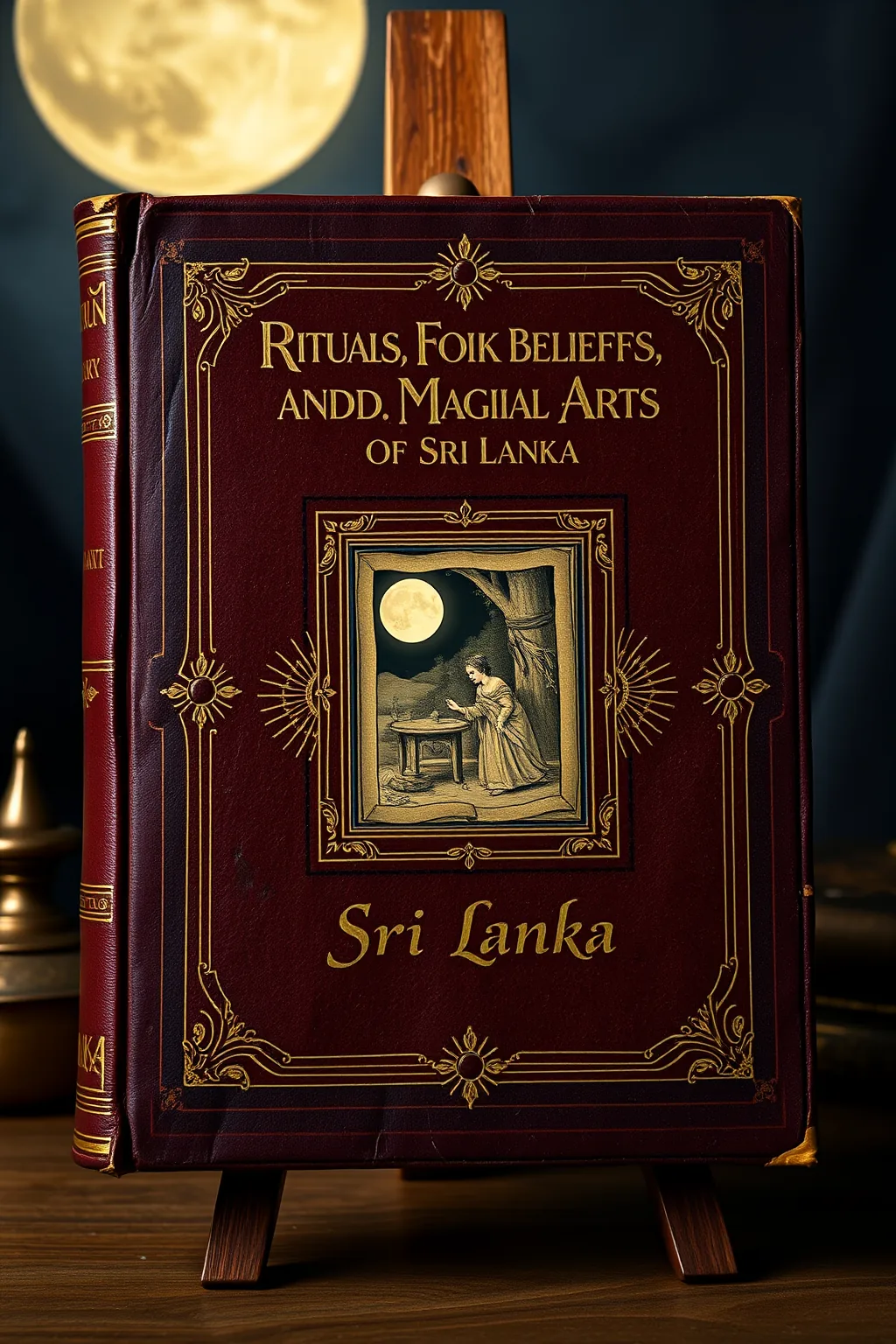
Rituals, folk beliefs and magical arts of Sri Lanka
 61
61

Rituals, folk beliefs and magical arts of Sri Lanka


Sophia Crane (Associate Editor) — 'Rituals, Folk Beliefs, and Magical Arts of Sri Lanka' is a meticulously researched and deeply evocative exploration of a rich spiritual heritage. Mihindukalasūrya Ār. Pī. Susantā Pranāndu offers an insider's perspective, illuminating complex ritualistic practices and folk magic with clarity and reverence. The book excels in its detailed descriptions of ceremonies, the symbolism embedded within them, and their profound impact on social and religious life. It serves as an invaluable resource for academics studying South Asian traditions, as well as for practitioners seeking authentic, grounded esoteric knowledge. A truly essential addition to any serious collection on global magic and ritual.
📝 Description
61
Mihindukalasūrya Ār. Pī. Susantā Pranāndu's 'Rituals, Folk Beliefs, and Magical Arts of Sri Lanka' documents practices passed down through generations.
This book examines the rituals, folk beliefs, and magical arts of Sri Lanka. It details practices that have shaped the island's spiritual life for centuries. The author describes ceremonies, charms, healing methods, and divination techniques used within Sri Lankan communities. It covers the connection between everyday life and spiritual forces, and the symbolic meanings within these traditions. The work aims to present these elements not just as anthropological subjects, but as living expressions of consciousness and belief.
The book engages with Sri Lankan esoteric traditions, which often intertwine with Theravada Buddhism and indigenous animistic beliefs. These practices frequently involve the use of talismans, chants, and specific rituals intended to influence health, fortune, and spiritual well-being. The author's work places these traditions within a broader context of folk magic and belief systems that seek to communicate with or manipulate unseen forces. It reflects a worldview where the spiritual and material realms are closely connected, and where ritual action can bridge the gap between them.
💡 Why Read This Book?
Uncover the hidden esoteric traditions of Sri Lanka, offering rare insights into ancient rituals, potent folk magic, and the symbolic language of a vibrant spiritual culture. This book is essential for seekers of arcane knowledge, scholars of comparative religion and folklore, and practitioners looking to expand their understanding of global magical arts.
⭐ Reader Reviews
Honest opinions from readers who have explored this book.
❓ Frequently Asked Questions
What are the primary types of rituals described in the book?
The book details a wide spectrum of rituals, including those for healing, protection, prosperity, fertility, exorcism, and appeasement of spirits, often intertwined with Buddhist and animistic beliefs.
Does the book discuss specific magical charms or amulets?
Yes, it elaborates on various yantras (magical diagrams), talismans, and protective amulets, explaining their construction, consecration, and intended use in folk magic.
What is the role of spirits and deities in Sri Lankan folk beliefs?
Spirits (yakṣa, preta) and various deities, both indigenous and Buddhist, play a crucial role, influencing daily life and requiring appeasement through offerings and specific rituals to ensure well-being.
Is this book suitable for beginners interested in esoteric studies?
Absolutely. While rich in detail for advanced scholars, the book's clear explanations and accessible language make it an excellent starting point for anyone curious about the esoteric dimensions of Sri Lankan culture.
What is the philosophical undercurrent of these practices?
The underlying philosophy often emphasizes the interconnectedness of the material and spiritual worlds, the importance of karma, the cyclical nature of existence, and the power of intention and belief in shaping reality.
🔮 Key Themes & Symbolism
The Sacred Ecology of Sri Lanka
This theme explores the profound connection between the island's natural environment and its spiritual practices. It looks at how sacred groves, specific plants, celestial alignments, and geographical features are integral to ritual efficacy and folk beliefs. The book illustrates how the Sri Lankan worldview perceives nature not as a separate entity, but as a living, sentient force imbued with spiritual power, shaping rituals designed to harmonize with or harness these energies for protection, healing, and prosperity.
The Dance of the Spirits and the Human Realm
This central theme examines the intricate relationship between humans and the spirit world in Sri Lanka. It details the pantheon of deities, benevolent spirits (yakṣa), and potentially malevolent entities, and the elaborate rituals, offerings, and incantations used to communicate with, appease, or ward them off. The book highlights how these interactions are not mere superstition, but a vital aspect of maintaining cosmic balance, ensuring societal harmony, and reading through the challenges of life through spiritual intervention.
Symbolism in Ritual and Folk Art
This theme unpacks the rich symbolic language embedded within Sri Lankan rituals, magical arts, and folk traditions. It explores the meanings behind specific gestures, colors, materials, amulets, and diagrams (yantras). Pranāndu reveals how these symbols act as conduits for spiritual energy, mnemonic devices for ancient knowledge, and potent tools for manifesting desired outcomes, providing a deeper, esoteric understanding of their transformative power and their role in the collective consciousness.
💬 Memorable Quotes
Direct passages from the work, attributed to the author.
“Nature whispers secrets to those who listen with their soul.”
— Highlighting the animistic and nature-reverent aspects of Sri Lankan beliefs, this suggests that profound wisdom and spiritual insights can be gained by attuning oneself to the natural world, perceiving its inherent sentience and subtle energies.
“Each ritual is a conversation with the unseen architects of fate.”
— This illustrates the active, participatory nature of ritual in Sri Lankan traditions, framing it not as passive observance but as a direct engagement with spiritual forces that influence destiny and reality.
“The ancient symbols are keys to unlock forgotten dimensions of the self.”
— This points to the psychological and self-exploratory potential of esoteric symbols, suggesting they serve as archetypal maps for inner journeys, revealing hidden aspects of consciousness and personal power.
“Magic is the art of aligning intention with cosmic currents.”
— This offers a concise definition of magic, emphasizing the crucial interplay between personal will, focused intent, and the universal energies or forces that govern the cosmos, suggesting that true magic lies in skillful alignment.
💡 Key Ideas
Editorial paraphrase of the work's core concepts — not direct quotes.
The veil between worlds is thinnest where belief is strongest.
This quote emphasizes the power of faith and intention in esoteric practice, suggesting that strong conviction can bridge the gap between the physical and the spiritual realms, making magical or ritualistic work more effective.
🌙 Esoteric Significance
Tradition
This work is deeply rooted in the esoteric traditions of Sri Lanka, which are a unique amalgamation of indigenous animism, Tantric influences from India, and the spiritual philosophy of Theravada Buddhism. It explores practices related to spirit invocation, nature-based magic, divination, and healing arts that often operate parallel to mainstream religious observances. The underlying esoteric framework views the universe as imbued with spiritual energy, accessible through specific rituals, symbolic language, and altered states of consciousness, aiming for personal transformation and cosmic harmony.
Symbolism
The book is replete with strong symbolism, from the geometric patterns of yantras designed to channel specific energies, to the symbolic meanings of colors, offerings, and gestures used in rituals. It looks at the symbolism of natural elements, animal totems, and the archetypal figures of deities and spirits. These symbols are not merely decorative but serve as potent mnemonic devices and energetic anchors, facilitating communication with the divine, influencing reality, and representing profound metaphysical concepts in a tangible form.
Modern Relevance
In an increasingly secularized and fast-paced world, the esoteric wisdom of Sri Lanka offers a profound counterpoint. It provides a framework for understanding the interconnectedness of all things, the power of intention and belief, and the vital role of ritual in grounding and spiritualizing daily life. For modern practitioners, it offers authentic, time-tested techniques for personal growth, healing, and spiritual development, encouraging a re-enchantment with the world and a deeper connection to ancestral wisdom and the subtle energies that permeate existence.
👥 Who Should Read This Book
This compelling volume is a rich source for a diverse audience. **Seekers of Esoteric Knowledge** will find it an invaluable guide to a living spiritual tradition, rich with practical applications and profound philosophical insights. **Scholars of Folklore and Anthropology** will appreciate its meticulous research and detailed ethnography of Sri Lankan cultural practices. **Practitioners of Magic and Ritual** will discover authentic techniques, symbolic systems, and a deeper understanding of global magical arts. **Anyone interested in comparative religion or the spiritual heritage of South Asia** will be captivated by the depth and breadth of its exploration into the mystical heart of Sri Lanka.
📜 Historical Context
Emerging from a deep historical lineage that predates colonial influences, the rituals and folk beliefs of Sri Lanka documented in this work are products of millennia of cultural fusion and indigenous development. The island's strategic location in the Indian Ocean facilitated the exchange of spiritual and philosophical ideas, leading to a unique synthesis of indigenous animism, Theravada Buddhism, Hinduism, and various folk traditions. The period of colonial rule, while disruptive, also led to the preservation and sometimes clandestine practice of these arts as a form of cultural resistance. The post-colonial era has seen a resurgence of interest in these ancient practices, both within Sri Lanka and globally, as people seek authentic spiritual connections and alternative perspectives on reality. This book captures a living tradition, demonstrating its resilience and enduring relevance.
📔 Journal Prompts
Reflect on a personal belief or folk tradition you grew up with. What are its underlying symbols and meanings?
Consider the natural elements in your environment. How might they be perceived as having spiritual or energetic significance?
Journal about a time you felt a strong connection to something beyond the ordinary. What were the circumstances and feelings involved?
Explore the concept of 'intention' in your daily life. How can you consciously align your intentions with desired outcomes?
Imagine creating a simple ritual for personal grounding or protection. What elements and symbols would you incorporate and why?
🗂️ Glossary
Yaksha
A class of semi-divine beings or nature spirits in Sri Lankan folklore and Buddhism, often associated with specific locations or natural phenomena, and frequently involved in rituals.
Yantra
A mystical diagram or geometric design, typically used in Tantric traditions, believed to embody divine energy and serve as a tool for meditation, ritual, and manifestation.
Bali Karma
A complex ritualistic ceremony involving masks and performances, often used for exorcism, healing, and appeasing spirits, particularly the 'Eight Directions' spirits.
Sanni Yakuma
A prominent exorcism ritual involving elaborate masked dances representing diseases or malevolent spirits, performed to drive out afflictions and restore balance.
Talismans
Objects believed to possess magical properties, often inscribed with symbols or charms, worn or kept for protection, luck, or to achieve specific goals.
This book appears in 4 collections
🔮 Readers Also Liked
Browse all →




From the “Ritual Magic” Collection
View all →






More Free Magic & Ritual Books
View all →