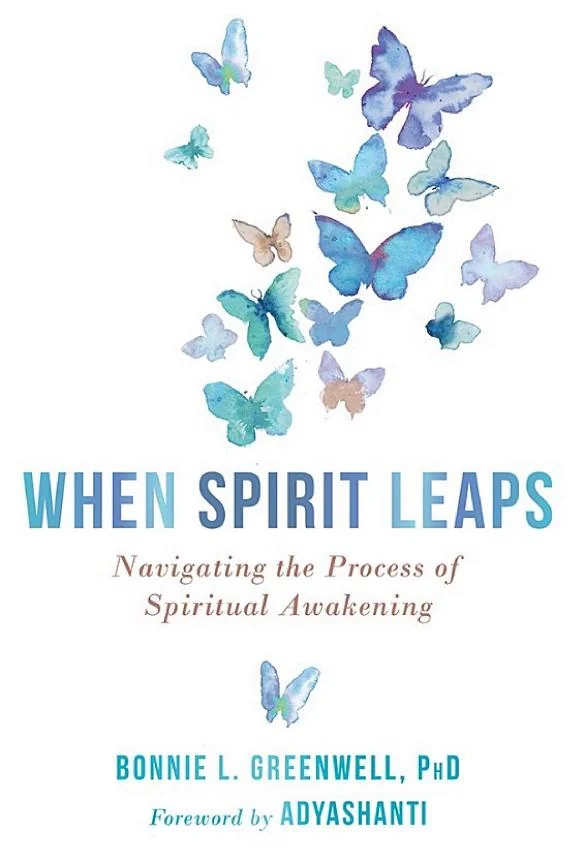
When Spirit Leaps
 71
71

When Spirit Leaps
Bonnie L. Greenwell’s *When Spirit Leaps* offers a refreshingly grounded perspective on spiritual awakening, moving beyond New Age platitudes to engage with the lived reality of profound consciousness shifts. Her background as a transpersonal psychologist lends a clinical rigor to her observations, particularly evident in the detailed case studies that form the backbone of the work. The book excels in mapping out the diverse "portals of awakening," providing readers with a vocabulary and framework for understanding their own experiences. One particular strength is Greenwell's consistent emphasis on integration, offering practical guidance for navigating the often-turbulent aftermath of awakening. However, the sheer breadth of phenomena covered, while comprehensive, can occasionally feel overwhelming, with some readers perhaps desiring deeper dives into specific aspects rather than such a wide survey. The 2018 publication date places it firmly in contemporary discussions of consciousness studies. Ultimately, *When Spirit Leaps* serves as a valuable, empirically informed companion for anyone traversing the unpredictable terrain of spiritual emergence.
📝 Description
71
Bonnie L. Greenwell's 2018 book, When Spirit Leaps, examines spiritual awakening using three decades of clinical data.
Published in 2018, When Spirit Leaps by transpersonal psychologist Bonnie L. Greenwell analyzes spiritual awakening. Greenwell draws on over thirty years of clinical observation and case studies to dissect the phenomenology of spiritual emergence. The book outlines distinct stages and varied paths individuals follow during profound shifts in consciousness. It functions as both an analytical framework and a practical guide for those experiencing these often disorienting, yet ultimately enlightening, transitions.
This work is for a wide audience. It is intended for individuals undergoing spiritual awakening, therapists and counselors wanting to understand client experiences, spiritual directors, and students of comparative religion and transpersonal psychology. Greenwell's inclusive approach acknowledges that spiritual awakening occurs across many cultural and religious traditions. This makes the book relevant for anyone interested in the deeper dimensions of human consciousness and personal change.
When Spirit Leaps contributes to transpersonal studies, a field that bridges psychology and spirituality. It follows thinkers like William James and Carl Jung who explored spiritual experience through a psychological lens. Greenwell's work provides a modern, empirically informed perspective on awakening phenomena. It complements contemporary discussions in the field, offering a detailed view of these transformations.
💡 Why Read This Book?
• Understand the diverse "portals of awakening" as detailed by Greenwell's thirty years of case studies, gaining specific frameworks beyond generic spiritual advice. • Find practical strategies for integrating profound consciousness shifts, a key focus since the book's 2018 publication, offering concrete steps not found in purely theoretical works. • Gain companionship through real-life stories of spiritual emergence, providing relatable narratives and validation for unique personal experiences of awakening.
⭐ Reader Reviews
Honest opinions from readers who have explored this book.
❓ Frequently Asked Questions
What is the primary focus of Bonnie L. Greenwell's "When Spirit Leaps"?
The book primarily focuses on understanding spiritual awakening, its various manifestations, and the process of integrating these profound shifts in consciousness into daily life, drawing on over thirty years of case studies.
When was "When Spirit Leaps" first published, and what is the author's background?
"When Spirit Leaps" was first published on May 1, 2018. The author, Bonnie L. Greenwell, is a transpersonal psychologist and a non-dual teacher with extensive experience in guiding individuals through spiritual emergence.
How does "When Spirit Leaps" address the challenges of spiritual awakening?
The book offers practical solutions and support for the challenges associated with spiritual awakening by examining real-life experiences and providing insights into common difficulties, grounded in clinical observation.
What does the book mean by 'portals of awakening'?
'Portals of awakening' refers to the diverse entry points or triggers through which individuals experience spiritual awakening, ranging from intense personal events to contemplative practices, as explored in the book's case studies.
Is "When Spirit Leaps" specific to any particular spiritual tradition?
No, the book emphasizes that spiritual awakening occurs across all traditions, offering a universal framework that respects and acknowledges the diverse expressions of spiritual emergence found globally.
What kind of support can readers expect from "When Spirit Leaps"?
Readers can expect companionship and validation through shared experiences documented in the book, along with practical guidance derived from Greenwell's thirty years of work with individuals undergoing spiritual shifts.
🔮 Key Themes & Symbolism
Phenomenology of Awakening
Greenwell meticulously documents the subjective experiences of spiritual awakening, moving beyond abstract notions to detail the felt sense, cognitive shifts, and emotional landscapes involved. This phenomenological approach, rooted in her work since the late 1980s, allows readers to recognize and validate their own unusual states of consciousness. The book differentiates between various types of awakening, providing a nuanced map of this often-unpredictable terrain. It highlights how these shifts can manifest across different cultural and religious backgrounds, emphasizing the universal nature of profound inner transformation.
Portals and Processes
The concept of 'portals of awakening' is central, identifying specific triggers or pathways that initiate profound consciousness shifts. These can range from sudden, intense events to gradual unfolding through contemplative practices. Greenwell outlines the 'awakening process,' detailing common phases individuals may encounter, from initial shock and disorientation to eventual integration. This structured yet flexible model, developed over thirty years of observation, offers clarity and a sense of direction for those experiencing the often bewildering journey of spiritual emergence.
Integration and Grounding
A critical aspect of the book is its focus on integrating spiritual awakening experiences into everyday life. Greenwell provides practical advice and coping mechanisms for working through the challenges that arise, such as psychological distress, social isolation, or difficulties in maintaining worldly responsibilities. This emphasis on grounding and practical application distinguishes the work, moving beyond mere description to offer tangible support for individuals seeking to live a balanced life while honoring their expanded consciousness.
Cross-Cultural Perspectives
When Spirit Leaps champions a non-sectarian view of spiritual awakening, asserting its presence across diverse traditions and cultures. Greenwell draws parallels between experiences documented in psychological case studies and those described in mystical literature from various global lineages. This comparative approach underscores the universality of the human drive towards transcendence and the commonalities in the awakening process, regardless of specific belief systems. The book serves as a bridge, connecting psychological inquiry with spiritual exploration.
💬 Memorable Quotes
Direct passages from the work, attributed to the author.
“Awakening is not a static event but a dynamic process that unfolds over time.”
— This interpretation highlights Greenwell's view that spiritual emergence is not a singular moment but an ongoing journey. It suggests that individuals may experience phases of development, challenge, and integration long after an initial shift.
“The body often plays a significant role in spiritual awakening, with physical sensations accompanying psychic events.”
— This emphasizes the psychosomatic nature of profound spiritual experiences, indicating that somatic responses are not merely incidental but integral to the process of awakening as observed over Greenwell's decades of study.
“Understanding the different 'portals' can help explain the onset of spiritual emergence.”
— This suggests that by categorizing the various entry points into spiritual awakening, readers can gain a more rational and less frightening perspective on how these experiences begin, aided by Greenwell's analytical framework.
“Integration is key to working through the challenges of a transformed consciousness.”
— This points to the practical necessity of grounding and assimilation. It implies that the benefits of spiritual awakening are fully realized only when the experience is successfully woven into the fabric of one's ordinary life.
“Spiritual awakening is a natural human potential, not an anomaly.”
— This statement reframes spiritual emergence as an inherent capacity within human beings, challenging the notion that such experiences are rare or pathological, and aligning with a naturalistic understanding of consciousness.
🌙 Esoteric Significance
Tradition
While not strictly adhering to a single esoteric lineage, Greenwell's work draws heavily from the principles of transpersonal psychology, which itself synthesizes elements from Western esoteric traditions, depth psychology, and Eastern contemplative philosophies. It aligns with Gnostic and Hermetic ideas concerning gnosis (direct knowing) and the potential for radical transformation of consciousness. The emphasis on awakening as an inherent human potential also appeals to certain mystical interpretations found across Sufism, Kabbalah, and Advaita Vedanta, positioning it as a bridge between psychological science and perennial spiritual insights.
Symbolism
The book frequently references the "light" or "divine spark" as a symbol of awakened consciousness, a motif common in many mystical traditions signifying illumination and inherent divinity. The concept of "portals" itself acts as a symbolic gateway, representing transitions between ordinary and non-ordinary states of awareness. Furthermore, the recurring theme of integration can be seen as symbolizing the alchemical process of transforming base elements (disorientation, crisis) into a refined substance (balanced, integrated consciousness), a core concept in Western esotericism.
Modern Relevance
Contemporary thinkers and practitioners in fields such as psychedelic-assisted therapy, mindfulness-based interventions, and integral theory often reference Greenwell's work. Her empirical approach to spiritual emergence provides a valuable framework for understanding the psychological impacts of intense spiritual experiences, whether spontaneous or induced. Schools exploring consciousness and personal development, particularly those seeking to bridge psychological and spiritual well-being, find her insights on integration and the phenomenology of awakening highly relevant for guiding clients and students.
👥 Who Should Read This Book
• Individuals actively experiencing spiritual awakening: Gain a comprehensive understanding of your experiences, validation through shared narratives, and practical tools for integration. • Therapists, counselors, and spiritual directors: Acquire a clinically informed framework for understanding and supporting clients undergoing profound consciousness shifts. • Students of transpersonal psychology and comparative religion: Access an empirically grounded exploration of spiritual emergence that synthesizes psychological observation with cross-cultural spiritual phenomena.
📜 Historical Context
Published in May 2018, Bonnie L. Greenwell's *When Spirit Leaps* emerged during a period of sustained academic and popular interest in consciousness studies, transpersonal psychology, and the integration of contemplative practices into Western thought. It builds upon a rich lineage of inquiry into spiritual experiences, tracing roots back to figures like William James, whose work in the early 20th century began to legitimize the study of religious and mystical experiences from a psychological perspective. Greenwell's contribution offers a contemporary, empirically grounded lens, extending the discourse initiated by pioneers like Carl Jung and further developed by contemporary thinkers such as Stanislav Grof. In an intellectual landscape increasingly populated by diverse approaches to altered states, from neuroscience to psychedelic research, Greenwell's work stands out for its focus on spontaneous spiritual emergence and its practical guidance for integration. It navigates a path distinct from purely academic theoretical frameworks, offering a clinician's perspective informed by extensive case studies, thereby providing a valuable resource for both practitioners and individuals undergoing such profound life changes.
📔 Journal Prompts
Reflect on your own 'awakening portals' and their potential impact.
Analyze the described 'awakening process' in relation to your personal journey.
Consider the challenges of integration presented in the case studies.
Explore the cross-cultural parallels of spiritual awakening mentioned.
Examine the role of the body in your own spiritual experiences.
🗂️ Glossary
Spiritual Awakening
A profound and often rapid shift in consciousness characterized by expanded awareness, altered perceptions of reality, and a deep sense of connection or transcendence.
Transpersonal Psychology
A branch of psychology that studies states and experiences beyond the ego or personal identity, including spiritual, mystical, and transcendent aspects of human existence.
Awakening Portals
Specific triggers, events, or practices that initiate or facilitate the process of spiritual awakening, as identified through case study analysis.
Awakening Process
The series of stages, challenges, and transformations an individual typically undergoes during and after a spiritual awakening experience.
Integration
The process of incorporating profound spiritual experiences and insights into one's everyday life, relationships, and sense of self.
Non-Dual Teacher
An individual who guides others toward the understanding or direct experience of non-duality – the absence of fundamental separation between self, others, and reality.
Phenomenology
The philosophical study of the structures of experience and consciousness as experienced from the first-person point of view.
This book appears in 1 collection
🔮 Readers Also Liked
Browse all →









From the “Spiritual Awakening” Collection
View all →









More Free Magic & Ritual Books
View all →