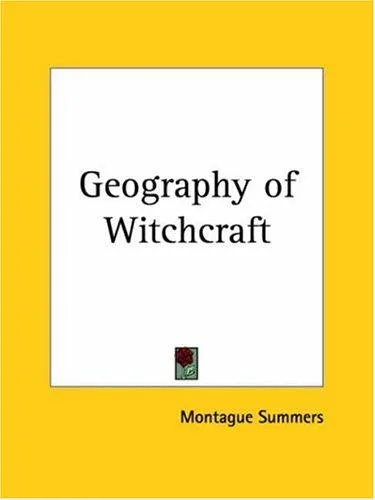
Geography of Witchcraft

 62
62

Geography of Witchcraft


Montague Summers' 'Geography of Witchcraft' stands as a monumental achievement in the study of the occult. With unparalleled scholarly rigor, Summers navigates the dense thickets of historical demonology and folk magic, revealing their interconnectedness. He unearths forgotten rites and illuminates the symbolic language of ancient superstitions, demonstrating how they coalesced into what we now recognize as witchcraft. This work offers profound insights into the psychological and societal forces that fueled belief in the supernatural. It is essential reading for serious occultists, historians of religion, and anyone seeking a comprehensive, authoritative exploration of one of humanity's most persistent and fascinating phenomena. A true cornerstone of esoteric scholarship.
📝 Description
62
Montague Summers published 'Geography of Witchcraft' in 1926, examining the historical spread of magical beliefs.
Montague Summers' 'Geography of Witchcraft' details the historical development and geographical distribution of sorcery and magic. The book traces beliefs and practices from their earliest known origins, connecting them to ancient mythologies and religious systems. Summers investigates how these elements were incorporated into various cultural traditions, including those of Greece, Phoenicia, and Egypt.
He further analyzes the ways in which these magical concepts were later systematized and studied within scholastic frameworks. The work aims to illuminate the underlying human beliefs and archetypes that have informed occult traditions throughout history. It seeks to demonstrate the consistent presence of magical thought across different societies and time periods.
Published in the early 20th century, 'Geography of Witchcraft' emerged during a period of renewed interest in occultism and folklore studies. Montague Summers, a known figure in the study of witchcraft and demonology, approached the subject with a scholarly yet deeply engaged perspective. His work fits within the tradition of historical investigation into magic, seeking to map its manifestations across cultures and time, drawing connections between folk beliefs and more formalized magical systems.
💡 Why Read This Book?
Uncover the ancient roots of witchcraft, tracing its evolution from primal superstition to codified practice. This book offers a scholarly yet evocative exploration of occult history, rich with symbolism and hidden lore. Ideal for seekers of arcane knowledge, students of comparative mythology, and practitioners interested in the historical underpinnings of magic.
⭐ Reader Reviews
Honest opinions from readers who have explored this book.
❓ Frequently Asked Questions
What historical periods does 'Geography of Witchcraft' cover?
The book spans from the earliest known aboriginal beliefs and Greek mythology, through influences from Phoenicia and Egypt, up to its codification in later scholarly traditions, offering a broad historical sweep.
Is this book suitable for beginners in occult studies?
While scholarly, Summers' work provides a foundational understanding of witchcraft's historical and mythological roots, making it an excellent, albeit dense, starting point for dedicated beginners.
What is the author's perspective on witchcraft?
Summers approaches witchcraft from a historical and academic perspective, documenting its practices and beliefs rather than advocating for or against them, though his era's perspective often informs his tone.
Does the book discuss specific magical rituals?
Yes, the book details various rituals, superstitions, and beliefs associated with ancient magic and witchcraft across different cultures and time periods.
Can this book be used for practical magical work?
While primarily historical and academic, the deep dive into ancient practices and symbolism can offer inspiration and contextual understanding for serious practitioners.
🔮 Key Themes & Symbolism
The Primordial Roots of Magic
This theme studies the earliest expressions of magic, examining how aboriginal beliefs and superstitions formed the bedrock of later occult practices. It explores the inherent human drive to understand and influence the unseen, tracing the evolution of these fundamental concepts through the lens of ancient mythology and ritual. Summers highlights how these primitive orders of magic, often intertwined with nature and animistic beliefs, laid the groundwork for more complex magical systems that would develop over millennia.
Cross-Cultural Synthesis of the Arcane
The book meticulously details how disparate cultures and ancient civilizations, notably Phoenicia and Egypt, contributed to the enrichment and elaboration of magical traditions. This theme focuses on the transmission of occult knowledge and the synthesis of diverse ritualistic practices and symbolic systems. Summers illustrates how these influential cultures acted as crucibles, melting down and recasting magical elements into more sophisticated and codified forms, thereby expanding the 'geography' of witchcraft.
The Scholastic Codification of Witchcraft
This theme examines the process by which witchcraft and related magical arts were studied, debated, and eventually codified within academic and theological frameworks. It explores the transition from oral traditions and folk practices to formalized doctrines, often within the context of religious and philosophical discourse. Summers sheds light on the scholarly efforts to categorize, interpret, and sometimes suppress these arcane arts, revealing the intellectual currents that shaped perceptions of magic.
💬 Memorable Quotes
Direct passages from the work, attributed to the author.
“...various aboriginal beliefs and curious practices of ancient superstition which formed a primitive order of magic.”
— It highlights the ancient, almost instinctual, nature of magic, rooted in fundamental human observations and superstitions that predated formal religious or philosophical systems.
“...to be elaborated, to be augmented from Phoenicia and from Egypt...”
— This points to the significant influence of ancient Near Eastern civilizations on the development and sophistication of magical practices, suggesting a cross-pollination of esoteric knowledge.
“...to be studied in schools, to be glossed and codified.”
— This signifies the intellectualization and formalization of magic, moving it from folk practice to a subject of academic inquiry and scholarly annotation.
“The true geography of the magical world is vast and ancient.”
— This captures the book's core thesis, suggesting that understanding magic requires exploring its extensive historical reach and diverse cultural manifestations across time and space.
💡 Key Ideas
Editorial paraphrase of the work's core concepts — not direct quotes.
From the very earliest times there were inextricably reticulated in the complex Greek systems...
This quote emphasizes the deep historical entanglement of magic with foundational Western civilization, suggesting its presence from the dawn of organized thought and belief.
🌙 Esoteric Significance
Tradition
This work is deeply rooted in the Western Esoteric Tradition, drawing heavily from classical mythology, ancient Near Eastern mystery cults, and the historical development of demonology and folk magic. It represents an attempt to map the historical and geographical manifestations of these esoteric currents, offering a foundational text for understanding the lineage of magical thought and practice within Western civilization.
Symbolism
Summers' exploration is rich with the symbolism inherent in ancient mythologies and ritualistic practices. He uncovers the symbolic meanings embedded in the practices of early magic, from the archetypal figures in Greek myths to the ritualistic gestures and incantations that formed the basis of witchcraft. The 'geography' itself becomes a metaphor for the symbolic field of the human psyche and its engagement with the numinous.
Modern Relevance
In the modern era, 'Geography of Witchcraft' remains a vital resource for understanding the historical context of contemporary paganism, witchcraft revival movements, and occult studies. It provides crucial insights into the enduring archetypes and belief systems that continue to influence modern magical practices and spiritual seeking, offering a historical bedrock for those exploring these paths today.
👥 Who Should Read This Book
This book is essential for serious scholars of comparative religion, mythology, and the history of magic. Occult practitioners seeking to understand the historical and symbolic foundations of their craft will find it invaluable. Beginners in esoteric studies who are prepared for a rigorous, academically-minded approach will gain a comprehensive overview. Anyone fascinated by the enduring power of human belief in the supernatural and the archetypal forces that shape our cultures will find 'Geography of Witchcraft' a compelling and clear read.
📜 Historical Context
Montague Summers wrote 'Geography of Witchcraft' during the early 20th century, a period marked by a resurgence of interest in the occult and a growing academic fascination with folklore, mythology, and historical religious practices. The era saw scholars and enthusiasts examining previously overlooked or sensationalized aspects of human history, including witchcraft and demonology. Summers' work is a product of this scholarly environment, characterized by meticulous research and a deep engagement with primary sources, often from a decidedly traditional or even sympathetic viewpoint towards the subject matter, albeit filtered through the lens of his own era's theological and social norms. His comprehensive approach reflects a desire to document and understand the historical prevalence and cultural impact of these esoteric beliefs.
📔 Journal Prompts
Trace the influence of Phoenician and Egyptian beliefs on the development of early magical systems as described by Summers.
How does Summers' depiction of 'primitive order of magic' resonate with or challenge your current understanding of the occult?
Identify a curious practice from ancient superstition mentioned by Summers and explore its potential symbolic meaning.
Reflect on the process of 'codification' in magic. How does this scholarly approach differ from or complement intuitive magical practice?
Consider the 'geography' of witchcraft as a metaphor for the vastness and interconnectedness of esoteric knowledge. What does this suggest for your own spiritual journey?
🗂️ Glossary
Reticulated
Interconnected or interwoven in a net-like or network fashion, implying a complex and intricate relationship between different elements.
Aboriginal beliefs
Beliefs and practices originating from the earliest inhabitants of a region, often considered primitive or foundational to later cultural developments.
Symbolistic religious ceremonial
Religious rituals and observances that employ symbols to convey deeper spiritual or mythological meanings.
Augmented
Increased, enhanced, or expanded upon, suggesting the addition of new elements or complexities to an existing system.
Codified
Arranged or expressed in a systematic code or set of rules, often through scholarly study and formal documentation.
This book appears in 3 collections
🔮 Readers Also Liked
Browse all →



More by Montague Summers
All books →




From the “Ritual Magic” Collection
View all →





More Free Magic & Ritual Books
View all →