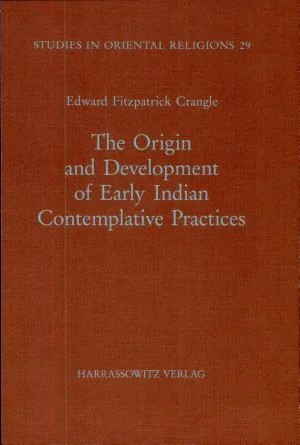
The Origin and Development of Early Indian Contemplative Practices
 83
83

The Origin and Development of Early Indian Contemplative Practices
Crangle's study provides a crucial, albeit dense, account of the historical germination of Indian contemplative traditions. The author's strength lies in his meticulous charting of conceptual shifts, particularly the movement from external Vedic ritual to internal meditative states. A particularly illuminating section details the textual evidence for early forms of *dhyana* in post-Vedic literature, demonstrating a clear scholarly grasp of the material. However, the prose can be exceedingly dry, often burying its fascinating insights under layers of academic jargon. The book's primary limitation is its lack of accessibility for those not already steeped in Indological scholarship. While it offers a vital historical anchor, its clinical presentation offers little in the way of experiential resonance. Crangle's work is an indispensable reference for specialists but a challenging entry point for the general seeker.
📝 Description
83
Edward Fitzpatrick Crangle's 1994 book examines early Indian contemplative practices.
Edward Fitzpatrick Crangle's "The Origin and Development of Early Indian Contemplative Practices" analyzes the formative techniques and philosophies that shaped spiritual and meditative traditions in India. First published in 1994, the work traces the evolution of these practices from their earliest documented forms. It provides a historical and conceptual framework for understanding their later influence.
The book is not a practical guide but a detailed historical analysis. It focuses on the intellectual and cultural environment from which these practices emerged. Crangle's research places itself within the academic study of ancient Indian religions. It moves beyond devotional interpretations to consider the empirical and psychological aspects of early contemplative methods.
The work engages with scholarly discussions surrounding Vedic rituals, Upanishadic thought, and the rise of monastic orders. It situates these developments within a broader cultural and chronological context, identifying the late Vedic period and the subsequent Upanishadic era as critical junctures.
This study delves into the historical roots of contemplative disciplines that later became central to various Indian mystical paths. It examines the transition from external Vedic ritual to internal meditative states, a shift crucial for understanding subsequent traditions like Yoga and Vedanta. By analyzing concepts like moksha and karma in their early philosophical formulations, the book illuminates the intellectual foundations upon which later esoteric systems were built.
💡 Why Read This Book?
• Gain a precise understanding of the historical evolution of *dhyana* and *yoga* from their earliest textual mentions, moving beyond modern interpretations to their ancient origins. • Grasp the philosophical transition from Vedic ritualism to Upanishadic introspection, understanding how early Indian thought laid the groundwork for later contemplative systems. • Appreciate the specific socio-historical conditions that fostered early asceticism and the development of concepts like *moksha*, as detailed in the book's chronological analysis.
⭐ Reader Reviews
Honest opinions from readers who have explored this book.
❓ Frequently Asked Questions
What is the primary focus of Edward Fitzpatrick Crangle's book on Indian contemplative practices?
The book focuses on the historical and developmental origins of early Indian contemplative practices, examining their philosophical underpinnings and evolution from Vedic times through the Upanishadic period.
When was 'The Origin and Development of Early Indian Contemplative Practices' first published?
The work was first published in 1994, offering a scholarly perspective informed by decades of research into ancient Indian religious thought.
Does the book offer practical meditation techniques?
No, the book is primarily a historical and academic analysis. It explores the origins and development of contemplative concepts rather than providing instructions for practice.
Which periods of Indian history does the book cover?
It covers the earliest traceable forms of contemplative practices, primarily focusing on the late Vedic period and the Upanishadic era, and the emergence of ascetic movements.
Who would benefit most from reading this book?
Scholars, students of comparative religion, and advanced practitioners seeking a deep historical understanding of the roots of Indian contemplative traditions will find it most beneficial.
What is the significance of the concept of 'moksha' discussed in the book?
The book explores the conceptualization of 'moksha' (liberation) as it developed within early Indian thought, examining its connection to the evolving contemplative and ascetic practices of the era.
🔮 Key Themes & Symbolism
Vedic Transition to Introspection
Crangle meticulously details the shift from the externally focused, ritualistic practices of the Vedic period to the internally oriented philosophical inquiries of the Upanishads. This transition is crucial, as it marks the nascent stage where contemplation began to be seen as a path to spiritual realization, moving beyond mere ritual efficacy. The work highlights how concepts foundational to later meditative states were first articulated in this transformative era, laying the groundwork for distinct schools of thought.
Asceticism and Early Liberation Concepts
The book examines the rise of ascetic movements and their impact on the development of contemplative disciplines. It traces the emergence of the concept of *moksha* (liberation) and its connection to practices aimed at transcending the cycle of suffering and rebirth. Crangle contextualizes these developments within the social and religious landscape, showing how the pursuit of liberation became intertwined with specific meditative and yogic techniques as articulated in early Indian texts.
Evolution of Dhyana and Yoga
Rather than treating terms like *dhyana* (meditation) and *yoga* as static entities, Crangle investigates their historical trajectory. The work focuses on identifying their earliest textual references and tracing their conceptual evolution from rudimentary forms to more complex philosophical systems. This approach underscores that these practices were not revealed fully formed but developed over centuries within specific intellectual currents and societal needs in ancient India.
The Upanishads as a Philosophical Nexus
The Upanishads are presented as a key philosophical nexus where earlier Vedic traditions began to synthesize with new introspective and metaphysical explorations. Crangle analyzes how these texts explore consciousness, the nature of reality, and the self (*atman*), providing a theoretical framework that deeply influenced the subsequent development of contemplative practices. Their philosophical depth provided the intellectual soil for the seeds of meditation and yoga to flourish.
💬 Memorable Quotes
Direct passages from the work, attributed to the author.
“The distinction between ritual action and contemplative practice.”
— This highlights the core argument about the historical shift from external, ritualistic performance to internal, meditative focus as a primary means of spiritual attainment in ancient India.
“The conceptualization of *moksha* within early ascetic traditions.”
— This points to the book's exploration of how the goal of liberation evolved, becoming intrinsically linked to the development and practice of specific contemplative techniques aimed at spiritual freedom.
“The nascent forms of *dhyana* in post-Vedic literature.”
— This refers to the work's meticulous tracing of the earliest textual evidence for meditation, showing how the practice began to take shape in the intellectual currents following the Vedic period.
“The Upanishads' contribution to understanding the self and consciousness.”
— This emphasizes the philosophical depth of the Upanishads as analyzed in the book, showing how their explorations of internal states provided a foundation for later contemplative systems.
“The socio-cultural milieu influencing early yogic development.”
— This indicates the book's attention to the broader historical context, demonstrating how societal structures and religious movements shaped the emergence and form of early yogic practices.
🌙 Esoteric Significance
Tradition
While not explicitly aligning with a single esoteric lineage like Hermeticism or Theosophy, Crangle's work is foundational for understanding the roots of practices central to many Western esoteric traditions that draw heavily on Indian philosophies, such as certain forms of modern yoga, meditation, and non-dual spiritual paths. It provides the scholarly, historical bedrock for practitioners who seek to understand the original context and evolution of these ancient techniques, moving beyond later syncretic or Westernized interpretations.
Symbolism
The book focuses more on conceptual evolution than overt symbolism. However, the transition from Vedic ritual (often involving symbolic objects and actions) to Upanishadic introspection implies a shift in focus from external, material symbolism to internal, psychological symbolism, such as the exploration of the *atman* (self) as a divine principle, or the concept of *Brahman* as the ultimate reality, which becomes a profound internal symbol of unity.
Modern Relevance
Contemporary thinkers and practitioners in fields like mindfulness, integral yoga, and transpersonal psychology frequently engage with the historical lineage Crangle meticulously traces. His work informs modern understandings of meditation (*dhyana*) and contemplative prayer by providing the historical depth to practices often stripped of their original Indian philosophical context. Researchers exploring the neuroscience of meditation also benefit from understanding the long historical development of these techniques.
👥 Who Should Read This Book
• Scholars of comparative religion and philosophy seeking a rigorous historical account of early Indian contemplative traditions. • Advanced practitioners of yoga and meditation interested in understanding the deep historical roots and conceptual evolution of their practices beyond modern interpretations. • Students of ancient Indian history and religious studies needing a foundational text on the transition from Vedic ritualism to Upanishadic thought and early asceticism.
📜 Historical Context
Published in 1994, Edward Fitzpatrick Crangle's work emerged during a period of robust academic engagement with the history of Indian religions. The late 20th century saw scholars increasingly scrutinizing the textual evidence for early contemplative practices, moving beyond earlier, more mythologized accounts. Crangle's research situates itself within this scholarly milieu, engaging with the established discourse on Vedic religion, the Upanishads, and the rise of Sramana movements. He directly addresses the intellectual currents that saw a growing interest in non-dualistic philosophies and the psychological dimensions of spiritual attainment. While not a direct polemic, his work implicitly contrasts with more simplistic or purely devotional interpretations prevalent in some circles. Key contemporaries in the field, such as Wendy Doniger and Patrick Olivelle, were also producing influential scholarship on related topics, contributing to a rich academic conversation about ancient Indian thought, though direct engagement with their specific works is not the primary focus of Crangle's text.
📔 Journal Prompts
The transition from Vedic ritual to Upanishadic introspection.
The evolving concept of *moksha* in early Indian thought.
The earliest textual evidence for *dhyana*.
The philosophical impact of the Upanishads on contemplative disciplines.
The role of ascetic movements in shaping early meditative practices.
🗂️ Glossary
Dhyana
A Sanskrit term referring to meditation, contemplation, or abstract meditation. It denotes a state of focused or sustained attention, often a key practice in yogic and Buddhist traditions.
Yoga
A broad term encompassing various physical, mental, and spiritual disciplines originating in ancient India. In its earliest contexts, it referred to methods of spiritual discipline and union with the divine or ultimate reality.
Upanishads
A collection of philosophical texts that form the theoretical basis of Hinduism. They represent a shift from earlier Vedic ritualism towards introspective and metaphysical inquiry into the nature of reality and the self.
Moksha
A key concept in Indian religions, referring to liberation or release from the cycle of death and rebirth (samsara). It is often achieved through spiritual knowledge, devotion, or ascetic practices.
Vedic Period
The period in ancient Indian history associated with the composition of the Vedas, the earliest scriptures of Hinduism. This era is characterized by ritualistic practices and early hymns.
Asceticism
A lifestyle characterized by abstinence from worldly pleasures and the pursuit of spiritual goals, often involving practices like fasting, celibacy, and deep meditation. It was prominent in ancient Indian religious movements.
Atman
A Sanskrit word meaning 'self' or 'essence'. In Upanishadic philosophy, it refers to the true self, often understood as identical with Brahman, the ultimate reality.
This book appears in 2 collections
🔮 Readers Also Liked
Browse all →









From the “Meditation” Collection
View all →





More Free Sacred Texts & Gnosticism Books
View all →