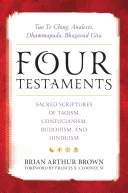
Four Testaments
 71
71

Four Testaments
Brian Arthur Brown’s *Four Testaments* offers a commendable, if somewhat conventional, gathering of foundational Eastern scriptures. The decision to present the Tao Te Ching, Dhammapada, Analects, and Bhagavad Gita in full, rather than abridged, is a significant strength, allowing the primary voices to speak without immediate mediation. The accompanying scholarly essays, while informative, vary in their depth and accessibility, a common challenge in such anthologies. I found the chapter on the Bhagavad Gita particularly illuminating, especially its treatment of Krishna's counsel to Arjuna on the battlefield of Kurukshetra, which grapples with duty and spiritual liberation. However, the volume occasionally feels like a missed opportunity to more explicitly bridge these texts with contemporary spiritual inquiry or to push beyond established comparative frameworks. Despite this, it serves as a solid, reliable introduction for those seeking direct access to these vital traditions.
📝 Description
71
Published in 2016, Four Testaments presents integral selections from four major world religious texts.
Brian Arthur Brown's Four Testaments gathers complete versions of the Tao Te Ching, the Dhammapada, the Analects of Confucius, and the Bhagavad Gita. This anthology aims to allow readers to directly encounter the core teachings of these traditions. The editor's intention is to highlight potential connections and differences between these distinct spiritual and ethical systems. To aid understanding, the volume includes scholarly essays that introduce each tradition.
This compilation is suited for those wanting a basic grasp of key Eastern philosophical and religious traditions. It appeals to readers interested in comparative spirituality, ethics, and the intellectual history of regions like India and China. Those who want to understand the origins of beliefs and practices that influence a large part of the world's population will find it useful. Students and academics of religion and philosophy seeking straightforward, full versions of these significant texts will also benefit.
The texts chosen for Four Testaments emerged during a period of significant intellectual and spiritual activity across Eurasia, roughly from the 6th to the 3rd century BCE. This era also saw the development of Greek philosophy and early Buddhist monasticism. By presenting these works together, Brown positions them within a lineage of thought that addresses fundamental questions about existence, ethics, and the nature of reality. Their inclusion suggests a shared impulse towards understanding inner life and societal harmony, often explored through practices and philosophies that go beyond conventional understanding.
💡 Why Read This Book?
• Gain direct exposure to the complete texts of the Tao Te Ching, Dhammapada, Analects of Confucius, and Bhagavad Gita, allowing for an unmediated understanding of their original teachings, unlike curated selections. • Explore the concept of *wu wei* (effortless action) as presented in the Tao Te Ching and compare it with the Buddhist concept of the Eightfold Path, offering a unique comparative insight not found in single-tradition studies. • Understand the Confucian ideal of *ren* (benevolence) in its original context, providing a specific ethical framework to contrast with the devotional aspects of the Bhagavad Gita, fostering a deeper appreciation for diverse moral philosophies.
⭐ Reader Reviews
Honest opinions from readers who have explored this book.
❓ Frequently Asked Questions
When was Brian Arthur Brown's 'Four Testaments' first published?
Brian Arthur Brown's 'Four Testaments' was first published on July 8, 2016, following his earlier work, 'Three Testaments'.
Which specific religious texts are included in 'Four Testaments'?
The book includes four foundational texts: the Tao Te Ching, the Dhammapada, the Analects of Confucius, and the Bhagavad Gita.
What is the primary goal of 'Four Testaments'?
The book aims to present these four texts in full, encouraging readers to explore their connections and differences and to better understand the people who follow these traditions.
Are there scholarly introductions to each text in the book?
Yes, 'Four Testaments' features essays by esteemed scholars to introduce readers to each of the four traditions represented.
What is the philosophical concept of 'wu wei' mentioned in the book?
'Wu wei' is a concept from the Tao Te Ching, often translated as 'effortless action' or 'non-action,' emphasizing acting in accordance with the natural flow of the universe.
How does 'Four Testaments' relate to Brian Arthur Brown's previous work?
'Four Testaments' is a follow-up to Brown's award-winning 'Three Testaments: Torah, Gospel, Quran,' continuing his exploration of foundational religious scriptures.
🔮 Key Themes & Symbolism
Ethical Frameworks
The collection juxtaposes distinct ethical systems, from the Confucian emphasis on social harmony and virtuous conduct (*ren*, *li*) to the Buddhist focus on detachment and compassion (Eightfold Path). It allows readers to compare how these traditions conceptualize right action, societal order, and individual moral development, highlighting both shared principles and divergent approaches to living a good life.
The Nature of Reality
Each text offers a unique perspective on the fundamental nature of existence. The Tao Te Ching explores the ineffable 'Tao,' the Bhagavad Gita explores the divine and the self (*atman*), and the Dhammapada addresses impermanence and suffering (*dukkha*). This comparative study illuminates diverse metaphysical understandings, from the impersonal cosmic principle to the personal divine and the nature of consciousness.
Spiritual Discipline
The volume showcases varied paths toward spiritual realization or enlightenment. It contrasts the contemplative practices and wisdom teachings of Buddhism (Dhammapada) and Taoism (Tao Te Ching) with the duty-bound action and devotion advocated in Hinduism (Bhagavad Gita) and the cultivation of virtue in Confucianism (Analects). Readers can observe different methods for achieving inner peace or liberation.
Harmony and Order
A significant theme across these texts is the pursuit of harmony—whether cosmic, social, or personal. The Tao Te Ching seeks alignment with the natural order, Confucianism with societal propriety and familial roles, the Bhagavad Gita with fulfilling one's *dharma*, and Buddhism with the cessation of suffering. The book invites contemplation on how different cultures conceptualize and strive for balance.
💬 Memorable Quotes
Direct passages from the work, attributed to the author.
“The Tao that can be told is not the eternal Tao.”
— This opening line from the Tao Te Ching immediately establishes the ineffable nature of the ultimate reality or principle, suggesting that true understanding transcends language and conceptualization.
“Hatred ceases by love, not by return of hatred.”
— A core teaching from the Dhammapada, this emphasizes the Buddhist principle of overcoming negative emotions through positive ones, advocating for compassion as the antidote to animosity.
“All that we are is the result of what we have thought.”
— This powerful statement from the Dhammapada underscores the Buddhist emphasis on the mind's role in shaping reality and experience, highlighting the importance of mental cultivation.
💡 Key Ideas
Editorial paraphrase of the work's core concepts — not direct quotes.
The superior man is modest in his speech, but exceeds in his actions.
This quote from the Analects of Confucius highlights the Confucian value placed on substantive deeds over mere words, prioritizing practical virtue and reliability in conduct.
Set your heart upon your work, but never forget the rewards.
Paraphrased concept from the Bhagavad Gita, this reflects Krishna's advice to Arjuna to act according to his duty (*dharma*) without attachment to the outcomes, focusing on the action itself.
🌙 Esoteric Significance
Tradition
While the included texts are foundational to major world religions rather than exclusively esoteric lineages, their profound philosophical depth and emphasis on inner transformation align with many esoteric traditions. For Hermeticism, Gnosticism, and Theosophy, these texts offer parallel or complementary wisdom on the nature of the cosmos, the human condition, and paths to enlightenment or unity with the divine. They provide source material for understanding universal spiritual principles.
Symbolism
The Tao Te Ching's concept of the 'Tao' itself functions as a potent symbol of the ultimate, ineffable reality, akin to the Hermetic 'All.' The Bhagavad Gita's battlefield setting symbolizes the human struggle between duty and desire, with Krishna acting as a divine guide—a recurring archetype in mystical traditions. The Dhammapada's focus on the mind as the creator of reality speaks to psychological and alchemical symbolism found in Western esotericism.
Modern Relevance
Contemporary thinkers and practitioners across mindfulness, meditation, and comparative spirituality frequently draw upon these texts. Schools of modern psychology, particularly those influenced by Jungian archetypes and Eastern philosophy, find resonance in the symbolic narratives and ethical teachings. Furthermore, movements advocating for holistic living and ethical leadership often reference the wisdom found in the Analects and the Tao Te Ching for guidance on societal and personal conduct.
👥 Who Should Read This Book
• Students of comparative religion and philosophy seeking foundational texts from major Eastern traditions presented in full. • Individuals interested in ethical systems and spiritual practices originating from ancient China and India, looking for direct scriptural sources. • Practitioners of meditation and mindfulness who wish to explore the philosophical underpinnings of traditions like Buddhism and Taoism, as detailed in the Dhammapada and Tao Te Ching.
📜 Historical Context
Brian Arthur Brown's *Four Testaments*, published in 2016, emerges within a contemporary academic landscape increasingly focused on comparative religion and the cross-pollination of ideas across ancient civilizations. The texts it compiles—the Tao Te Ching, Dhammapada, Analects of Confucius, and Bhagavad Gita—originate from a key period in Eastern intellectual history, roughly spanning the mid-first millennium BCE. This era also witnessed the flourishing of Greek philosophy, with figures like Socrates and Plato shaping Western thought. Brown's work follows his 2014 publication, *Three Testaments: Torah, Gospel, Quran*, indicating a sustained interest in tracing foundational narratives across cultures. While specific reception details for *Four Testaments* are not widely publicized, its inclusion of scholarly essays points to engagement with academic discourse. Its value lies in making these influential texts, which formed the bedrock of major philosophical and spiritual movements like Taoism, Buddhism, Confucianism, and Hinduism, readily accessible for study.
📔 Journal Prompts
The concept of *dharma* in the Bhagavad Gita and its relation to personal duty.
Lao Tzu's notion of *wu wei* and its application in daily life.
Confucius's ideal of *ren* (benevolence) and its social implications.
The Buddhist understanding of *dukkha* (suffering) presented in the Dhammapada.
Comparing the paths to enlightenment offered by these four diverse traditions.
🗂️ Glossary
Tao (Dao)
The fundamental, ineffable principle or way of the universe in Taoism, often translated as 'the Way.' It represents the natural order and source from which all things arise.
Wu Wei
A Taoist concept meaning 'non-action' or 'effortless action.' It signifies acting in harmony with the natural flow of the Tao, without forced or unnatural striving.
Dhammapada
A collection of sayings of the Buddha in verse, considered one of the most accessible Buddhist scriptures, focusing on ethical conduct and the path to enlightenment.
Four Noble Truths
The foundational teachings of Buddhism: the truth of suffering (*dukkha*), the truth of the cause of suffering (craving), the truth of the cessation of suffering, and the truth of the path to the cessation of suffering (the Eightfold Path).
Analects
A collection of sayings and ideas attributed to the Chinese philosopher Confucius and his contemporaries, forming the foundational text of Confucianism.
Ren
A central Confucian virtue, often translated as 'benevolence,' 'humaneness,' or 'goodness.' It emphasizes empathy, compassion, and the ideal human relationship.
Bhagavad Gita
A 700-verse Hindu scripture in Sanskrit, part of the epic Mahabharata, presenting a dialogue between Prince Arjuna and Lord Krishna on duty, devotion, and liberation.
Dharma
In Hinduism, the cosmic law, moral duty, or inherent nature of things. In the Bhagavad Gita, it often refers to one's righteous duty and role in society.
Atman
The eternal self or soul in Hinduism, considered to be the true essence of an individual, often seen as identical with Brahman (the ultimate reality).